
| 1900 – 1901 Season |
| “The Carl Rosa Opera Co., Ltd., under the direction of Mr T. H. Friend, will commence its season, which will include six weeks in London, on August 6. The company includes Mdlle. Aurelia Revy. of Buda Pesth. who will make her first appearance in English opera, and Herr Julius Walther, a Wagnerian tenor who is new to this country. Two features will be the production of Wagner’s “Siegfried,” and for the first time in England Goldmarck’s domestic and fairy opera, “The Cricket on the Hearth.” [Edinburgh Evening News, Issue: 8512, Friday, Aug. 3, 1900] | |
| Early August [2 weeks] Rehearsals, London, Ladbroke Hall | |
| “The Carl Rosa Company, who have been rehearsing for the last fortnight at Ladbroke Hall, went down to-day to Eastbourne, where to-night they begin a provincial tour which, all going well, will last till next April. During the tour it is expected that the repertory will be increased by English versions of Gounod’s “Cinq Mars” and of Goldmarck’s “Cricket on the Earth,” the latter a far better choice. The company have been increased by the engagement of Miss Revy, a soprano, who has been heard at miscellaneous concerts in London, and Miss Yuliose Harrison, a young soprano of Canadian birth, but Scotch descent, as she is said to be a grand niece of the Earl of Mar. This lady will make her debut to-morrow in “Maritana;” Mr Julius Walther, an American tenor of German descent, is also engaged. The first week’s repertory includes only well-known operas, such as “Faust,” “Lohengrin,” “Tanuhauser,” “Maritana,” and “Carmen.” [Glasgow Herald, Issue: 188, Tuesday, Aug. 7, 1900] |
| 6th – 18th Aug 1900 [2 weeks] Eastbourne, Devonshire Park Theatre | |
| “….The Rosa Company started at Eastbourne on Monday, but the week has been devoted to familiar operas, supported by Miss Harrison, a Scottish-Canadian soprano; Mr Julius Walther, and Americo-German tenor; Mlle. Revy, Miss Burnett, Mr. Bevan and others.” [Daily News, Issue: 16967, Friday, Aug. 10, 1900] | |
| “The Carl Rosa Troupe, which has partially reconstructed, began at Eastbourne on Bank Holiday a provincial tour which, it is hoped, will last till late into the spring. There will be least two novelties of large proportions during this tour, namely, Gounod’s Cinq Mars, and Goldmark’s Cricket on the Hearth. The former is not one of Gounod’s most popular works, although it is, of course, possible that the verdict of France may be reversed by Britain. The opera was produced at the Paris Opera Comique about twenty-four years ago, and the libretto is based on a novel by Alfred de Ligny. It is partly on the lines of “Marion Delorme,” who, indeed, is one of the chief characters in the piece. Another is Cardinal Richelieu. Goldmark’s opera is, of course, suggested by Dickens’s story, and it was produced in Vienna about three years ago. At one time there was a talk of producing it in German on the stage of Covent Garden, but the matter fell through. The Carl Rosa Company has been largely reinforced for this tour, and among the new singers are Mr. Julius Walther, American tenor of German descent, Miss Aurlia Revy, a soprano, who has already tried her fortune on the concert stage in London, and a light soprano, Miss Yulisse Harrison, who, although she comes from Canada, is really of direct Scotch descent. This week’s programmes at Eastbourne include Faust, Carmen, Maritana, Tannhauser and Lohengrin, that is to say, the regular standard operas now most popular in the provinces.” [Graphic, Issue: 1602, Saturday, Aug. 11, 1900] | |
| “DEVONSHIRE PARK THEATRE.-Managing – Director, Mr A. Standen Triggs.-Under the direction of Mr T. H. Friend, the Carl Rosa Opera company is here this week with Faust, Maritana, Carmen, The Bohemian Girl, Lohengrin, and Tannhauser. Carmen occupies the bill for matinees on Wednesday and Saturday. The conductors are Mr Eugene Goosens and Mr Walter Van Noorden.” [The Era, Issue: 3229, Saturday, Aug. 11, 1900] | |
| Mon 13th Aug 1900 | Faust – Aurelia Revy, Julius Walther, Alex Bevan, Maud Burnett, Arthur Deane |
| Tue 14th Aug 1900 | Maritana ?? |
| Wed 15th Aug 1900 (m) | Carmen |
| Wed 15th Aug 1900 (e) | The Bohemian Girl ?? |
| Thu 16th Aug 1900 | Lohengrin ?? |
| Fri 17th Aug 1900 | Tannhauser ?? |
| Sat 18th Aug 1900 (m) | Carmen |
| Sat 18th Aug 1900 (e) | ?? |
| “The Royal Carl Rosa Opera company commenced its season at Devonshire Park theatre, Eastbourne, on Monday. The opera was Faust, Margaret being taken by a new-comer in English opera – Mlle. Aurelia Revy. She is known as a singer, pianist, and violinist, with the rare gift of singing to her own accompaniment on the violin. Excepting her appearance in the Wagner Ring at Covent Garden this season, this was her first appearance on an English stage. Herr Julius Walther, Mr. Alex. Bevan, Miss Maud Burnett, and Mr. Arthur Deane were also in the cast.” [Lloyd’s Illustrated Newspaper, Issue: 3012, Sunday, Aug. 12, 1900] |
| 20th – 22nd Aug [3 nights and one matinee] Rhyl, Grand Pavilion | |
| “AMUSEMENTS IN RHYL – GRAND PAVILION THEATRE.-Proprietors, Messrs. Carter and Warhurst; Theatrical Manager, Mr. David Williams.-On Monday, Tuesday, and Wednesday the Royal Carl Rosa opera company was here. On Monday Lohenqrin was given, and Mr. Julius Walther assumed the title-part admirably, being ably seconded by Mdlle. Aurelia Revy. On Tuesday a good house listened to Carmen, in which Miss Winifred Ludlam’s vocal talent was greatly appreciated in the leading role. Mr. Charles Stephen [sic.] was a capital Don Jose, and Mr Arthur Deane earned many plaudits as Escamillo. On Wednesday a matinee of Balfe’s Bohemian Girl was – given. Miss Lizzie Burgess as Arline was much admired, and Miss Winifred Ludlam’s Gipsy met with deserved recognition. Mr Wm. Stephens as Thaddeus was excellent, and Mr Alex. Bevan as Devilshoof was very successful. On Wednesday evening Gounod’s Faust was performed, Mr Alex. Bevan making a typical Mephistopheles and Mdlle. Aurelia Revy being a fine Marguerite. Miss D. Wilson was applauded as Martha, and Mr. Julius Walther as Faust was greatly appreciated. Mr. Haigh Jackson came in for commendation as Valentine.” [The Era, Issue: 3231, Saturday, Aug. 25, 1900] | |
| Mon 20th Aug 1900 | Lohengrin – Julius Walther, Aurelia Revy, |
| Tue 21st Aug 1900 | Carmen – Winifred Ludlam, William Stephens, Arthur Deane |
| Wed 22nd Aug 1900 (m) | The Bohemian Girl – Lizzie Burgess, Winifred Ludlam, William Stephens, Alex Bevan, |
| Wed 22nd Aug 1900 (e) | Faust – Alex Bevan, Aurelia Revy, Miss Douglas Wilson, Julius Walther, Haigh Jackson |
| 27th Aug – 1 Sep [1 week] Buxton, Pavilion Theatre | |
| “DERBYSHIRE. THE CARL ROSA OPERA COMPANY. This company opened on Monday at the Buxton Pavilion Theatre for a weeks engagement with “Lohengrin.” There was a crowded and fashionable audience, and the music and singing were excellent. Last night “Maritana” was performed. The company included Mdlle. Revy, the prima donna of the Royal Opera House, Buda Pesth, and Mr. Julius Walther, the Wagnerian tenor. The company is under the direction of Mr. T. H. Friend, and there is a full chorus and orchestra.” [Sheffield Independent, Volume: 40 , Issue: 14287, Wednesday, Aug. 29, 1900] | |
| “BUXTON. PAVILION THEATRE – Manager, Mr. John Willoughby ; Acting-Manager, Mr. Arthur Willoughby – Undoubtedly the most important engagement of our dramatic season is that of the Carl Rosa Opera Company, and on Monday evening a crowded audience of fashionable folk witnesed with evident enjoyment the performance of Lohengrin. Mr Julius Walther’s Lohengrin was a masterly and artistic characterisation. Possessed of a voice of wonderful power and sweetness, he sang Wagner’s music with remarkable ease and telling effect. Mr Alex. Bevan’s rendering of King Henry deserves more than passing mention. Mr Bevan endowed the part with becoming dignity, his powerful rich voice being heard to great advantage. Mr. Haigh Jackson sang with exceptional taste and realistic passion as Frederick, and Mir Albert Chapman, another baritone of comprehensive range and quality, greatly pleased I with his singing as the Herald. Miss Winifred Ludlam’s Ortrude was full of dramatic power; and Elsa was charmingly portrayed by Miss Amelia Revy. The opera was conducted by Mr Eugene Goossens, jun. . The whole performance was under the able management of Mr T. H. Friend. Maritana, Tannhauser, Carmen, A Basso Porto, and Faust are also in the repertoire of the week.” [The Era, Issue: 3232, Saturday, Sept. 1, 1900] | |
| Mon 27th Aug 1900 | Lohengrin – Julius Walther, Alex Bevan, Haigh Jackson, Albert Chapman, Winifred Ludlam, Aurelia Revy; c. Eugene Goossens jnr |
| Tue 28th Aug 1900 | Maritana |
| Wed 29th Aug 1900 | Tannhauser |
| Thu 30th Aug 1900 | Carmen |
| Fri 31st Aug 1900 | A Basso Porto |
| Sat 1st Sep 1900 | Faust |
| 3rd?? – 8th?? Sep [1 week] Stoke-on-Trent, [“Gordon”??] Opera House ?? | |
| “STOKE – GORDON – Proprietor and Manager, Mr. D. H. Mountford: Assistant-Manager, Mr. Frank Mountford.-The Carl Rosa opera company is paying a welcome visit to this handsome theatre. On Monday Carmen was presented to a capital house, Lohengrin being given for the first time in this theatre on Tuesday. There was a fashionable audience to hear Wagner’s charming opera. The Lohengrin of Mr Julius Walther was an admirable performance; Mr. Alex. Bevan was heard to advantage as Henry; Mr. Haigh Jackson was a particularly clever exponent of Frederick of Telramund; and Mdlle. Aurelia Revy’s performance of Elsa was decidedly good Miss Winifred Ludlam was admirably placed as Ortrud. Maritana, A Basso Porto, Faust, Tannhauser, and The Bohemian Girl are in the week’s programme.” [The Era, Issue: 3233, Saturday, Sept. 8, 1900] | |
| Mon 3rd Sep 1900 | Carmen |
| Tues 4th Sep 1900 | Lohengrin – Julius Walther, Alex Bevan, Haigh Jackson, Aurelia Revy, Winifred Ludlam |
| Wed 5th Sep 1900 | A Basso Porto |
| Thu 6th Sep 1900 | Faust |
| Fri 7th Sep 1900 | Tannhauser |
| Sat 8th Sep 1900 | The Bohemian Girl |

| 10th – 15th Sep [1 week] Hull, Grand Theatre | |
| Mon 10th Sep 1900 | Tannhauser – Julius Walther, Lizzie Burgess, Aurelia Revy, Arthur Deane; c. Eugene Goosens |
| “BEFORE the FOOTLIGHTS,”TANNHAUSER” STILL POPULAR IN HULL – LAST NIGHT AT THE GRAND THEATRE. It is only the brethren of the “higher musical criticism” who feel that “Tannhauser” is a thing that palls. They glory in “Parsifal” but groan, over “Tannhauser.” But “Tannhauser” has plenty of life in it yet — for Hull, at any rate. Last night’s audience at the Grand Theatre proved this. Different though the Carl Rosa Company may be from what we knew it years ago, it still retains some dignity and distinction; and though Wagner’s opera was not rendered in a way which would justify the use of the word “perfection,” it was nevertheless presented in a form that was at any rate highly enjoyable and acceptable. The crowded audience seemed to be delighted. Such applause as broke out now and again is rarely heard in Hull. In places there was much really good work. To begin with, Mr Eugene Goossens did admirably with the Overture, which must have been listened to by the majority of the audience with intelligent interest. Unhappily, Hull has not reached the point when good taste prevents the disturbing passage to far-off seats during the performance of this matchless prelude. Pity that the theatre attendants are not authorised to detain latecomers until the overture is finished. The “Mail” commented last year upon the meagreness of the accessories which the Carl Rosa management introduce into the scene at Venusburg. Last night there was the same fault. A very sorry and unenchanting region, truly! It was quite a relief when the corybantic revels before Venus were ended, and the Goddess of Love rose from her couch to begin her prolonged and passionate scena with Tannhauser. Miss Lizzie Burgess, who was the Venus, is no stranger to Hull. She will be remembered from her connection with the Moody Manners Company. Before that, she was with the Carl Rosa combination, playing, for one thing, the part of Michaela, in “Carmen,” ten years ago. The Venuses of opera are varied. We have had fat Venuses, “stodgy” Venuses, awkward Venuses, ungainly Venuses. Miss Burgess sheds a new light on the part. She invests it with the atmosphere of graceful charm which it demands. She is a handsome Venus, a Venus who smiles an alluring smile. She is, moreover, a highly accomplished singer, and last night, whether in the soft enchantments of the charmer, or the fierce invective of the woman scorned, she displayed art of a very high type. Herr Julius Walther was the Tannhauser. He is a young German, experienced in the theatres of Munich and Hamburg. And yet they announce him as the new American tenor! He has a commanding stage presence; his chief fault as an actor seems to be in the direction of self-conscious “posing.” But his voice permits of no fault finding. It is a tenor of the Hedmondt kind. Quality and method of production remind us of Mr Hedmondt. It is a bigger voice than Hedmondt’s, however, and a little less tender. At present it shows no sign of wear. Throughout Herr Walther sang very finely. His contribution in the Hall of Song was a thoroughly artistic performance. In the long scene with Venus he sang with great dramatic fervour. His singing over the bier of Elizabeth was charged with sympathetic emotion. Altogether, a powerful and impressive Tannhauser. Mdlle. Aurelia Revy is a brilliant singer, and clearly brings to bear on the conception of the part of Elizabeth an intelligent mind. A joyous and smiling Elizabeth she gives us at first — appropriately smiling, for is she not united to her love — but later on there is a note of sadness in her manner which is very eloquent. Mdlle. Revy is very young. She is only —. No; the “Mail” will not say it. She is a Hungarian, prima donna of the Opera House at Buda Pesth, and has been with the Carl Rosa Company for five weeks only. She is a welcome acquisition. Brilliantly though she sang generally, nothing was more thoroughly in the manner of a true artist than the Supplication after Tannhauser’s delivery of his ribald song. For the rest, the parts were well filled. Especially is Mr Arthur Deane an admirable Wolfram. Considering that he was affected with tonsil trouble, He sang all his music more than creditably — “O Star of Eve” particularly. The band played throughout with care. Occasional slips there were, but, generally speaking, nothing of serious moment. There is a large chorus, and last night the male voices were heard to conspicuous advantage in the many fine passages for men’s voices which Wagner has introduced. The great concerted piece in the Hall of Song was magnificently rendered. To-night, “Maritana.” [Hull Daily Mail, Issue: 4651, Tuesday, Sept. 11, 1900] | |
| Tue 11th Sep 1900 | Maritana |
| Wed 12th Sep 1900 | Lohengrin – Julius Walther, Aurelia Revy, Alex Bevan, Arthur Chapman, Haigh Jackson, Winifred Ludlam; c.Eugene Goossens |
| “THE KNIGHT OF THE SWAN” AT THE “GRAND” – Unfortunately, for the credit of musical Hull, the opportunity of hearing “Lohengrin,” performed by an able and talented company, did net draw a good house to the “Grand” lust night. The stalls, for instance, were not more than half filled. This is discouraging, for though, as we already said, the Carl Rosa Co. is not what it was a few years ago, it. still comprises some very excellent principals, and the claim of the Manager that he has had all round efficiency in his mind is no empty boast. The company are Well trained, capable, and effective, the choruses sang with marked intelligence and spirit, and the principals were well up to their work. The Elsa of the evening was Miss Aurelia Revy, and her assumption of the role was marked by many points of merit. She used her fine voice with remarkable intelligence and effect, and showed on every occasion that she is a highly trained and accomplished singer. Her acting was very appropriate. The balcony song especially was a great success, and won hearty plaudits. For Mr. Walther, as the glittering Knight, we have nothing but praise. He has a fine stage presence, and the “easy strength which makes a joke of toil,” and which last night enabled him to go through his exacting and fatiguing part with assurance and success. He is rather debonair than earnest, but he is a very graceful Knight, and in the interchange of endearments with Elsa he was greatly admired. Mr. Alex Bevan was dignified as the King, and sang with marked clearness and emphasis. The somewhat ungrateful part of Ortrud was taken acceptably enough by Miss Winifred Ludlam, who used a queenly and scornful manner, well suited to the character. More energy in the wilder scenes would have added to the impression she made. Mr Arthur Chapman was not unduly strident as the Herald, and his voice was well under control. The dramatic power of Mr. Haigh Jackson as Telramund was more noticeable than his singing, though the latter never fell below a high standard. Indeed the representation throughout was singularly free from weak spots. The orchestra under Mr. Eugene Goossens did their work very creditably, and the overture was particularly admired. The instrumentalists were never unduly noisy. The stage management was satisfactory, with the exception of the long waits, which caused the opera not to be over until 11.10, and the various tableaux, which add so much to the scenic charm of “Lohengrin,” were dealt with in no stinting spirit. The costumes were gorgeously rich, and the groupings most artistically arranged. The performance in short was an excellent one, and worthy of a much bigger house. The recalls were most hearty, and the audience repeatedly showed their warm appreciation. To-night Spineili’s new opera, “A Basso Porto.” [Hull Daily Mail, Issue: 4653, Thursday, Sept. 13, 1900] | |
| Thu 13th Sep 1900 | A Basso Porto |
| “A BASSO PORTO” – A FEW WORDS ABOUT TOMORROW’S OPERA. “A Basso Porto” means “at the lower harbour.” The “lower harbour” is in Naples, and in Niccola Spinelli’s opera a very rough quarter we find it. Here the passions of the people run riot. They love with ferocity, and murder without care. They cheat, betray, and stab. We have met such people before, in “Cavalleria Rusticana,” and kindred operas. Spinelli’s opera takes us into very stormy human seas. Treachery and jealousy are the ruling emotions. We begin with the quarrels of a gang of assassins, and end with the murder of a traitor. And Love runs through it all! Luigino, the principal tenor, is the son of Maria, the dramatic soprano. He quarrels at cards with Pascale, a bass, and his mother drags him away. This is in the inn frequented by the Camorristi, a gang of assassins. Cicillo, the baritone, is also there, in love with Maria’s daughter Sesella, soprano. Maria and Luigino object. Maria has reason to. Years ago she loved Cicillo herself, and killed her rival Learning this as the opera proceeds, Cicillo swears vengeance. Luigino shall go to the dogs, and his sister shall starve — and worse! Perusal of the vocal score of the opera gives some idea of the masterly way in which Spinelli has risen to the dramatic heights to which this strenuous scene is carried — the terror-stricken confession of the mother and the mad frenzy of the man whose sweetheart she has killed. There is no toying with the theme; the music rushes with mad, resistless velocity, and carries the first act to a stirring finale, complicated by the discovery of the Camorristi that they are betrayed. The second act finds the men in the interior of the inn, where Luigino sings a lovely barcarolle. The murderous Cicillo beaks in, with curses, and a fiery scene ensues, the music becoming more dramatic and agitated as the passions of the quarrellers rise. In the midst of the conflict Cicillo denounces Luigino as the betrayer of the Camorristi, and the party breaks up amid clamourings for vengeance. The next episode is a meeting between Cicillo and Sesella, in which the man declares his passion for the daughter of the woman he once loved, and hears her declaration of love in return. The appearance of Maria leads to a thrilling duet with the daughter, in which the mother paints in harsh colours the future which Cicillo has designed for her. Sesella, convinced by her mother’s earnestness, gives up Cicillo. The Camorristi re-appear, Cicillo is proclaimed the treacherous one, proof of his guilt being hurled out by Maria. Ciciilo must die. Maria, to save him after all, promises to aid his escape on condition that he withdraws his oath to ruin herself and her children. He refuses, believing he can escape by means of his own. And to end it all, Maria stabs him. Judging from the pianoforte score, the orchestration of the opera has been the subject of careful and devoted study. It is quite in the modern manner, fierily descriptive, and full of the colour given by constant harmonic changes. There is no overture, but an instrumental interlude precedes the third act. This is especially interesting by reason of a beautiful mandolin obbligato, played in conjunction with the band. The instruction of the score is that when no capable mandolinist is available this prelude shall be omitted, and an alternative movement be substituted. Since the Carl Rosa Company, who perform “A Basso Porto” to-morrow night at the Grand Theatre, Hull, travel with an expert mandolinist, this optional movement is used as an overture to the opera.” [Hull Daily Mail, Issue: 4652, Wednesday, Sept. 12, 1900] | |
| Fri 14th Sep 1900 | Faust – Lilian Eldee, |
| “Madame Lilian Eldee, who plays the part of “Marguerite” in Gounod’s “Faust” to-night, at the Grand Theatre, appears now for the first time with the Carl Rosa Company. She is, as stated last week, the wife of a well-known Yorkshire captain at the front in South Africa. She has had some continental experience as a singer, and in England has done much concert singing. On Wednesday night she sang at the Queen’s Hail concert, she made a good impression when she sang in the opera “La Boheme,” at Covent Garden. Her voice is a light soprano.” [Hull Daily Mail, Issue: 4654, Friday, Sept. 14, 1900] | |
| Sat 15th Sep 1900 (m) | Carmen |
| Sat 15th Sep 1900 (e) | The Bohemian Girl |
| 17th – 22nd Sep [1 week] Belfast, Grand Opera House “Full Orchestra and Chorus of seventy professional Operatic Artistes; Conductors: Mr. Eugene Goossens and Mr. Walter van Noorden. Laate trains on all Lines.” [Belfast News-Letter, Issue: 26556, Thursday, Sept. 13, 1900] | |
| Mon 17th Sep 1900 | Tannhauser – Julius Walther, Arthur Deane, Alex Bevan, Frank A. Wood, Albert Chapman, Mr. A. Felton, Mr. Isidore Marcil, Miss Eugenie Barker, Miss Lizzie Burgess, Mdlle. Aurelia Revy; c.Eugene Goossens |
| “Those who visited this house last night must have been very agreeably surprised. It is gratifying to be able to say that the glories of the Royal Carl Rosa Opera Company, now on their annual visit to Belfast, are coming back. The performance of last night could not but have reminded the audience of the palmy days of the company. It was a starting from a new point. If the Company work up from the standard of last night, there is a bright future before them. The provinces of the United Kingdom owe very much to them; for years they have been almost the only company giving opera of the highest class outside London. Last night’s performance speaks the more highly, in as much as it, was one of Wagner’s works, that was given, and there is no music more testing than that of this great master. The opera, chosen was “Tannhauser.” With this tone-drama the public of this city should be well acquainted; they have had a good many opportunities of hearing it in recent years. One cannot but be surprised at the coldness with which it was first received; probably it was owing, to the great difference between it and the opera of the old school. Such a work as “Tannhauser” almost chains the listener to his seat, such is the spell it exercises over him. Its great wealth of musical loveliness and grandeur is one of its principal features. Wagner seems to h1ave been working from boundless resources. The themes of this opera ever haunt one by their melodic splendour and impressiveness. as if they came, on the wings of the air from some fair land far away. The orchestral and choral work is at times overpowering; no words could describe its imposing grandeur. In this massive and moss brilliant composition, Wagner has given proof of those powers which show him to he one of the greatest Masters of the art of orchestration the world has produced. The opera is founded upon a legend, in which, as here rendered, reformation is wrought through love. In “Lohengrin” the weakness of women is shown; in “Tannhauser” her power. Dramatically, the work given last night, is most complete; the subject was admirably adapted to the genius of Wagner. If “Tannhauser” was not understood at first its author is revenged now in its popularity. One would make a great mistake in confounding this composition with opera of the old school. It was Wagner’s business to reform. But although be does not write as if the main object were to give opportunities for showing off the excellencies of particular voices, yet at the same time the artistes who essay to fill the roles of Tannhauser and Elizabeth must be of high merit; one looks for this – nay, it is necessary – and without it there cannot fail to be shortcoming and disappointment. The company were fortunate in the artistes who sustained these roles last night. Mdlle. Aurelia Revy, the Elizabeth. and Mr. Julius Walther, the Tannhauser, are both new to Belfast. The former is a Hungarian and the latter an American. Both made a very favourable impression. With youth on her side and a charming presence, Mdlle. Aurelia Revy was well calculated, in addition to her vocal abilities, to take the part of Elizabeth. She possesses a soprano of great purity and flexibility. Her high notes are particularly good. She sang all her music with artistic grace and power, and was notably successful in Elizabeth’s Prayer, in the third act, which was feelingly rendered. As Tannhauser Mr. Julius Walther had most exacting music, of which he gave a very admirable exposition. His tenor is always reliable, and was used with discrimination. Dramatically, he gave a very sympathetic interpretation; he “looks” the part well. Both ‘Mdlle. Aurelia Revy and Mr. Julius Walther received unequivocal tokens of the approval of the house. Mr. Alex Bevan, a favourite in Belfast, and deservedly so, was impressive as the Landgrave, giving a good rendering of the music Miss Lizzie Burgess sang the music of Venus well. The processional March music, both orchestral and choral, was given with telling effect. The Minstrels acquitted themselves well in the second act. The ovreture, which is one of the features of the opera, was well rendered by the orchestra, under the conductorship of Mr. Eugene Goossens, who was welcomed on entering the house. The overture was received with demonstrative applause. and the conductor bowed his acknowledgements. Tonight “Carmen” will be presented.” [Belfast News-Letter, Issue: 26560, Tuesday, Sept. 18, 1900] | |
| “OPERA HOUSE – Managing-Director, Mr. Fred W. Warden; Acting-Manager, Mr W. J. Andrews.- A crowded audience assembled here on Monday to extend a hearty welcome to the Royal Carl Rosa opera company. There have been many changes in the cast, the most important new-comer being Mr. Julius Walther, the new American tenor, for the leading roles. On Monday evening Tannhauser was presented, in which this gentleman scored an artistic triumph, the highest point of excellence being attained in the opening scenes with Venus in which Mr Walther was so effective that he was loudly recalled at the end the act. Mdlle. Aurelia Revy, the Hungarian prima donna, essayed the part of Elizabeth, and must be warmly congratulated on her success. Wagner’s exacting music was admirably rendered by this cultured artiste. Most successful also was Mr. Arthur Deane, who again submitted his excellent impersonation of Wolfram, his remarkably fine baritone voice being heard to distinct advantage in “Star of Eve” and in the “tournament of song. Miss Lizzie Burgess as Venus furnished an artistic representation, her charming voice being greatly admired. In the role of the shepherd boy Miss Eugene Barker sang the herd boy’s song with such sweetness that the audience were quite captivated. Mr Alexander Bevan’s impersonation of the Landgrave could hardly improved upon, and the roles of Walther, Biterolf, Heinrich, and Reinmar were capably sustained by Messrs Frank A. Wood, Albert Chapman, A. Felton and Isidore Marcell. The beautiful concerted music of the Meinnsingers was exquisitely rendered, and the chorus was not only powerful but well balanced. The largely augmented orchestra was satisfactory, and under the baton of Mr Eugene Goossens played the well-known overture so skilfully that the applause at its conclusion was very demonstrative. During the week Carmen, Faust, and Lohengrin are announced for performance, and on Thursday evening for the first tine in Belfast the new opera, The Harbour Side, and Piccolo Haydn were presented.” [The Era, Issue: 3235, Saturday, Sept. 22, 1900] | |
| Tue 18th Sep 1900 | Carmen – William Stephens, Winifred Ludlam |
| Wed 19th Sep 1900 | Faust – Julius Walther, Alex Bevan, Haigh Jackson, Albert Chapman, Marie Burnett, Mrs. D. Wilson, Aurelia Revy; c.Eugene Goosens |
| “This work of Gounod seems never to lose its attraction and it is no wonder, glowing, as it does, with musical life and beauty, and giving such exquisite expression to the subject The performance of last night, by this company, at the Grand Opera House, was a very fine one, though not of exceptional merit. The part of Marguerita seems to afford Mdlle Aurelia Revy more score than that of Elizabeth in “Tannhauser.” At any rate, the former role appears to suit a vivacious and emotional temperament. The prima scored a marked success in the jewel scene, singing with great ease and charm, and being most rapturously encored; but it is a question if she did not surpass this in the tender passages between Marguerita and Faust. Mr. Julius Walther made an excellent Faust. He was in capital form, and looked the part admirably. He was at his best in the garden scene, which is the most trying part for the tenor. Too high praise cannot be accorded to Mr. Bevan for his conception of the part of Mephistopheles. His magnificent bass voice did full justice to the musical demands of this character. Possibly he was somewhat weaker from a histrionic point of view than some of his predecessors in this role. A greater deal of that sardonic cynicism which is essential to the part would improve the portraiture. His rendering of the “Calf of Gold” could hardly have been surpassed, though this was only one of his many triumphs. Not the least interesting items were the concerted numbers in the garden scene, which were beautifully rendered. Both Siebel and Martha were well portrayed; and Mr. Jackson was admirable as Valentine. The Soldier’s Chorus’ received the inevitable encore, and that in most emphatic style. Mr. Eugene Goosens conducted. To-night a Belfast audience will hear “The Harbour Side” for the first time. It is by Spinnelli, an Italian composer. High praise has been bestowed upon the beauty of the music, but those who attend the Grand Opera House to-night w11l be able to judge for themselves.” [Belfast News-Letter, Issue: 26562, Thursday, Sept. 20, 1900] | |
| Thu 20th Sep 1900 | A Basso Porto – Winifred Ludlam, Wiliam Stephens, Arthur Deane, Isidore Marcil, Frank A. Wood, Aurelia Revy; c.Eugene Goossens |
| “Unusual interest attached to the performance by this this company at the Grand Opera House last night. A comparatively new opera – “At the Harbour Side” or to give it its native title – “A Basso Porto” – was presented for the first time to a Belfast audience. The event aroused considerable interest in musical and dramatic circles, as was evidenced by the large attendance. The Belfast public are indebted to the Carl Rosa company for including the work in the repertoire of the week. The present visit has been one of great interest. The character of the performances has been such as to remind one of the Carl Rosa Opera Company gof other days. The company deserve to be congratulated on their success in attaining a high artistic level once again. This was fully proved by the performance of last night; a remarkable work was not only well done, but with striking brilliancy. The composer, Spinnelli, a native of Turin, is only thirty-five years of age. It may be mentoned that is “Cabilia” was second in the competition that was won by “Cavalleria Rusticana.” The present work was originally produced at Cologne three or four years ago and achieve a great success in Berlin, From a musical point of view the Opera is exceedingly rich. It has quite a refreshing charm in its originality. The music flows with great ease. No bizarre effects are sought after, but the musical setting is vividly picturesque and adapts itself to the plot with wonderful realism. The story is told almost entirely in musical dialogue. and choral effects are sometimes used for the purpose of accentuation. The orchestration shows verv fine ecolouring. The histrionic groundwork is thorouuhly Italian, showing all the hot temperament of the South. Knives are drawn in the first act; the same weapon is produced in the second and there is the tragedy in the third act. The work is pitched in an exceedingly high dramatic key. We do not remember having seen work so intensely dramatic. There seems to be no relief from this high-strung condition. This, in our opinion, is the weak point of the opera. It keeps one continually on on the stretch. There is too much of the passionate. The darkness requires some light: one longs for it. But it does not come. Nevertheless, it made a, wonderful impression upon the house; and, all things considered, it deserves the description we have given it – a remarkable work. The story is founded upon one of the Neapolitan Scenes of Geoffrede Cognetti. Maria, one of the principal characters, has a son and daughter. Luigino and Sesella. The dramatis personae include Cicillo, the leader of a gang of assassins. He has lured Luigino into gambling, and is in love with Sesella. The opening of the work shows the gambling proceeding at Pascale’s inn. Maria, who had formerly been in love with Cicillo, and had murdered her rival , resents the turn things have taken; and her confession leads to one of the strong scenes. Cicillo determines to be revenged on Maria’s children, but becomes involved in his own traitorous ways. Having betrayed his companion, the Camorristi, he boldly accuses Luigino, and forthwith arranges to elope with Sesella. Maria, however, arrives in time to detail her daughter, explains the circumstances of her own desertion by Cicillo, and his scheme of revenge on her children, and exposes him as a traitor to his gang of assassins. Sesella realises Cicillo’s deceit, and, on the return of the Camorristi, Luigino is proclaimed innocent of the charge of treachery. The guilt is fixed upon Cicillo; the death sentence is passed, and Luigino is selected to deal the death blow. In the last act, Maria meets Cicillo at the harbour, and promises to effect his escape from the Camorristi if he will swear not to wreak his vengeance on her children. Cicillo, strong in his belief that his own treachery will secure the capture of his companions, still vows revenge, but fails, stabbed by Maria, just as the Camorristi rush n. The burden of the work devolved upon Miss Winifred Ludlam as Maria, Mdlle. Aurelia Revy as Sesella, Mr.William Stephens as Luigino and Mr. Arthur Deane as Cicillo. The cast was exceedingly well chosen. Both Miss Ludlam and Mdlle. Aurelia distinguished themselves by their dramatic portrayal, which was exceedingly powerful, and by the splendour of their vocal rendering. What Miss Ludlum lacked, from a histrionic point of view, as Carmen, she more than made up for as Maria, proving herself a to be a brilliant actress. Nor can too high praise be given to Mdlle. Aurelia Revy, whose charming soprano has made a very favourable impression on Belfast audiences. Mr Arthur Deane also excelled as Cicillo, coming fully up to all requirements; and Mr. William Stephens filled the role of Luigino to perfection. The principals were called before the curtain at the close of the acts and very warmly applauded. Mr Eugene Goossens conducted. The work was preceded by a lyric opera in one act entitled “Piccolo Haydn,” by Antonio Cippolino. To-day there will be a matinee performance of “Faust” and in the evening “Lohengrin,” a work of greater beauty still than “Tannhauser,” will form the programme.” [Belfast News-Letter, Friday, Issue: 26563, Sept. 21, 1900] | |
| Fri 21st Sep 1900 (m) | [originally advertised as Carmen] Faust – William Stephens, Lizzie Burgess, Arthur Deane, Alexander Bevan; c. Eugene Goossens |
| Fri 21st Sep 1900 (e) | Lohengrin – Julius Walther, Aurelia Revy, Alexander Bevan, Winifred Ludlum, Albert Chapman; c. Eugene Goosens |
| “The work performed by this company at the Grand Opera House last night, in presence of a very large audience, was “Lohengrin.” Of the overpowering beauty of this opera it should scarcely be necessary to say anything. No lover of music can hear it without being profoundly moved. It affords illustrations of a kind of workmanship in which Wagner is, perhaps, unexcelled. We refer to the effects he produces by blending orchestra and chorus, uniting the principals with the latter. He may begin by working up from the orchestra, but the consummation is attained by the complete use of all the resources of the operatic stage. The grandeur of the effects is beyond description The presentation of last night was, taken all round, one that reached a high level. Mdlle. Aurelia Revy, with her fine soprano voice, gained fresh distinction as Elsa. It says a great deal for her that in music of this exacting description she sang with much ease. Her voice is used with “great artistic effect. and her personation was vary sympathetic. Mr. Julius Walther looked the part of Lohengrin well and he gave a fine rendering of his music. Too much praise cannot be accorded to Mr. Bevan. who took the part of Henry the Fowler. He was magnificent in his imploration towards the close of the first act. Miss Winifred Ludlum made an excellent Ortrude, giving her music with effect. Mr. Albert Chapman was admirable as the herald, and Mr Haigh Jackson was suited to the part of Telramund. The performance was enthusiastically received. Mr. Eugene Goossens conducted this great work with characteristic ability. “Faust” was given at a matinee performance. The principal characters were different from the last performance with the exception of Mephistopheles, which was again sustained by Mr. Bevan. Mr. William Stephens was the Faust, and Miss Lizzie Burgess the Marguerite. Arthur Deane gave an ideal, representation of the part of Valentine. The death scene in the fourth act furnished proof of his histrionic ability. The present visit of the Carl Rosa Opera Company will close tonight with the presentation of Maritana.” [Belfast News-Letter, Issue: 26564, Saturday, Sept. 22, 1900] | |
| Sat 22nd Sep 1900 | Maritana – William Stephens, Lizzie Burgess, Haigh Jackson, Albert Chapman, Isidore Marcil, Albert Fenton, Marie Burnett, Nora Roy; c. Walter van Noorden |
| 24th – 29th Sep [1 week] Dublin, Gaiety Theatre | |
| Mon 24th Sep 1900 | Lohengrin – Mr. Julius Walther (Lohengrin), Mr. Alex Bevan (Henry the Fowler), Mr. Haigh Jackson (Frederick of Telramund), Mr. Albert Chapman (The Herald), Miss Winifred Ludlam (Ortrude), Mdlle. Aurelia Revy (Elsa); c.Mr. Eugene Goossens |
| “CARL ROSA OPERA COMPANY IN “LOHENGRIN” – An extremely large audience filled the Gaiety Theatre last night when the Carl Rosa Opera Company entered upon a short engagement, commencing with the production of “Lohengrin.” The Carl Rosa Company has gone through some vicissitudes in recent years, and although the present organisation of operatic art is far from being one and the same as the grand old company which years ago boasted much that was best in the traditions of opera, yet the magic of the name Carl Rosa is still potent enough to gather together a highly creditable combination, as evidenced by last night’s performance. Time was, and recently enough, to be within the recollection of those who followed the opera stage for only a limited period, when the Carl Rosa company, at the height of its fame, would visit us for four weeks, commencing at Horse Show week; now we have to content ourselves with a stay of a week in our midst. Last night’s performance of “Lohengrin” proved that the reorganisation of the Carl Rosa Company has not been unfruitful in results. The piece was presented, as regards principals, orchestra and staging, in a way that brought out to striking effect the irresistible beauty of the old German legend, with Wagner’s matchless musical settings. An interesting feature of the production was the fact that a tenor, new to Dublin, was introduced, who can sing – with really artistic effect the exacting music of the title role. The advent oi a new tenor into the arena of opera – once his capacity has stood the test — is an event par excellence in connection with matters musical, and the auspicious debut of Mr. Julius Walther, a German singer, in Dublin is consequently something of more than passing importance, Mr. Walther sings with artistic taste and splendid expression. Men have taken the part who have boasted better than he as far as what is known as stage presence is concerned, men have walked the stage in the same role and borne themselves with a larger measure of external dignity, but judging Mr. Walther as an artist rather than as an actor, he is a tenor whose talent is decidedly out of the common. And considering that Mr. Walther has youth on his side, he is a vocalist of great promise if his voice is allowed to develop itself without being overstrained. Mr. Alexr. Bevan, whose gifts Dublin audiences have already had an opportunity of hearing to advantage, sang with spirit as Henry the Fowler. Mr. Albert Chapman used his robust voice with splendid effect as the Herald. Mr. Haigh Jackson sang and acted in capital style as Frederick. Mdlle. Aurelia Revy, as Elsa, sang with sweetness, and her acting also appealed to the emotions of the audience Miss Winifred Ludlum, the contralto, as Ortude, acquitted herself dramatically. The staging of the piece was picturesque, especially fine being the court scene in the first act. The chorus was not a strong point of the production. It might have been somewhat larger at times, and once or twice a little want of unison presented some blemish. The orchestra, under Mr. Goossens, was thoroughly efficient and rendered a full measure of justice to the succession of melodic masterpieces for which the opera is so deservedly famed. To-night “Carmen” will be produced.” [Irish Daily Independent, Tuesday, September 25, 1900; Page: 6] | |
| “THE CARL ROSA OPERAS – Last evening, at the Gaiety Theatre, the famous and ever-welcome Carl Rosa company commenced an engagement for a week with a performance of Wagner’s Lohengrin. The house was crowded in every part. Additional accommodation for the augmented band had to be found in one of the omnibus boxes. The conductor was Mr. Eugene Goossens. The performance of “Lohengrin” was an admirable one in every way both as regarded solo ad concerted effects. All the salient and peculiar features of this particular work of the great modern maestro – the fine orchestra, the grand and impressive, though intricate, choral and concerted music, and the abundant – perhaps it might be nearer the truth to say the too superabundant, though always lofty and thrilling, musical declamation – were wrought out with most satisfying effect. The exquisite and truly original introduction which sums up so much of what follows was capitally played by the band, and was attentively listened to and I applauded by the audience. Of bath band end chorus it may be said that they were thoroughly up to the mark, and did their work well throughout the evening. The premier vocalist was undoubtedly Mr Julius Walther, who as Lohengrin fully justified the laudatory terms in which his name was mentioned in the programme. He exhibited a tenor voice of ample power and most agreeable quality, always strong without straining, and tender and sympathetic in a high degree. Mr Walther’s face and figure were most apt for the representation of the ethereal knight. His fine vocalism, characterised by both musical and dramatic excellence, made a decided impression on the audience. The part of Elsa was, on the whole, verv creditably sustained by Mdlle. Aurelia Revy. Her appearance well became the part, and she sang artistically and with a good conception of the music, but allowed herself to be betrayed into too much vibrato. In this respect her singing compared unfavourably with that of Mr Walther’s, who only vibrated with delicacy and at the right moments. Mr. Alexander Bevan, as Henry the Fowler, and Mr. Haigh Jackson, as Frederick of Telramund, did excellently. The leading vocalists were more than once complimented by the audience. Miss Winifred Ludlum as Ortrud, sang her music brilliantly, dramatically, and without vibrato. It may be added that “Lohengrin” has not often been heard to such advantage in Dublin as it was last night. “Carmen” will be the opera this evening.” [Freeman’s Journal, Tuesday, Sept. 25, 1900] | |
| “GAIETY THEATRE.-Lessee, Michael Gunn, Limited Manager, Mr Charles Hyland. – The Carl Rosa opera company opened here on Monday, when a large audience assembled to witness the performance of Wagner’s Lohengrin, which was admirably put on. Herr Julius Walther appeared to great advantage in the role of Lohengrin, in which he displayed ample power and sang his numbers in a tender and sympathetic manner. Mr Alexander Bevan was very good and sang admirably in the part of Henry the Fowler; the Frederick of Telramund was exceedingly well played by Mr. Haigh Jackson; Miss Winifred Ludlam gave a brilliant performance of Ortrude, singing in a most pleasing and effective manner and Mr. Albert Chapman sang excellently in the Part of Herald. Mdlle. Aurelia Revy acted very gracefully and sang with sweetness in the part of Elsa. The staging was excellent, and the choruses were sung in an effective manner. A large audience attended on Tuesday night, when Carmen was performed. Miss Winifred Ludlam achieved a great success in the title role, her vocalism being extremely good. Miss Ludlam was most heartily and deservedly applauded for her excellent performance. The part of Don Jose was cleverly portrayed by Mr William Stephens. who sang his music with great spirit. Miss Lizzie Burgess acted in a sympathetic style, and sang sweetly as Michela. Mr. Arthur Deane was admirable as Escamillo; his rendering of the Toreador song was most effective, and received enthusiastic applause. The Dancairo of Mr. Albert Chapman was verv good, and Mr. Frank A. Wood as Remendado was capital. Mr. Walter Van Noorden conducted the orchestra in splendid style.” [The Era, Issue: 3236, Saturday, Sept. 29, 1900] | |
| Tue 25th Sep 1900 | Carmen – Mr. William Stephens (Don Jose), Miss Lizzie Burgess (Michaela), Mr. Arthur Deane (Escamillo), Mr. Albert Chapman (Dancairo), Mr. Frank A. Wood (Remendado), Mr. Isidore Marcil (Zuniga), Mr. A. Fenton (Lilas Pastia) Miss Eugenie Barker (Mercedes), Miss Florence Lelgarde (Frasquita), Miss Winifred Ludlum (Carmen); c.Mr. Walter Van Noorden |
| “A large audience attended the Gaiety Theatre last night — although the balcony presented plenty of room to spare —when the Car! Rosa Opera Company appeared in “Carmen.” The performance was a really admirable one, and the excellent achievements of the Carl Rosa Company so far cause a feeling of regret that the present engagement at the Gaiety will last no longer than a week. The principals in the opera last night proved thoroughly competent to take their respective parts, while the other accessories to the effective presenting of Bizet’s beautiful piece were equally creditable. Miss Winifred Ludlam was a distinct success in the title role. The character of Carmen is, indeed, a complex one, exacting in its vocalism, and demanding at the same time exceptional histrionic gifts. Many a vocalist who can sing the music with skill lacks the ability to act the part, but it is gratifying to find that Miss Winifred Ludlum not only scored brilliantly in her singing as Carmen last night but also entered in thorough-going style into the spirit of the part from a dramatic point of view. Her singing was pervaded with commendable richness of voice and refinement of enunciation. while her acting showed forth the character with a natural assumption of coquettishness. and defiant roguishness which produced a captivating impression on the audience. True there have been one or two Carmens whose demeanour gave way to a more fascinating degree of abandon and dare-devilry of mannerism, but considering how difficult it is to find an artiste who not alone can sing Carmen but can do justice to the acting of the part, Miss Ludlum is entitled to hearty praise for the manner in which she adapts herself to the part, without any manifestations of restraint. Her portrayal of the Gipsy girl was greeted last night with a warmth of well-deserved applause. Mr. William Stephens as Don Jose, sang with an intensity of spirit and culture. Miss Lizzie Burgess sang sweetly as Michaela, and acted in sympathetic style. Mr. Arthur Deane, as Escamillo, was admirable and his singing of the Toreador song was full of artistic vigour, eliciting enthusiastic applause. Mr. Albert Chapman, as Dancairo, and Mr. Frank A. Wood, as Remendado, made the most of these parts. The choruses were strong and well balanced, while the staging was effective. The orchestra, under the baton of Mr. Walter Van Noorden, played in splendid style, rendering full justice to the exquisite music of the work. Tonight “Tannhauser.” [Irish Daily Independent, Wednesday, September 26, 1900; Page: 6] | |
| Wed 26th Sep 1900 | Tannhauser – Mr. Julius Walther (Tannhauser), Mr Arthur Deane (Wolfram), Mr. Alex Bevan (The Landgrave), Mr. Frank A. Wood (Walther), Mr. Albert Chapman (Biterolf), Mr. Isidore Marcil (Reinmar), Miss Eugenie Barker (Shepherd Boy), Miss Lizzie Burgess (Venus), Mdlle. Aurelia Revy (Elizabeth) |
| Thu 27th Sep 1900 | Faust – Mr. Julius Walther (Faust), Mr. Alex Bevan (Mephistopheles), Mr. Haigh Jackson (Valentine), Mr. Albert Chapman (Wagner), Miss Marie Burnett (Siebel), Miss D. Wilson (Martha), Miss Florence O’Kell [“Irish Prima Donna; her first appearance on any Stage”] (Marguerita) |
| “A new prima-donna has made her debut with the Carl Rosa Company in Miss Florence O’Kell, a young lady who was born in Australia not very many years ago. So greatly were her powers of singing esteemed “down under” that she became know as the Queensland Melba.” [, Manchester Courier and Lancashire General Advertiser, Volume: 76 , Issue: 13695, Saturday, Sept. 29, 1900] | |
| Fri 28th Sep 1900 | A Basso Porto (At the lower harbour) – Miss Winifred Ludlam (Maria), Mr. William Stephens (Luigino), Mr. Arthur Deane (Cieilio), Mr. Isidore Marcil (Pascalo), Mr. Frank A. Wood (Pichillo), Mdlle. Aurelia Revy (Sesella) |
| Sat 29th Sep 1900 (m) | Carmen – Mr. Julius Walther (Don Jose), Miss Lizzie Burgess (Michaela), Mr. Arthur Deane (Escamillo), Mr. Albert Chapman (Dancairo), Mr. Frank A. Wood (Remendado), Miss Eugenie Barker (Mercedes), Miss Florence Lelgarde (Frasquita), Miss Winifred Ludlum (Carmen) |
| Sat 29th Sep 1900 (e) | Maritana – Mr. William Stephens (Don Cesar de Bazin), Mr. Haigh Jackson (Don Jose), Mr. Albert Chapman (King of Spain), Miss Marie Burnett (Lazarillo), Miss Nora Roy (Marchioness), Miss Lizzie Burgess (Maritana) |
| 1st – 6th Oct [1 week] Chester, Royalty Theatre | |
| “CARL ROSA OPERA COMPANY – There are memories awakened by the visit of this famous combination, memories of great artists who have left the ranks, but worthy successors have been found both in organisation and artistic ability. The work chosen by the company for Monday night at the Royalty Theatre, Chester, has probably no equal from the point of view of testing the capabilities of the tenor role. In presenting “Lohengrin,” with Mr. Julius Walther in the title part, the company are giving Chester opera goers an opportunity of hearing the finest exponent of Wagnerian music now on the operatic stage. Mr. William Stevens, another successful tenor, who has acquired a high reputation in London and the large towns, will make his reappearance on Tuesday night in “Carmen.” He has a voice of great power, tender and sympathetic in a high degree. Mr. Alexander Bevan, whose gifts Chester audiences have already had an opportunity of hearing to advantage, sings the part of Henry the Fowler with remarkable spirit. Other members of the company are Mr. Arthur Deane, a fine baritone, Messrs. Haigh Jackson, Frank Wood, Marcil, Davis, and Chapman. Miss Aurelia Revy, the Hungarian prima donna ; Miss Lizzie Burgess, Miss Ludlam, and Miss Barker. The week’s operas are — Monday, “Lohengrin;” Tuesday, “Carmen;” Wednesday. “Faust;” Thursday, “The Harbour Side,” Friday, “Tannhauser;” Saturday morning, “Carmen;” Saturday night, “Bohemian Girl.” [Cheshire Observer, Volume: 48 , Issue: 2512, Saturday, Sept. 29, 1900] | |
| Mon 1st Oct 1900 | Lohengrin – Julius Walther, Aurelia Revy, Alexander Bevan, Arthur Deane, Winifred Ludlum; c.Eugene Goosens |
| “Those who have regarded grand opera in the light of rare exotic and had the privilege of hearing “Lohengrin” on Monday night at the Royalty Theatre must have been impressed’ with the conviction that the Carl Rosa combination gave a very highly creditable performance and will compare favourably, with any organization now touring. The piece was presented as regards principals, chorus and orchestra and staging in a, way that brought out in striking effect the irresistible beauty of the old German legend with Wagner’s matchless musical settings, Mr. Julius Walther, a German tenor of high Continental repute, sang the title role with artistic taste and splendid expression. Undoubtedly he has a great future before him – his voice is very powerful, his upper register, being particularly good. Miss Aurilla Revy is gifted with a soprano of good range. Her Elsa was a sympathetic performance. Ortude found a highly capable exponent in Miss Winifred Ludham. Her voice is one of great sweetness and flexibility, but she is much more than a sweet singer. She is instinctively an artist with keen intelligence and fine sensibility. Mr. Alexander Bevan’s fine powerful voice told with wonderful effect in the prayer. Telramund as interpreted by Mr. Haigh Jackson, was vocally and histrionically a pronounced success. In the duet of the second act with Ortrude, the music was intelligently and artistically rendered. Mr. Albert Chapman used his robust basso voice, with splendid effect. The chorus showed evidence of careful training. The orchestra, under Mr. Goosens creditably acquitted itself. Mr. T. H. Friend, to whom we are indebted for the courtesies extended to the press, is to be congratulated on the general excellence of the members of the company.” [Cheshire Observer, Volume: 48 , Issue: 2513, Saturday, Oct. 6, 1900] | |
| Tue 2nd Oct 1900 | Carmen |
| Wed 3rd Oct 1900 | Faust |
| Thu 4th Oct 1900 | A Basso Porto (“The Harbour Side”) |
| Fri 5th Oct 1900 | Tannhauser |
| Sat 6th Oct 1900 (m) | Carmen |
| Sat 6th Oct 1900 (e) | The Bohemian Girl |
| 8th – 13th Oct 1900 [1 week] Oldham, Empire Theatre | |
| “EMPIRE – Lessee, Mr Joseph Platt; Manager, Mr Stafford Grafton – For the second time only within a period of seventeen years the Carl Rosa opera company has visited Oldham. Herr Julius Walther is described as the great Wagnerian tenor, and to him was assigned the titular character, and with “The Song of the Grail” he raised the audience to the highest pitch of enthusiasm. Mdlle. Aurelia Revy was the Elsa, and the new debutante bids fair to occupy a prominent position in the operatic firmament. The other characters were sustained by Miss Winifred Ludlam and Messrs Alex. Bevan, Haigh Jacobson, and Albert Chapman. On Tuesday evening the performance was graced by the presence of Miss Ella Russell. when Carmen was set down for representation, Miss Winifred Ludlam sustaining the name-role with distinction and verve. On Wednesday his worship the Mayor (Mr John Hood) honoured the performance by his presence, when Tannhauser was set down for delectation, the theatre again being crowded; and for the third time enthusiasm prevailed. Thursday saw Maritana, and Friday was set apart for the initial staging in the town of The Harbour Side (“A Basso Porto.”) The orchestration of the various works has been brilliantly executed, and the chorus is one of exceptional “weight” and ability. Mr T H. Friend has personally staged the operas.” [The Era, Issue: 3238, Saturday, Oct. 13, 1900] | |
| Mon 8th Oct 1900 | Lohengrin – Julius Walther, Aurelia Revy, Winifred Ludlam, Alexander Bevan, Haigh Jacobson, Albert Chapman |
| Tue 9th Oct 1900 | Carmen – Winifred Ludlam |
| Wed 10th Oct 1900 | Tannhauser – Sidney Poyser |
| “A great many people in this neighbourhood will be interested to learn that a young and talented local vocalist has just made his debut on the operatic stage, and that has showed so much promise that there is every reason to hope he has a bright and successful career before him. We are alluding to Mr. Sidney Poyser, of Swarkestone. A few years ago he was associated with amateur opera in this town, and, acting on sound advice, he commenced the study of music under Dr. Huntley. After being with this well known organist and musician eight months Mr. Poyser gained competition appointments in Newcastle-on-Tyne and Worcester cathedrals on consecutive days. He accepted the one at Worcester and remained there two and a half years. Then Mr. Charles Santley heard him and advised a special course of study in London, with the result that ten mouths later he won competitions at Lincoln and the American Church at Paris. Whilst in France Mr. Poyser studied for a considerable time under Monsieur Alfred Giraudot, of the Grand Opera, and returned to London last Christmas. In July he gave a most successful concert at Steinway Hall, and just after he received an invitation to join the Carl Rosa Opera Company. This he accepted, and the other day he made his appearance in opera at Oldham, where he undertook, with very gratifying results, the part of the Landgrave in “Tannhauser.” Mr. Poyser was highly complimented by the management and the Press upon the favourable impression he created, and the ability with which he interpreted the part, and his many Derby friends will doubtless be pleased to know that he will appear at our local theatre when the Carl Rosa Opera Company come to Derby next spring. Besides possessing a splendid voice, Mr. Poyser has the additional advantage of a fine stage presence, and we hope his career will in every respect prove successful.” [Derby Daily Telegraph, Volume: 43 , Issue: 6531, Tuesday, Oct. 23, 1900] | |
| Thu 11th Oct 1900 | Maritana |
| Fri 12th Oct 1900 | A Basso Porto (“The Harbour Side”) |
| Sat 13th Oct 1900 (m) | Faust – Julius Walther, Alexander Bevan |
| “DR. FAUSTUS AND THE GOBLET – ALARMING INCIDENT AT AN OLDHAM THEATRE – The audience at the Empire Theatre, Oldham, were treated to an unrehearsed incident on Saturday afternoon when “Faust” was produced by the Carl Rosa Opera Company. In the first act a goblet, into which evidently too much spirits had been poured, was given by Mephistopheles (Mr. Alexander Bevan) to Faust (Mr. Julius Walther). As soon as the goblet had changed hands flames burst out. and Mr. Walther’s hand was burned. When he felt the heat he dropped the goblet, and, had the two actors not had presence of mind, the stage would have been set on fire. However, they soon stamped out the flames, and continued the act as if nothing had happened, but on the re-appearance of Mr. Walther in the second act, it was noticed that his hand was bandaged, and throughout the opera he appeared to be in pain.” [Manchester Courier and Lancashire General Advertiser, Volume: 76 , Issue: 13708, Monday, Oct. 15, 1900] | |
| “EXCITING INCIDENT IN A THEATRE – The Royal Carl Rosa Opera Company was playing Gounod’s “Faust” on Saturday afternoon at the Empire Theatre, Oldham, with Herr Julius Walther in the title role and Mr. Alex. Bevan as Mephistopheles In the first act the latter hands Faust a flaming goblet, from which he drinks. On Saturday, however, the concoctor of the draught had been rather liberal with the supply of methylated spirit, and as Faust took the cup the flame blazed up and scorched his hand. He dropped the cup, and both the performers stamped the flames out before any further damage was done. The whole thing happened so quickly that only a few of the audience, who were well acquainted with the action of the opera, were aware that anything unusual had occurred; but for the remainder of the afternoon, the tenor had his hand wrapped up in a bandage, evidently suffering considerably, though he went through with the part to the finish.” [Derby Daily Telegraph, Volume: 43 , Issue: 6525, Tuesday, Oct. 16, 1900] | |
| Sat 13th Oct 1900 (e) | ?? |
| “The Carl Rosa opera company last week broke all records at the Empire, Oldham, at present prices, and Mr Grafton has rebooked the company for an annual visit.” [The Era, Issue: 3239, Saturday, Oct. 20, 1900] |
| 15th – 20th Oct [1 week] Bradford, Theatre Royal | |
| Monday 15th Oct 1900 | Lohengrin – Julius Walther, Aurelia Revy, Alexander Bevan, Haigh Jackson, Winifred Ludlum, Albert Chapman; c. Eugene Goossens |
| “CARL ROSA COMPANY IN BRADFORD – The Carl Rosa Opera Company, to the delight of all lovers of grand opera, has lived through its recent trials and tribulations, and under the guidance of Mr. T. H. Friend would appear now to be in a fair way to retain some of the lost glory of the past. There has been a return to the policy of the late Mr. Carl Rosa himself. The company is not made up of one star, with all the other parts merely filled, but every character is well sustained and capably rendered. New talent has been sought for with considerable success, and last night Bradfordians had the opportunity of hearing for the first time Mr. Julius Walther, tenor, and Mdlle. Aurelia Revy. soprano, both of whom will become very popular in their particular spheres. Mr. Walther is essentially dramatic, and admirably suited to Wagner’s work, and last night, at the Theatre Royal, he appeared in the part of Lohengrin, carrying conviction at every point, as well as rendering the music of the part with taste and effect. The duet with Elsa towards the close was a really splendid piece of work. Nor did Mdlle. Aurelia Revy, as the heroine of the piece, fall short. Less dramatic than some of her predecessors, she nevertheless conveyed absolutely the intensity of feeling which moves through her part. and her sweet voice always commanded the ear of the audience. Miss Ludlam we have seen before, and again she shared in the honours of the evening by her graphic rendering of Ortruda’s scheming for the downfall of Elsa, whilst Mr. Haigh Jackson, as Frederick of Telramund, worked with her to good purpose. The part of Henry the Fowler was filled efficiently by Mr. Alex Bevan, and the chorus was strong all the way through.” [Leeds Mercury, Tuesday, Issue: 19512, Oct. 16, 1900] | |
| Tue 16th Oct 1900 | Carmen |
| “THEATRE ROYAL – Lessee, Mr. John Hart; General Manager, Mr W. M. Hart – The short season which was commenced on Monday by the Carl Rosa opera company is an event of considerable interest to the regular patrons of the theatre. The week was commenced with an admirable performance of Lohengrin, Mr. Eugene Goossens treated the orchestration, which is a main factor in the recital of the legend of “The Knight of the Swan,” excellently, and Mdlle. Aurelia Revy scored a veritable triumph as Elsa, her pathos and tenderness being exquisite. Mr Julius Walther, the graceful tenor, was an ideal Lohengrin. With excellent effect Mr. Alex. Bevan played Henry the Fowler; Miss Winifred Ludlam was heard to advantage as Ortrude. Mr. Haigh Jackson as Frederick of Telramund and Mr. Albert Chapman as the Herald were effective; and the production was admirable from a spectacular point of view, great applause greeting the performance. Carmen was the opera on Tuesday evening, and during the week Maritana, Tannhauser, Faust, The Bohemian Girl, and At the Harbour Side are billed for representation.” [The Era, Issue: 3239, Saturday, Oct. 20, 1900] | |
| Wed 17th Oct 1900 | Maritana |
| Thu 18th Oct 1900 | Tannhauser |
| Fri 19th Oct 1900? | Faust |
| Sat 20th Oct 1900 (m)? | The Bohemian Girl |
| Sat 20th Oct 1900 (e)? | At the Harbourside |
| 22nd – 27th Nov [ 1 week] Leeds, Grand Theatre “CINQ MARS,” the light romantic opera by the late Charles Gounod, will be presented in English by the Carl Rosa opera company at the Grand Theatre, Leeds, on Oct. 26th, with the following ladies and gentlemen in the cast:- Messrs Julius Walther, Arthur Dean, Eugene Barker, Alexander Bevan, Haigh Jackson, Isidore Marcil, Frank A. Wood, Innis, Albert Chapman, and Davis; Mesdames Lizzie Burgess, Marie Burnett, and Aurelia Revy.” [The Era, Issue: 3239, Saturday, Oct. 20, 1900] | |
| Mon 22nd Oct 1900 | Tannhauser – Julius Walther, Aurelia Revy, Arthur Deane, Eugenie Barker, Alex Bevan, Lizzie Burgess; c.Eugene Goossens |
| “GRAND OPERA IN LEEDS – THE CARL ROSA COMPANY – It says a good deal for the methods employed by the founder of the one great English provincial combination exploiting grand opera that, notwithstanding the vicissitudes which the company that bears his name has of recent years experienced, the magic words Carl Rosa are still sufficient to crowd a theatre in the provinces even when “The Bohemian Girl” or “Maritana” does not constitute the bill. To those *who have followed the fortunes of the company these last few years, the more recent changes and experiments – for such they were – will be familiar enough. There is no necessity for dwelling now either on the failures of those who sought to restore its original prestige to the company, or the reasons that led to those failures. It is sufficient to know that the head of affairs now is essentially the right man in the right place. What Mr. T. H. Friend does not know about the Carl Rosa Company, and what its exact requirements are, and what its legitimate aims should be, is not, assuredly, worth knowing. Under brighter auspices than many a previous tour of the company had been blessed with, the present tour started some few weeks back at Eastbourne, and up to the present moment the success achieved, both artistically and financially, has, one takes it, almost exceeded the most hopeful expectations. There seems little reason to fear that Leeds is going to spoil the record, for there was an astonishingly good house last night, when “Tannhauser” was given. Leeds, it would seem, won’t have light opera; it will scarcely countenance “musical comedy.” except of one particular brand; it gives the cold shoulder to comedy; it is but lukewarm in its attitude towards farce; it sometimes pretends to patronise Shakespeare, though in reality it can’t abide him,; and it tolerates pantomime much in the same spirit that one makes allowances for old age. What is there left? Well, there is grand opera, and, judging by the crowded gallery, circles, stalls, and pit last night, there is something to be said, after all, in support of the view that appreciation is not entirely lacking on the part of the “masses” amongst the playgoers, whatever may be said of the “classes.” To be candid, the latter plump for musical comedy of the sort already hinted at. “Tannhauser,” as played by the Carl Rosa Company last night, was a distinct success. It is unusual to employ exaggerated adjectives in regard to a performance of grand opera in the provinces, otherwise the performance might well have been described as brilliant. The main feature of it was that it introduced to us two new vocalists in the persons of Mr. Julius Walther and Mdlle. Aurelia Revy. Both, curiously enough, hail from Hungary. Mr. Walther is described on the programme as “the great Wagnerian tenor,” which seems to suggest limitations which Mr. Walther does not possess. There is no doubt about one thing, official description apart. The house last night almost literally rose at Mr. Walther and Mdlle. Revy, and the curtain at the finish had to be raised over and over again. Mr. Walther makes, in appearance, something approaching an ideal Tannhauser, and his voice is of that robust type which is remarkable in these days of degenerate tenors, by its singular rarity. Certainly, Mr. Walther appeared quite at home in the music so generously allotted to the part, and he gained all his effects with an absence of artificial means that was refreshing. Moreover, he is an admirable actor. Mdlle. Revy had a great reception. She was a most sympathetic Elizabeth, but her singing at once secured her the good opinions of her hearers – opinions that were pronounced last night with no uncertain voice. Hers is what may most aptly be termed a dramatic soprano, capable of giving expression to most of the emotions from passion to love, and of singular purity. Mdlle. Revy is especially good when singing with Mr. Walther – the excellence of each vocalist seems to spur the other on to yet better results. The company have evidently a valuable prima donna in Mdlle. Revy. There was a new Venus in Miss Lizzie Burgess, but this lady scored a really great success. True, her voice was occasionally overtaxed in some of the more trying music at the opening: but, on the whole, it was a pleasure to listen to Miss Burgess, and to recognise how worthy an acquisition she is to Mr. Friend’s resources. There are, happily, old faces and old names still. Mr. Arthur Deane was a splendid Wolfram, and sang magnificently. Mr. Alex. Bevan, the Landgrave, was equal to his task throughout, and Mr. Frank A. Wood was a good Walter. The solo of the shepherd boy, sung by Miss Eugenie Barker, was a capital instance of how much effective attention the Carl Rosa management are now paying to comparative detail, for Miss Barker is an accomplished singer, with an evidently artistic perception. Then there was the band. Mr. Eugene Goossens, who is one of the best conductors we have for this kind of work, occupied the desk last night, and his success was distinctly gratifying. Bar an unaccountable aversion on the part of the trombones to pay a strict regard to tempo in the overture – not a defect to overlook, however, in this particular instance – bar this, the work of the band was wonderfully good, especially when all he circumstances are taken into consideration, and when it is remembered that this is not a festival band. Altogether, “Tannhauser,” as given last night, formed a happy omen of what may be expected during the rest of the week. It was really one of the most brilliant nights that the Grand Theatre has witnessed for many a long day. This evening “Carmen” will be played.” [Leeds Mercury, Issue: 19518, Tuesday, Oct. 23, 1900] | |
| Tue 23rd Oct 1900 | Carmen |
| Wed 24th Oct 1900 | Lohengrin – Julius Walther, Aurelia Revy, Alexander Bevan, Haigh Jackson, Winifred Ludlum; c. Eugene Goossens |
| “THE CARL ROSA OPERA COMPANY – The little it knows of Wagner certainly amuses Leeds for there was again a crowded house at the Grand Theatre last evening when the Carl Rosa Company produced “Lohengrin.” This and “Tannhauser” are always safe cards to play in Leeds; but what it would be were any other of the works of the Master of Bayreuth attempted must be regarded as open to question. The experiment has not yet been attempted, and probably a good many years will have to be recorded yet ere the Carl Rosa or any other daring combination tempt fate and risk their reputation by the representation of any Wagnerian opera outside the two already mentioned. However, “Lohengrin” last night was a noteworthy example of how well the Carl Rosa Company as at present constituted can exploit Wagner if they only try. It was in every respect a much better performance than that of “Tannhauser” on Monday night. And this must be regarded as praise indeed. “Tannhauser” on Monday was not devoid of obvious faults; but “Lohengrin” last night was a triumph. “Lohengrin” has the advantage of being an opera readily understood by the people, and therefore the story is followed with an interest that is not open to interpretation by doubts as to what “it is all about.” The story of “Lohgengrin” is a poem which proves that even poetry need not necessarily be too far above the intelligence of the average nineteenth-century intelligence as represented in the popular parts of a modern playhouse. Wagner was his own librettist here, and he couldn’t have made a better choice. The story finishes without the hopeless note of tragedy that disrupts the finale of “Tannhauser,” but with just that suggestion of what might have been, and so nearly was, that makes a poetic story acceptable to the material world of today. The chief weakness of “Lohengrin” as an opera, lies in the fact that the scene between Frederick and Ortrude at night is attenuated to the last [xxxx]. What they have to say, and the decision these two come to in the end, seems capable, in the ordinary mind, of fruition in less than half the time devoted to it in the opera, thereby ensuring a saving of valuable time, and relieving to a considerable extent the monotony of the incident – the only monotonous period of the work, in fact. This may be heresy, but the truth has often figured as such in times past. Of course, the chief interest in last night’s performance centred in the Lohengrin of Mr. Julius Walther and the Elsa of Mdlle. Aurelia Revy. Which of the twain secured the higher honours it would be a hard task to determine. Mr. Walther appeared absolutely perfection, both in vocalism and in presence. The audience will not soon forget his original entrance in – or should it be, on? – the Swan – a magnificent figure, the embodiment of the fancies of German mythology. But this was a secondary consideration after all. Mr. Walther sang superbly, and without strain or effort. It was a thoroughly splendid performance all round. He was admirably supported by Mdlle. Revy, whose singing and gestures and all round acting as the pathetic Elsa at one stamped her as a true artist, a worthy exponent of the period temperament, even if these points remained in doubt after her performance as Elizabeth in “Tannhauser.” The reception both of these gifted performers received last night was the verdict of a numerous jury, to whom the idea of a dissentient voice would have been intolerably obnoxious. Miss Winifred Ludlam was a satisfactory Ortruda. Her ideas of the character were adequately expressed, both in mannerism and vocally. There was something original, or possibly even striking, in her resisting this hypocritical conception: but for all that it was a highly creditable performance. Miss Ludlum was best in her wild prayer for vengeance, though it is clear she taxed her voice in those angry passages in that appeared its greatest capacity. Of course, the art of taxing ones vocal powers to that extent lies in doing without any one else knowing it. Frederick von Telramund was played by Mr. Haigh Jackson who did well and looked even better, and the same assertion will do very conveniently applied to the approach that Mr. Albert Chapman took into the performance of the Herald. Lastly, there was Mr. Alex Bevan whose Henry the Fowler was almost identical, both in terms of merit and particularly in personal appearance, with his Landgrave in “Tannhauser.” The work of the chorus in “Lohengrin” las night was a notable feature. The members exhibited poise one had not hitherto suspected, and the sopranos were especially good. Mr. Eugene Goossens conducted and kept his forces admirably under control: the band, in fact, we hardly ever guilty of the suspicion of detracting from the many merits of a most gripping performance. After Wagner, Balfe: and so perhaps we are to have “The Bohemian Girl,” though it is true that the reprehensible habit of “mixing the drinks” is a trifle more to be deprecated.” [Leeds Mercury, Issue: 19520, Thursday, Oct. 25, 1900] | |
| Thu 25th Oct 1900 | The Bohemian Girl |
| “You may take “The Shop Girl,” “The Circus Girl,” “The Gaiety Girl,” “The Ballet Girl,” “The Telephone Girl,” and “The Runaway Girl,” but “The Bohemian Girl,” for popularity, beats them all. Early last evening there was a queue outside the Grand Theatre that would have surprised even Wilson Barrett himself. “Tannhauser” on Monday attracted a big house, and “Lohengrin” on Wednesday an even more numerous audience – whilst “Carmen,” – on Tuesday, did excellent business. But once more, the immortal Balfe romps in an easy Winner, for the takings at the Grand Theatre last night exceeded anything previously recorded during the present visit of the Carl Rosa Company. The house hung to to the story and the string of ballads with an intensity that would have been amusing had it not been so astonishing-. But, after all, it is only what is to be expected. The modern lady vocalist, for example, who charms all her acquaintances at private musical evenings during the winter months, goes out to supper with modern songs by Maud Valerie White, and Sullivan, and Sidney Jones, and perhaps an occasional German composer, and everybody, apparently, is thrilled by her contributions, until some gushing listener in the corner by the fireside says, “Oh, how lovely! But do you think you could sing us “I dreamt I dwelt in marble halls” This is the sort of spirit that goes so far to make Balfe’s “masterpiece” the money-taking opera it is, has been, and, apparently, for ever will be. The incongruities of much of the piece do not matter in the slightest to the people, who crowd to see if; but, in this connection, one felt intensely grateful last night to a slight rearrangement in the orthodox stare of things. Everybody knows and appreciates the unhappy state of mind that the Count Arnheim must he in during the performance of that lingering clarinet symphony which precedes “The heart bow’d down,” and most of us have waited with our hearts in our mouths for the last note of that elongated introduction. Last evening the soloist had the theatre all to himself, and there Was nothing to detract one’s attention from the admirable exercises he indulged in, for the Count with the de-pressed heart did not appear until a couple of bars or so before he started his philosophical recital and dreary reflection of which this particular soul-stirring ballad is composed. But outside all this, let it be cheerfully and readily conceded that the performance Was an admirable one – possibly the best that has been given to Leeds within the memory of the present generation. Everybody I sang and acted well, and it will suffice, just to mention names – Mr. William Stephens (Thaddeus), Mr. Isidore Marcil (Count Arnheim), Mr. Alex. Bevan (Devilshoof), Miss Winifred Ludlam (Gipsy Queen), Miss Nora Roy (Budo), and Miss Lizzie Burgess (a charming Arline). Perhaps a special Word of praise should be given to Mr. Frank A. Wood for his really humorous impersonation. of the flowery Florestein. Mr. Walter Van Noorden conducted.” [Leeds Mercury, Issue: 19521, Friday, Oct. 26, 1900] | |
| Fri 26th Oct 1900 | Cinq Mars – Julius Walther, Aurelia Revy |
| “GOUNOD’S CINQ MARS – The first performance in England of Gounod’s “Cinq Mars” by the Carl Rosa Company, at the Leeds Grand Theatre to night, forms an event of some Musical interest. The opera was written to oblige Carvalho on the latter’s accession to the post of director of the Opera Comique. It was finished within twenty-six days, and signs Of haste are more or less evident in the music. The opera, which was originally in four acts, is founded upon Alfred de Vigny’s romance of the same name, as adapted by Paul Poirson and Louis Gallet. it opens with a brief introduction embodying a funeral march that is afterwards employed more or less significantly. The curtain rises upon the chateau of the mother of Cinq-Mars. Among the visitors at the chateau is De Thou, the intimate friend of Cinq-Mars, who taxes the latter with being in love with the Princess Marie. Cinq-Mars admits the impeachment, and laments the fate that separates him from his idol. A book is opened at random, and the friends chance to read what amounts to a prophecy of their fate. The act closes with a love scene between Cinq-Mars and the Princess. The second act introduces the Court of Louis XIII. The King favours the marriage of Cinq-Mars and the Princess, but the great and wily Cardinal of the time has other designs, and intends the Princess to marry the King of Poland. There is a Watteau-like masque in this act, with accompanying music, that is full of quaint and old-time grace. Subsequently the question of a conspiracy arises. and Cinq-Mars joins the plotters. There is a betrothal scene in the third act, with the opening funeral march casting a sinister shadow upon it. Another shadow is thrown upon it by Father Joseph, the villain of the story, who shortly confides to the heroine that he has discovered Cinq-Mars is a traitor, and that nothing but her renunciation of him can save the rebel. Catastrophe arrives with the last act, wherein Cinq-Mars and his friend De Thou fall under sentence of death. The Princess Marie seeks to deliver the friends, but it is too late, the block awaits them, and the curtain falls as the prisoners are led away. “Cinq-Mars” is not one of Gounod’s finest operas, but it assuredly contains much to justify occasional hearing.” [Leeds Mercury, Issue: 19521, Friday, Oct. 26, 1900] | |
| “GRAND THEATRE – Managing Director, Mr John Hart stage and General Manager, Mr Fred. Vincent – The Carl Rosa opera company opened on Monday with Tannhauser. In the title role, Mr Julius Walther, a newcomer, who has a fine presence and possesses an admirable voice, sang with effect. Another newcomer, Miss Aurelia Revy as the Elizabeth, made a good impression, acting with genuine feeling. Miss Lizzie Burgess sang the part of Venus efficiently. Mr. Deane’s Wolfram was excellent; he has a baritone voice of pleasant quality. Mr. Bevan was a dignified Landgrave. Messrs Wood, Chapman, Felton, and Marcil were capable representatives of the other minstrels, and Miss Barker was good as the shepherd boy. The chorus sang well, and the ensembles of the second act were particularly well done. The orchestra, under Mr Eugene Goossens very capable conductorship, worked hard. On Friday, Gounod’s romantic opera Cinq Mars was performed for the first time in England with Mr Julius Walther as Henry D’Effiat and Mdlle. Aurelia Revy as Princess Marie.” [The Era, Issue: 3240, Saturday, Oct. 27, 1900] | |
| Sat 27th Oct 1900 (m) | A Basso Porto |
| Sat 27th Oct 1900 (e) | Faust |
| “THE CARL ROSA OPERA COMPANY – SPINELLI’S NEW YORK – “A Basso Porto,” or, as the English version is called, “At the Harbour Side,” was produced for the first time in Leeds at a matinee performance by the Carl Rosa Company at the Grand Theatre on Saturday. The new opera, about which so much has been heard, and which was said to resemble in many respects the familiar “Cavalleria Rusticana,” was accorded a very encouraging reception by a house that was by no means crowded, nor, for the matter of that, inclined, perhaps, to be in too critical a mood. Spinelli is a, young man, and a disciple of what is known now as the Young Italian School, and for that reason he has a good deal to learn. He has an excellent advertisement to favour him, at any rate, for had it not been for Mascagni, Spinelli would have occupied the envied Position in that admirable operatic composing competition which resulted in “Cavalleria” being thrust upon the notice of a delighted Europe. But we are not for the moment concerned with what Spinelli did, except in relation to the three-act opera, “A Basso Porto.” One of the principal charms of Mascagni’s masterpiece is its concentration, and the story of Spinelli’s opera, which is also one of jealousy and the stiletto, might well have been confined to the same limits. As it is, “A Basso Porto” has an almost disconcertingly short third act, whilst at least one portion of the middle scene strikes one as altogether too unnecessarily drawn out to an extent, in fact, that unfortunately spoils what effect the main idea of this particular incident might have had. To be candid, it must be confessed that, despite some obvious merits, “A Basso Porto” is rather dull. Concentration would probably have prevented such an impression being formed. As it is, the opera is too short for an evening performance, and just too long to constitute the half of a double bill. It does very well for a matinee, however. What strikes one most about it is that the composer has entirely subjugated his vocal effects, such as they are, to his orchestral exercises. One could very well sit and listen to the score of “A Basso Porto,” played by a competent band, and without hearing a note of the vocal music, without feeling unduly bored. The instrumental share in the opera is, in fact, its chiefest claim to one’s attention. The scene itself is not in any sense daringly original. It is thoroughly consistent with the ideas that seem to imbue the majority of the known composers of Spinelli’s type, country, and age. But there can hardly be said to be any strongly marked characteristics about Spinelli’s music, such as distinguishes the work of Mascagni, Perosi, or Leoncavallo. The promise of the overture is not duly fulfilled in all that follows it. The overture is a neat piece of writing, effective and attractive, yet leaving no sensations that would be worth the trouble to analyse in the minds of those who listened to it. There is, of course. an intermezzo, only it is not called by that name. It passes as the instrumental prelude of the third act, and it is, if anything, rather better and gives evidence of more definite ideas than the original overture. The colouring in the orchestration of the opera itself is laid on generously. Two things Spinelli is obviously in love with – the employment of brass, often in the most unexpected places, and the use of the twelve-eight tempo in the more earnest and passionate passages. An Italian composer who had not the gift of melody would be a singular phenomenon indeed, and Spineili is very happy in his inspirations here – notably at the close of the first act and in the song sung by the hero in the inn at the beginning of the second. A curious feature is the introduction of a chorus that really looks as if it had been dragged in for no other reason than that a three-act grand opera without one would scarcely have been “the thing.” As a matter of fact, the work the chorus are called upon to perform is almost infinitesimal, but the little choral writing included in the score is good. Spinelli has not made the best use of his opportunity in the despairing solo of the principal female character at the finish, but it is easy to imagine what the composer sought to attain. The first act is decidedly the best of the three from every point Of view, though there is some very good m music in the long-drawn-out scene between mother and daughter in the inn scene. To recite the story of “A Basso Porto” would serve no useful purpose – it is simply a case of jealousy, and the Italian accompaniment – murder. It has a jerky finish, which it just manages to prove, up to a certain point, dramatic. Before leaving the music it may be said that the employment of the mandoline in the prelude to the third act is rather happy, and no little praise is due to the young lady who played this instrument on Saturday afternoon in so effective a fashion. Miss Winifred Ludlam, as the maternal Maria, carried off the honours of the performance, and sang and acted with considerable vigour and effect. Mdlle. Aurelia Revy was content with a small part as the daughter, Sesella, but, of course, did that little well, and Mr. William Stephens was entirely satisfying as her brother, Luigino. The Cicillo of Mr. Arthur Deane was another capital performance by this versatile artist, to whom little seems to come amiss. Mr. Isidore Marcil and Mr. Frank A Wood also figured in the cast. The work, of the band, conducted by Mr. Eugene Goossens, was excellent, though not uniformly so, the trombones now and then appearing to flounder in difficulties that, to put it mildly, hardly added to the dramatic effect of the whole. – GOUNOD’S “FAUST” – Curiously enough, “Faust,” in the evening, was perhaps the least satisfactory performance of the whole week. So much was expected that possibly, after an arduous and most highly creditable week’s work, the company were nor found in their best form. Moreover, the average opera-goer has seen so many performances of “Faust ” that the spirit of comparison is all the harder to resist. There was a tremendous house – money was everywhere refused, and how many had to be content with wishing they had been enabled to get even standing room one has no means of estimating. It must not be supposed for one moment that the performance was either a bad or even an indifferent one. It merely did not reach that high artistic standard which the company attained in “Tannhauser” on Monday, “Lohengrin” on Wednesday, and “Cinq Mars” on Friday. The chief disappointment was in the Faust of Mr. Julius Walther. But it would be most unfair to set too much importance upon the shortcomings of Mr. Walther on Saturday night after his magnificent work during the rest of the week – Most-operatic tenors of his type – and there are sadly too few – would have been in no mood at all to undertake the exacting work that Faust demands from the artist. Mr. Walther seemed tired, and not himself, but he sang the “Salve dimora” excellently, and rose admirably to the occasion in that last grand trio. The great success of the evening was the Margharita of Mdlle. Aurelia Revy, whose singing was, if anything. better than ever. This was especially the case in the Jewel Song and at the dramatic close, though both she and Mr. Walther made much of the beautiful love music in the garden scene. Mdlle. Revy is to be congratulated on making her Margharita a more natural girl in the earlier-stages of the opera than the majority of modern singers on the operatic stage do. She does not crawl when she first meets Faust; she walks as if she had an object at the end of her journey, and was not promenading as a sort of depressed invalid. The house was delighted with her, and had good reason for its enthusiasm. The Mephistopheles of Mr. Alex. Bevan was another very clever performance; his singing is invariably a pleasure to listen to, and the other characters were al satisfactorily assumed. They were Miss Marie Burnett (Siebel), Mr. Haigh Jackson (Valentine), Mr. Albert Chapman (Wagner), and Miss D. Wilson (Martha). The chorus did moderately well, and the soldiers’ scene met with what it is the proper form to term the inevitable encore. On the work of the band, under Mr. Eugene Goossens’s energetic direction, only praise can be bestowed. Taken altogether, the season of opera at the Grand Theatre last week was a splendid achievement – certainly the bast work accomplished by the Carl Rosa Company in Leeds for many years.” [Leeds Mercury, Issue: 19523, Monday, Oct. 29, 1900] |

| 29th Oct – 4th Nov [1 week] Sheffield, Lyceum Theatre | |
| Mon 29th Oct 1900 | Tannhauser – Julius Walther, Arthur Deane, Alex Bevan, Frank A. Wood, Albert Chapman, Mr. A. Felton, Isidore Marcil, Eugene Barker, Lizzie Burgess, Aurelia Revy; c. Eugene Goossens |
| “TANNHAUSER” – Following closely upon the visit of such an excellent company as that which occupied the boards of the Theatre Royal a fortnight ago, the Carl Rosa Opera Company’s visit to the Lyceum Theatre, which commenced last evening, might be expected to suffer somewhat in the measure of patronage accorded to it. Happily, however, it would appear that the opera loving public remains loyal to old-established favourites, and although the Carl Rosa Company has during the last half-dozen years experienced changes sufficient to completely re-cast the combination, it has survived and, judging by last night’s performance, is still capable of giving a good lead to touring companies. That this is so was matter of general felicitation last evening, especially when it is remembered that the standard of travelling companies is now so much higher than was formerly the case. The test was severe enough to prove the worth of all concerned. Wagner is always exacting; but in nothing with which the opera-lover is familiar are the demands upon instrumental, vocal, and dramatic ability more likely to find disappointment awaiting the hearer than in the great German’s masterpiece, “Tannhauser.” Daring in its conception it rises to heights of genius in its treatment, while all the possibilities of the tonal artist are demonstrated in the themes and the instrumental colouring. Last night the orchestra won first honours in the shape of a double round of applause following the overture. And indeed this rare mark of approval was well merited. The title roll was entrusted to Mr. Julius Walther, described as “the great Wagnerian tenor,” while the part of Elisabeth was in the hands of Mdlle. Aurelia Revy, prima donna of the Royal Opera House, Buda Pesth. Brilliantly did these two talented Hungarians discharge every claim upon their artistic endowment. Mr. Walther, we should rather prefer to describe as a brilliant Wagnerian tenor, than as the management class him. From the moment of his discovery in the Court of Venus, amid the revels of her train, to the final fall of the curtain on the bier of Elisabeth and the prostrate form of the repentant Tannhauser, Mr. Walther demonstrated himself an ideal representative of Wagner’s creation. Gifted with a good stage presence, he has a voice that is robust and full, and highly pleasing in quality. With him there is no undue straining. In the tournament of song he was distinctly original in his acting, and in the rendering of his disputation with the minstrels, who declare that he has loved profanely; but he rose to rarely attained heights in the scene in which he narrates to Wolfram the story of his pilgrimage to Rome, his self-tormenting remorse, his appeal to the Pope, and the declaration of the latter that his sin was one for which there was no absolution. His despairing attempts to rejoin Venus, and his ultimate salvation also showed the student and actor no less than the singer. Mdlle. Revy’s Elisabeth was one in which dramatic intensity was not lacking, but with that dramatic fervour was blended such womanly sympathy and so much of genuine and unaffected emotion as to make her one of the most captivating portrayers of the part that Sheffield has known. Her acting in the Tournament of Song scene was equal to that of Tannhauser, her defiance of the Landgrave and nobles being a great scene. Her singing of Elisabeth’s prayer was marked by much expression, albeit it was taken much slower than usual; and in every bar that is scored for the devout daughter of the Landgrave she revealed true musicianly instinct and culture. As Venus, Miss Lizzie Burgess left nothing in acting and little in vocal method to be desired. She suffered a little in the unsatisfactory character of the stage effects in the third act, but added to the laurels she had previously won in this city. Wolfram had a very capable delineator in Mr. Arthur Deane, who sang finely and acted the part of the unrequited lover of Elisabeth and also in his interview with Tannhauser in the latter’s direst despair with dignity. Mr. Alex. Bevan, as Landgrave, made a distinct impression; Mr. Frank Wood, a capable Walther; and Mr. Albert Chapman as Biterolf was undoubtedly the most enjoyably clear in diction of all the artistes. Miss Eugenie Barker — surely no one would imagine that as the programme set forth the part of the Shepherd Boy was entrusted to a young gentleman — also gave promise of ability greater than is called for in this part. Mr. Goossens, at the conductor’s desk, had the augmented orchestra and the excellent chorus in perfect control, and is to be complimented upon the grand ensemble in the various scenes, and the distinctness of the instrumentation. In staging the opera suffered little, nothing in fact that is not experienced at every provincial theatre. For spectacular effect the grouping of the nobles and their ladies with the minstrels in the Kail of Song was perfect, as also was the chorus singing. To-night Bizet’s “Carmen” will be given, with Mdlle. Revy and Mr. Walther in the chief parts. Tomorrow the “Bohemian Girl,” on Thursday “Maritana,” and after these old favourites, on Friday for the second time in England, Gounod’s romantic “Cinq Mars,” Saturday being reserved for another new feature to Sheffield in “At the Harbour Side” (matinee), and “Faust” (evening).” [Sheffield Independent, Volume: 40, Issue: 14341, Tuesday, Oct. 30, 1900] | |
| Tue 30th Oct 1900 | Carmen – Lizzie Burgess (Micaela), Julius Walther (Don Jose), Arthur Deane (Escamillo), Albert Chapman (Dancairo), Frank A. Wood (Remendado), Isidore Marcil, Mr. A Felton (Lilas Pastia), Miss Eugene Barker (Mercedes), Miss Florence Lelgarde (Frasquita), Miss Aurelia Revy (Carmen); c, Walter van Noorden |
| “Carmen” at the Lyceum — “Carmen,” which the Carl Rosa company presented at the Lyceum last night, ought, performed as it was, to have drawn a bigger house and evoked more enthusiasm. It is true that Mdlle. Revy, who had been announced to fill the title role, did not feel equal to the strain of Elizabeth in “Tannhauser” and Carmen on successive evenings, but Mr. Julius Walther, whose Tannhauser on Monday evening was such a revelation to the Wagnerites who attended, was again at at work as Don Jose, and the Carmen of Miss Winifred Ludlam was musically a really brilliant performance. From first to last she sang with remarkable vigour and vivacity and passionateness, filling the whole performance with that dramatic intensity and excitement which is the outstanding merit of “Carmen,” and which makes it keep its place, despite obvious defects, in the list of popular operas. We should imagine that Mr. Walther was less at ease in the role of the Spanish soldier-smuggler than in the more heroic characters of Wagnerian opera. His singing was always enjoyable, but it lacked the triumphant ease of mastery exhibited in his Tannhauser; and unless he was actually restraining the full exercise of his powers in deference to the supposed exigencies of the character he appeared in, he must have been not quite equal physically to a second heavy part so soon after the other one. Two such parts on successive evenings are not usually undertaken by any operatic singer, and while the Carl Rosa company command such a varied repertoire and such a numerous staff of vocalists there seems no real reason why a useful custom should be given up. Mr. Arthur Deane as the Toreador scored a decided success, singing well and with wonderful power throughout. His rendering of the famous “Toreador” song in the second act was encored — a distinction worth mentioning when the audience on the whole were so scant in their applause. Miss Lizzie Burgess was Michaela and sang that attractive part with much sweetness. Among the other artistes Mr. Albert Chapman as Don Ciro and Mr. Frank A. Wood as the amusing Remendado did well, and Miss Florence Lelgard was a most acceptable Frasquita. We have unqualified praise for chorus and orchestra — the latter under Mr. Walter Noorden. To-night “The Bohemian Girl” is to be presented.” (Sheffield Independent, Volume: 40, Issue: 14342, Tuesday, Oct. 31, 1900) | |
| Wed 31st Oct 1900 | The Bohemian Girl |
| Thu 1st Nov 1900 | Maritana |
| Fri 2nd Nov 1900 | Cinq Mars or “The Conspiracy” [premiere – first time in England and first time in Sheffield] |
| Sat 3rd Nov 1900 (m) | The Harbour Side |
| Sat 3rd Nov 1900 (e) | (originally advertised as Faust, but replaced by) Tannhauser – Julius Walther, Aurelia Revy; c. Eugene Goossens |
| “Tannhauser” at the Lyceum — The Royal Carl Rosa Opera Company finished their last performance at the Lyceum with Wagner’s great opera. It was intended that “Faust” should be presented on Saturday evening; but the management had had such numerous requests for the repetition of “Tannhauser” that it was decided to change the programme. The house was packed in every part, and the large audience witnessed another fine performance. M. Julius Walther was in splendid voice, and the intensely dramatic way in which he presented the character of Tannhauser was a revelation to many who had seen this part in other hands. Miss Revy’s Elisabeth was quite in keeping with the work of the great tenor ; and the result was another triumph for the Royal Carl Rosa Opera Company in Wagnerian opera. The other artistes are all to be commended for good work and splendid vocal abilities; and the band, under Mr. Eugene Goossens, richly deserve mention for the fine orchestral interpretation of the composers work.” [Sheffield Independent, Monday, Volume: 40 , Issue: 14346, Nov. 5, 1900] |
| Mon 5th – Sat 10th Nov [1 week] Stoke Newington N., Alexandra Theatre, | |
| Mon 5th Nov 1900 | Lohengrin |
| Tue 6th Nov 1900 | Faust |
| Wed 7th Nov 1900 | Maritana |
| Thu 8th Nov 1900 (m) | Carmen |
| Thu 8th Nov 1900 (e) | Tannhauser |
| Fri 9th Nov 1900 | Carmen |
| Sat 10th Nov 1900 | The Bohemian Girl |
| “Mr Purcell has secured a strong attraction for the Alexandra Theatre, Stoke Newington, this week in a visit of the Carl Rosa Opera Company in a repertoire comprising Lohengrin, Faust, Maritana, Carmen, Tannhauser, and The Bohimian Girl, which have been performed to excellent houses.” [The Era, Issue: 3242, Saturday, Nov. 10, 1900] |
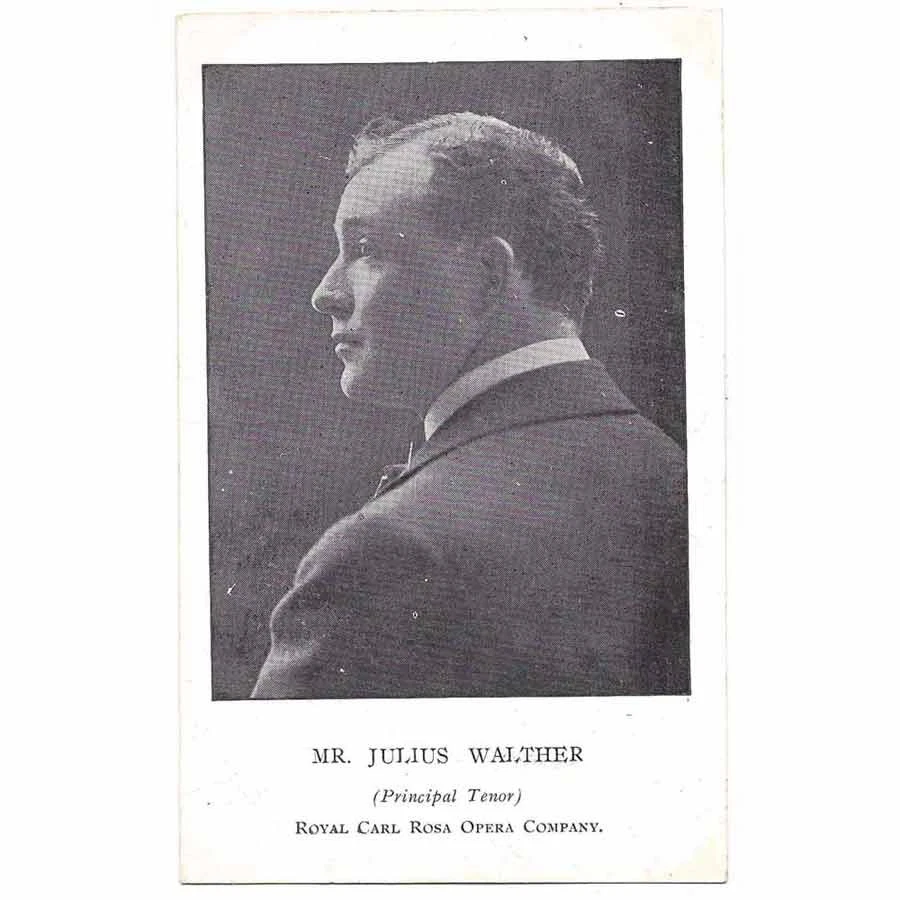
| Notting Hill Gate W., Coronet Theatre | |
| Mon 12th Nov 1900 | Lohengrin – Aurelia Revy, Julius Walther, Haigh Jackson, Alexander Bevan, Winifred Ludlam, Mr. Chapman; c. Eugene Goossens |
| “CORONET THEATRE- Not long since it seemed as though the Royal Carl Rosa Opera Company would cease to exist, but nothing would appear impossible to reorganisation, and last night the company began a week’s opera in English at the Coronet Theatre. The work chosen was Wagner’s “Lohengrin,” and in its interpretation the best traditions of the company were preserved. The chorus sang with intelligence, and the orchestral portion was admirably played by an efficient body of instrumentalists under the conductorship of Mr. Eugene Goosens. With regard to the soloists, a sympathetic and attractive exponent of Elsa was found in Madlle. Aurelia Revy, and an excellent reading of the name part was given by Herr Julius Walther. Miss Winifred Ludlam as Ortrude, Mr. Haigh Jackson as Telramund, and Mr. Alexander Bevan as Henry the Fowler presented very capable embodiments of the respective characters, and taken in its entirety the performance was decidedly praiseworthy. The management is to be commended for including in the scheme for the week Signor Spinilli’s “A Basso Porto” on Wednesday and Friday, and Gounod’s “Cinq Mars” on Saturday, neither of these operas having yet been performed in London.” [Morning Post, Issue: 40077, Tuesday, Nov. 13, 1900] / “The Royal Carl Rosa Opera Company,” to give them their full style and title, opened a week’s work last night at the Coronet Theatre, Notting Hill Gate, with quite an excellent performance of “Lohengrin.” Herr Julius Walther was the Lohengrin, and sang and acted with much earnestness and spirit, although to outward view he scarce represented the spiritual and ethereal knight of the legend. Mlle. Aurelia Revy’s Elsa was quite good; she had realized in a rather subtle way the Teutonic, the “ground-bars” German element, of the part – a very satisfactory matter to note. Miss Winifred Ludlam’s Ortrud was a trifle stagey, but earnest nevertheless; and the smaller parts were taken by Mr. Bevan, Mr. Jackson, and Mr. Chapman with some distinction and with much spirit. The orchestra was capital, and the chorus quite good.” [Pall Mall Gazette, Issue: 11115, Tuesday, Nov. 13, 1900] / “CORONET THEATRE – The recently re-formed Royal Carl Rosa Opera Company began last night a week of opera in English, at the Coronet Theatre, with Wagner’s “Lohengrin.” Completeness of detail can scarcely be expected from travelling grand opera companies, and such omissions as the three trumpeters on the stage in the first act may be forgiven when so much earnest, endeavour is shown, and so much that is praiseworthy is presented, as yesterday, Mlle. Aurelia Revy’s reading of the maid of Brabant was very intelligent, and she sang the music with sympathetic charm and considerable dramatic perception. It is to be regretted that an English tenor was not forthcoming to sustain the name-part, but it must be admitted that Herr Julius Walther is a very capable artist, and that his voice, if somewhat hard, is adequate to the somewhat exacting demands of the music. Miss Winifred Ludlum’s personation of Ortrude was; deficient in dignity ; but she brought out the salient points of the part with due emphasis, and was excellently supported by Mr. Haigh Jackson, who embodied Telrumund with manly decision and histrionic ski!!. Mr. Alexander Bevan brought experience to the part of Henry the Fowler, and the words of the Herald were well declaimed by Mr. Albert Chapman, The choristers sang with care, for the most part; showed lively interest in their duties, and were appropriately dressed. A specially commendable feature of this interpretation was the efficient orchestra, which, under the direction of Mr. Eugene Goosens, rendered the instrumental portion of the work with precision and point. Exceptional interest pertains to the scheme for this week, owing to the first performance in London being announced, on Wednesday and Saturday respectively, of Signor Spinelli’s .”A Basso Porta” and Gounod’s “Cinq-Mars.” [The Standard, Issue: 23832, Tuesday, Nov. 13, 1900] / “CARL ROSA COMPANY – English opera companies now very rarely visit central London, but some of the travelling troupes engaged during the autumn and winter in touring through the provinces frequently appear in the suburbs. During the present week the singers of the newly reconstructed Carl Rosa Company are giving eight representations at the Coronet of “Lohengrin” (in which Mdlle. Revy proved herself a highly acceptable Elsa), “Faust,” “Carmen,” and other familiar works. while they also promise to-night Spinelli’s “A Basso Porto,” for the first time in the suburbs: and on Saturday Gounod’s “Cinq Mars.” an opera which, when it was produced in Paris nearly four and twenty years since, attracted much attention. “A Basso Porto,” which was originally performed at Cologne about half a dozen years ago. is based upon one of the “Neapolitan Scenas” of Cognetti, which have already furnished plots for modern Italian operas. It is a sordid story of low Italian life, drawn, we believe, from the authentic records of the police courts, and in which the chief of a band of thieves seeks, from motives of revenge, to ruin the son and daughter of the woman whom he formerly loved, and who, to save her children, stab him, just as the members of is his robber band rush in to kill him for an act of treachery. The music, which has just ben published by Messrs. Ascherberg and Co.. has plenty of Italian melody. as well as dratmatic force of the modern strenuous sort, while the inevitable intermezzo, which was, by the way, played recently at Mr. Newman’s Promenade Concerts, is written for mandolines, and both at the production oi the English version at Brighton last March, and in various other parts of the country since, it has proved a highly popular number.” [Daily News, Wednesday, Issue: 17049, Nov. 14, 1900] | |
| Tue 13th Nov 1900 | Carmen – Aurelia Revy |
| Wed 14th Nov 1900 (m) | Faust – Aurelia Revy |
| Wed 15th Nov 1900 (e) | The Harbour Side (“A Basso Porto” – “First Performance in London”) |
| Thu 16th Nov 1900 | Tannhauser – Aurelia Revy |
| Fri 17th Nov 1900 | The Harbour Side (“A Basso Porto”) |
| Sat 18th Nov 1900 (m) | Carmen – Aurelia Revy |
| “At last Wednesday’s matinee with “Carmen,” the Carl Rosa opera company attracted one of the largest audiences Which have yet flocked to the popular Coronet Theatre. The company has secured the services of that past-master in advance agency, Mr A. H. Yolland, Who promises, as the herald of the Carl Rosa opera company, to make business “hum.” [The Era, , Issue: 3243, Saturday, Nov. 17, 1900] | |
| Sat 18th Nov 1900 (e) | Cinq-Mars – Aurelia Revy |
| 19th – 24th Nov 1900 [1 week] London, Brixton Theatre, S.W. | |
| Mon 19th Nov 1900 | Tannhauser |
| Tue 20th Nov 1900 | Carmen |
| “BRIXTON THEATRE On Monday, Nov. 19th, the Opera, “TANNHAUSER” Mr E. G. Saunders has secured a very powerful attraction in the Royal Carl Rosa opera company, under the capable direction of Mr T. H. Friend. The bill for the week includes Tannhauser, Carmen, Faust, At the Harbour Side, The Cricket on the Hearth, and Cinq Mars. A very full attendance on Monday showed marked appreciation of the excellent performance. The character of Tannhauser was well rendered by Herr Julius Walther, a tenor vocalist who acquitted himself admirably. Elizabeth was portrayed by Miss Lizzie Burgess (in the absence of Mdlle. Aurelia Revy, through indisposition) in an acceptable manner, and the lady gained hearty applause for her clever acting and vocalisation. In the part of Venus Miss Winifred Ludlam proved a good substitute for Miss Burgess. Mr Alex. Bevan was all that could he desired as the Landgrave. The Australian baritone, Mr Arthur Deane, was particularly good in his interpretation of Wolfram, and merited the enthusiastic plaudits bestowed on his efforts. Mr Frank A. Wood contributed largely to the success achieved by his enjoyable singing. The opera was capitally “dressed” and well mounted. The orchestra was ably led by Mr. Eugene Goossens, the overture being played in such a manner as to arouse very demonstrative recognition from the audience. The other members of the company each appeared to do his or her best to support the principals engaged in the representation. “Carmen” was given in excellent style on Tuesday, when there was a full house.” [The Era, Issue: 3244, Saturday, Nov. 24, 1900] | |
| Wed 21st Nov 1900 | Faust |
| Thu 22nd Nov 1900 | A Basso Porto – Winifred Ludlam, Aurelia Revy, Arthur Deane, William Stephens; c. Eugene Goossens |
| “The Royal Carl Rosa, Opera Company has at last returned to London, and has given some pleasing performances at the Coronet Theatre, Notting Hill, a play-house which is one of the best of those forming the suburban ring round the metropolis. The English version of Signor Spinelli’s “A Basso Porto,” entitled “At the Harbour Side,” has not met with much favour, the sordid story being its chief fault. Last night the company performed Gounod’s “Cinq Mars,” a work which, although it was produced in Paris as far back as April, 1877, had not previously been heard in London. “Cinq Mars” is said to be one of the poorest compositions of the lamented Frenchman, and this is no doubt owing to the fact that the story is so strong – While the music is so weak. The ballet in the third act is, perhaps, the most charming part of the opera. Mdlle. Aurelia Revy, the Hungarian vocalist, sang well as the Princess Marie, beloved by Cinq Mars, a character sturdily represented by Herr Julius Walther. Mr. Bevan in the part of the spy Noorden conducted a very creditable performance.” [Leeds Mercury, Issue: 19541, Monday, Nov. 19, 1900] | |
| Fri 23rd Nov 1o900 | The Cricket on the Hearth [Goldmarck] (“First performance in England”) |
| “MISS AURELIA Revy, of the Carl Rosa opera company, has now, we are pleased to learn, quite recovered from the accident which she sustained when acting as Carmen on Saturday last, and was announced to appear in Goldmark’s opera, Cricket on the Hearth, at the Brixton Theatre last night.” [The Era, Issue: 3244, Saturday, Nov. 24, 1900] / “NEW PRODUCTION BY CARL ROSA COMPANY – Goldmark’s three-act opera, “The Cricket on the Hearth,” founded upon Dickens’ familiar story, was performed for the first time in this country by the Carl Rosa Opera Company at the Brixton Theatre, London, last night, and was received with emphatic favour by a crowded audience. For nearly five years this charming little opera has enjoyed great popularity on the Continent, more especially in Vienna, where it was first produced in 1896. As last nights experience showed, it is calculated to appeal most forcibly to an English audience when sung to an English text. The librettist, Herr Wilner, follows pretty closely the lines of Dickens’ story, and furnishes a sufficiently dramatic, as well as graceful and poetic, story. His music, although essentially modern in character and treatment, is exceedingly melodious, and includes some numbers to which the term beautiful may fairly be applied. The performance was of unequal merit, but the characters were in competent hands, and after a few repetitions the rendering of the opera should leave little to be desired. The artistes who most distinguished themselves to-night were Miss Aurelia Revy (Dot), Mr Arthur Deane (John), Mise Lizzie Burgess (May), and Miss Eugenie Barker (the Fairy Cricket), while Mr. William Stephens did tolerably well with the high tenor music of Edward. Mr Goosens conducted with conspicuous ability.” [Evening Telegraph, Issue: 7421, Saturday, Nov. 24, 1900] / “OPERA AT BRIXTON THEATRE. Mr. E. G. Saunders has housed the Carl Rosa Opera company with excellent results. The preceding week they produced at his Notting Hill establishment Spinelli’s A Basso Porto and Gounod’s Cinq Mars, and on Friday at Brixton they introduced to England Goldmark’s The Cricket On the Hearth, originally given in Vienna four years ago. Charles Dickens’s beautiful story has undergone a few changes in detail, but the main theme is preserved. As poor old Caleb Plummer would scarcely fit well with opera he has been excised, but, of course, there are Dot and John Peerybingle, May and the returned lover Edward, and snarling old Tackleton, all of whom behave pretty much as they do in the book. The cricket is a fairy, and there is an elfin chorus. A good deal of charming music is contained in the opera, and the second and third acts are much better than the first. An excellently written quintetto occurs when Edward reveals himself to Dot, and being spiritedly sung by Mlle. Aurelia Revy (Dot), Miss Lizzie Burgess (May), Mr. Arthur Deane (John), Mr. William Stephens (Edward), and Mr. Isidore Marcil (Tackleton) it was enthusiastically encored. Mr. Eugene Goossens conducted. Goldmark’s work is a valuable addition to the Carl Rosa repertoire.” [Lloyd’s Illustrated Newspaper, Issue: 3027, Sunday, Nov. 25, 1900] / “THE CARL ROSA OPERA COMPANY – An opera by Carl Goldmark has at last found its way to England, and has been produced at the Brixton Theatre. The directors of the Carl Rosa Company deserve the heartiest thanks of all music lovers. Goldmark is one of the most individual of living composers. His beautiful opera “The Queen of Sheba” has for years occupied a permanent place in the repertoires of German and Austrian opera houses, and his other operatic works, “Merlin,” “The Cricket on the Hearth,” and “The Prisoners of War,” have all met with success. In England the name of Goldmark is rather associated with the concert-room, and the composer is known through work such as the idyllic Symphony “A Rustic Wedding,” the strikingly imaginative and gorgeously-scored “Sakuntala,” “Penthisilea,”and “Sappho” Overtures, the two violin Suites, and other characteristic examples of chamber music. It may here be remarked that Goldmark’s larger orchestral compositions deserve to figure oftener than they do on our programmes. The opera produced at Brixton was “The Cricket on the Hearth,” which, owing to its subject, might naturally be expected to appeal with peculiar force to English audiences. That it will do so there can, we imagine, be very little doubt. The story is one dear to British hearts, and the music illustrating it is altogether charming, alternately light and pathetic, abounding in melody, and worked out in a truly masterly fashion. It is the privilege of musicians of original genius to impress their own individuality on all they attempt. The themes they employ may occasionally possess a certain affinity to others one has heard before, but their treatment unmistakably reveals their author. This is the case with Goldmark, especially in the present work. Forsaking for the moment the heroic style he knows so felicitously how to employ, Goldmark shows himself in this instance altogether different to the composer whose music has evoked the magnificence of King Solomon’s palace and illustrated legendary lore in accents so inspired. In treating a simple and touching tale he has descended from his high pedestal and become what he was of yore in “A Rustic Wedding” thoroughly gemutlich. The language he speaks is one that can be readily understood by all. Its comparative simplicity does not prevent it at times from being eminently impressive. Above all, it invariably bears the mark of its author’s hand. Distinction is imparted to many of the melodies by certain specifically Goldmarkian harmonies and by an admirable orchestral treatment. Among the prominent features of the score may be singled out the beautiful Quintet of the second act and the love Duet of the third act. The Preludes to the first and third act, are also worthy of mention. The second of these has been frequently heard in London. It is bright and spirited, and offers some curious reminiscences of Herold’s Overture to “Zampa,” Mendelssohn’s Violin Concerto, and Offenbach’s “La Belle Helene,” a decidedly amusing combination. The book, except for the omission of the characters of Caleb Plummer and Tilly Slowboy, follows Dickens’s story pretty accurately. If it can scarcely be said that full justice was rendered to Goldmark’s work, yet the performance was in the main creditable. Miss Aurelia Revy sang and acted charmingly as Dot, while Miss Eugenic Barker and Messrs. Arthur Deane and Isidore Marcil were all efficient. Mr. Eugene Goossens conducted. “The Cricket on the Hearth” was originally produced in Vienna in 1896.” [Morning Post, Issue: 40088, Monday, Nov. 26, 1900] | |
| Sat 24th Nov 1900 (m) | Carmen |
| Sat 24th Nov 1900 (e) | Cinq-Mars – Aurelia Revy, Julius Walther, Mr. Alex. Bevan, Mr. Arthur Deane, Miss Lizzie Burgess, Miss Emily Barker c. Van Noorden |
| “CARL ROSA COMPANY – The artists Of the Carl Rosa Company on Saturday presented Gounod’s “Cinq Mars” at the Coronet Theatre for the first time in the suburbs. We have already given a description of this opera, which was produced in Paris as far back as 1877, but has never been taken seriously into the repertory, even in the French capital. The music is by no means up to the standard expected from the composer of “Faust” and of “Romeo et Juliette.” At the Coronet, the part of Cinq Mars, whose best vocal effort is the cavatina in the last act, was sustained by Mr. Walther, while Mdlle. Revy vas the heroine. Marie de Gonzague, Mr. Bevan was the villain, Pere Joseph (“L’Eminence grise” of French history), and Mr. Van Noorden conducted. The company will this week appear at the Brixton Theatre. where, among other things, they propose to try Goldmark’s operatic version of Dickens’s “Cricket on the Hearth,” which was produced in March. l896, at Vienna.” [Daily News, Monday, Issue: 17053, Nov. 19, 1900] | |
| “”ROYAL CARL ROSA OPERA — The six days’ stay of the Royal Carl Rosa Company at the Coronet Theatre, Notting Hill, under the experienced direction of Mr. T. H. Friend, came to an end on Saturday. During the coming week the company will be at Brixton where will be produced for the first time in England, Golmark’s opera “The Cricket on the Hearth.” In the meanwhile we have had during the past week two more or less familiar operas in Spinelli’s “A Basso Porto” and Gounod’s “Cinq-Mars.” The first of these works was originally brought out at Cologne in 1894 and was produced by the Carl Rosa Company a lew months ago at Brighton for the first time in England, since when it has been given with success in the provinces. Signor Spinelli has followed the lead of Signor Mascagni and Signor Leoncavallo by choosing a story of repelling realism. Essentially a musical melodrama, “A Basso Porto” or “At the Harbour Side,” to employ its English title, furnishes a pretty startling record of crime. The scene is laid in the lowest Neapolitan quarter, where dwell the “Camorristi.” It would be difficult to imagine a greater scoundrel than the hero, Cicillo, who having some years previously played false with his sweetheart, and been the cause of her killing her rival, now endeavours to seduce the daughter of his former love and to ruin her son Luigino by making him gamble. Susella, the daughter, learning from her mother’s lips the story of what had occurred long ago, seeks revenge, and denounces Cicillo as a spy to the “Camorristi,” who commission Luigino to kill him. The act of retribution is, however, finally performed by Marie, Cicillo’s first love, who stabs the villain with a knife. Such, in brief, is the unsavoury plot of Signor Spinelli’s opera. It may readily be imagined that this unpleasant story is susceptible of furnishing strong dramatic situation. This, indeed, is the case, and the composer has fully risen to the occasion, and has written a score that may compare with the best that have emanated from Italy during recent years. The music is replete with melody, and accords well with the situations. It palpitates with passion and runs through the whole gamut of the emotions. Besides this, it is scored with a thorough knowledge of orchestral effect. The duets between Cicillo and Susella and between the latter and her mother are among the noteworthy portions of the opera. A charming “intermezzo,” with solo for mandoline, precedes the third act. “A Basso Porto” is quite worthy of being given at Covent Garden during the regular season. Its performance reflected great credit on the members of the Carl Rosa Company, the two principal female parts finding adequate representatives in Miss Winifred Ludlam and Mdlle. Aurelia Revy, while Mr. Arthur Deane displayed a really fine baritone voice in the part of Cicillo, and Mr. W. Stephens was acceptable a3 Luigino. Mr. Eugene Goossens conducted with care. “Cinq Mars,” given on Saturday evening, is one of the weakest of Gounod’s operas. It was originally produced at the Paris Opera Comique in April, 1877. Ten years had then elapsed since the French master had brought out a new opera, “Romeo et Juliette,” dating from 1867. His “Polyeucte” had been written, but was yet awaiting production. It is said that “Cinq Mars” was composed in a hurry. The libretto, which is, of course, taken from Alfred da Vigny’s famous romance, is not well constructed, and produces the impression of a series of unconnected scenes. History has often been tampered with by the authors of operatic libretti. In the present instance, one of the most prominent personages in the opera, Pere Joseph, known as “L’Eminence Grise,” had already departed from this world five years at the time of the Cinq Mars conspiracy. This, however, is a matter of comparatively small importance. The above-named Pere Joseph is made to take the place of Cardinal Richelieu, whose presence is dispensed with altogether, in the machinations directed against the lovers Cinq Mars and Marie de Gonzague. The music certainly has that personal note which is present in every work by Gounod. It is, however, conceived in a conventional form. What it contains has been better said by the composer in former works. There are, however, several pleasing and graceful numbers. Gounod was ever at his best when writing love music, and the duets in this work reveal the hand that penned “Faust” and “Romeo.” The cantilena “Nuit resplendissante,” with its luscious melody, is full of charm, and has often been heard in the concert-room. The performance of Gounod’s opera, under the direction of Mr. Walter van Noorden, was extremely praiseworthy. Mdlle. Aurelia Revy sang and acted charmingly as the heroine, and Mr. Julius Walther showed off his ringing tenor voice with excellent effect as Cinq Mars. Mr. Alex. Bevan, Mr. Arthur Deane, Miss Lizzie Burgess, and Miss Emily Barker were all thoroughly efficient.” [Morning Post, Issue: 40082, Monday, Nov. 19, 1900] | |
| “CORONET THEATRE – The Carl Rosa Opera Company on Saturday brought a successful week of opera in English, at the Coronet Theatre, to a close with Gounod’s “Cinq Mars.” The performance acquired distinction owing to the work not having previously been heard in London. “Cinq Mars” was produced originally at the Opera Comique, Paris, on April 5, 1877, and has for its subject the conspiracy of the Marquis de Cinq Mars against Cardinal Richelieu. The Cardinal does not appear, but the designs of Cinq Mars are defeated by the efforts of Father Joseph, who, by the way, according to history, died five years before the conspiracy. The love interest is centred in the union of Cinq Mars to the Princess Marie, who dies as her husband is led to execution. The opera proved a complete failure. This is not astonishing, for it is one of the weakest and most invertebrate of the French composer’s dramatic works. Gounod’s genius reached its apogee in “Faust,” his fourth opera; “Cinq Mars” is his tenth. Now and again there is a daswhich possess some musical interest arc the cantilena “Night pure and resplendent,” and some ballet music. Mlle. Aurelia Revy, who embodied the Princess, had had the misfortune to sprain her ankle during the performance in the afternoon of Carmen, but she sang with her wonted intelligence, and struggled bravely through her part. Miss Eugenie Barker for her effective rendering of the Shepherd song, and the characters of the Marquis and Father Joseph were efficiently sustained by Herr Julius Walther and Mr. Alexander Bevan. The chorus were brightly rendered, and justice done to the instrumental portion under the direction of Mr. Walter van Noorden.” [The Standard, Issue: 23837, Monday, Nov. 19, 1900] |
| Dudley, Opera House | |
| Mon 26th Nov 1900 | Lohengrin – |
| Tue 27th Nov 1900 | Maritana |
| Wed 28th Nov 1900 | Faust |
| Thu 29th Nov 1900 | Carmen |
| Fri 30th Nov 1900 | At the Harbour Side |
| Sat 1st Dec 1900 | Tannhauser |
| “DUDLEY OPERA HOUSE – Proprietor and Manager, Mr J. Maurice Clement; Acting-Manager, Mr J. W. Tilley – Patrons of the above house have had a rare treat this week, Mr Clement having engaged the renowned Royal Carl Rosa Opera company. On Monday Lohengrin was put before an appreciative audience, and rendered in good style. Herr Julius Walther, in the title-role, was excellent, being the posessor of a tenor voice of wonderful volume and compass, while Mdlle. Aurelia Revy as Elsa fairly electrified her audience by the intensity and fervour of her acting. Mr. Alex. Bevan as the King rendered his numbers in a rich and profound bass voice of remarkable clearness. Mr. Haigh Jackson was highly successful in the difficult part of Frederick of Telramund, and was ably assisted by Miss Winifred Ludlam as Ortrude, who sang in excellent style. Mr. Albert Chapman was distinctly good as the Herald. Mr. Eugene Goossens was the efficient conductor of an augmented orchestra. Maritana, Faust, Carmen, At the Harbour Side, and Tannhauser are also included in the repertoire.” [The Era, Issue: 3245, Saturday, Dec. 1, 1900] |
| 3rd – 8th Dec [1 week] Nottingham, Theatre Royal | |
| Mon 3rd Dec 1900 | Tannhauser |
| “THEATRE ROYAL – With a Wagnerian representation the Carl Rosa Opera Company last night inaugurated their engagement at the Nottingham Theatre Royal. Every part of the Theatre Royal was filled with an audience who followed “Tannhauser” with earnest appreciation. In every department, from principals to chorus, the organisation bears the stamp of high excellence. As “Tannhauser” constitutes a pretty severe test, this opinion is all the more confidently expressed. In Mr. Julius Walther, a Wagnerian tenor of remarkable attainments was introduced to Nottingham. Mr. Walther came with a high reputation, which he amply sustained. Nothing could have been more delightful than the handling of the exquisite septett by Mr. Walther and Messrs. Arthur Deane. Alex Bevan, Frank A. Wood. Albert Chapman, A. Felton, and Isidor Marcil. A most polished interpretation of Elisabeth’s “Greeting to the Hall of Seng” was that of Mdlle. Aurelia Revy, whose initial effort, proved her a dramatic soprano of high ability. Mdlle. Revy’s voice is extensive in compass, and clear and pure in quality, and she u<es it in the manner of a finished artist. The principals and the male choristers came with perfect success through the exacting finale to the act, in which Mdlle. Revy as Elizabeth the only feminine character “on” to the close, sang in unmistakably telling manner. Her voice rang through the fortissimo of the band and chorus with striking effect, and her share was borne throughout irreproachably. The scene was extremely impressive alike in its vocal and its spectacular features, and that the audience were of this opinion was evident from the fact that the curtain had to be twice raised. The “Prayer” in the third act was interpreted in touching and sympathetic fashion by Mdlle. Revy, who was obviously in entire sympathy with her work. Mr. Deane gave Wolfram’s song to the Evening Star with manifest thoughtfulness and fervour, and his impassioned singing was in keeping with the nature of the subject. Intensely dramatic was Mr. Walther’s delivery of the “Narration” in regard to which he excelled himself. The tenor had evidently devoted exhaustive study to this arduous scene, in which he acted and sung with unsparing energy. It was a superb vocal effort finely sustained. and as such met with appropriate recognition. The work of the orchestra under Mr. Eugene Goossens was sound throughout. This evening “Carmen” is to be represented.” [Nottingham Evening Post, Issue: 6951, Tuesday, Dec. 4, 1900] / “THEATRE ROYAL – Managing-Director, Mr Robert Arthur – Acting-Manager, Mr F. Teale Lingham – The Carl Rosa Opera Company’s visit is always appreciated by the musical portion of the Nottingham public, and this is being sufficiently evidenced by crowded houses nightly. The repertoire is a varied one, and a fine performance of Tannhauser was given on Monday night. Herr Julius Walther has a strikingly powerful and musical voice, which he used with artistic effect in the trying role of Tannhauser. Mdlle. Aurelia Revy is undoubtedly a cultured and experienced vocalist, and her interpretation of Elizabeth was pervaded by real dramatic intensity. In the character of Wolfram, Mr. Arthur Deane displayed high ability, and fully deserved his success. Mr. Alex Bevan’s declamatory style is eminently suited to the music of the Landgrave. Mr. F. A. Wood as Walther sang excellently, and Mr. Albert Chapman as Biterolf, Mr. A. Felton as Henrich, and Mr. Isidore Marcil as Reinmar filled their parts creditably. Miss Lizzie Burgess sang exquisitely the music of Venus, and Miss Eugenie Barker made a charming Shepherd Boy. The chorus is an exceptionally good one, and their work merits praise. Other artists of note who appear during the week are Miss Winifred Ludlam, Miss Marie Burnett, Mr. William Stephens, and Mr. Haigh Jackson.” [The Era, Issue: 3246, Saturday, Dec. 8, 1900] | |
| Tue 4th Dec 1900 | Carmen |
| Wed 5th Dec 1900 | Maritana |
| Thu 6th Dec 1900 | The Bohemian Girl |
| Fri 7th Dec 1900 | Cinq Mars |
| Sat 8th Dec 1900 (m) | Carmen |
| Sat 8th Dec 1900 (e) | Faust |
| 10th – 15th Dec [1 week] Middlesbrough, Theatre | |
| Mon 10th Dec 1900 | (as mentioned in “on the Road” in “The Era” (notoriously unreliable)- it has not been possible to verify this nor to find any other trace of the company during these dates |
| 17th – 22nd Dec [1 week] Wolverhampton, Grand Theatre | |
| Mon 17th Dec 1900 | Tannhauser – Julius Walther, Arthur Deane, Frank A. Wood, Isidore Marcil, Albert Chapman, Mr. A. Felton, Aurelia Revy, Lizzie Burgess, Eugenie Barker |
| “GRAND THEATRE – Lessees and Managers, Mr. E. H. Bull and Mr Milton Bode; Acting-Manager, Mr. Wm. Lockhart – It is many years since the Royal Carl Rosa opera company were at Wolverhampton, and their visit this week is the first appearance of the company at this house. A large audience was attracted on Monday night to witness what was an admirable performance of Tannhauser. First and foremost should be mentioned Herr Julius Walther, who filled the part of the title role, and whose excellent singing throughout the heavy work which falls to his lot was accurate, forcible, and dramatic. Mr. Arthur Deane also has a fine voice, and – used it well in the part of Wolfram; while as Walther Mr. Frank A. Wood display capital vocal abilities. Mr. Isidore Marcil was very successful in the dual part of the Landgrave and Reinmar; and the characters of Biterolf and Henrich were creditably sustained by Messrs Albert Chapman and A. Felton respectively. Mdlle. Aurelia Revy possesses a rich voice, and used it with skilful effect in the character of Elizabeth; while Miss Lizzie Burgess as Venus sang with charming grace; and Miss Eugenie Barker made a pleasing shepherd boy. The choruses, particularly that of “Hail, bright abode,” were admirably rendered. Different operas were announced for each night, and the other leading performers were Mr. William Stephens, Mr. Haigh Jackson, Miss Winifred Ludlam, and Miss Nora Roy.” [The Era, Issue: 3247, Saturday, Dec. 15, 1900] | |
| Tue 18th Dec 1900 | ?? |
| Wed 19th Dec 1900 | ?? |
| Thu 20th Dec 1900 | ?? |
| Fri 21st Dec 1900 | ?? |
| Sat 22nd Dec 1900 | ?? |
| 26th – 29th Dec [Christmas Week; Four Nights Only] Bradford, St Georges Hall | |
| Wed 26th Dec 1900 (m) | Maritana – William Stephens, Haigh Jackson, Mr. Chapman, Mr.Marcil, Miss Marie Bennett, Miss Roy, Miss Lizzie Burgess; c. Walter van Noorden |
| Wed 26th Dec 1900 (e) | Carmen – Julius Walther, Arthur Deane, Frank Wood, Mr. Chapman, Mr. Marcil, Miss Lizzie Burgess, Miss Eugenie Barker, Miss Winifred Ludlum; c. Walter van Noorden |
| “The Carl Rosa Opera company’s season in St. George’s Hall, Bradford, on this occasion consists of four nights only. The company is practically the same as visited Bradford and Leeds not long ago, and it was then at a much higher standard than it had been for some years. The season yesterday was opened with “Maritana” in the afternoon and “Carmen” at night: both of which are popular with holiday-makers. The first-named was admirably rendered, with Mr. W. Stephens as Don Cesar, and Miss Lizzie Burgess as Maritana, but the attendance was not great. At night, however, there was a large audience in all parts of the hall. Miss Winifred Ludlam again took the character of Carmen, and rendered the music sweetly and with taste. Herr Julius Walther appeared as Don Jose, and showed that he can act in the lighter vein, though his special ability is in dealing with Wagnerian opera. Mr. Arthur Deane, as Escamillo, and Miss Lizzie Burgess, as Michaela, were good, and Mr. F. A. Wood was as humorous as ever in the part of Remendado The chorus is well balanced, and contributed in no small degree to a most successful performance. “Tannhauser” is to be given tonight; “The Cricket on the Hearth” to-morrow, “Faust” on Saturday afternoon, and at night “Cinq Mars.” [Leeds Mercury, Issue: 19573, Thursday, Dec. 27, 1900] | |
| Thu 27th Dec 1900 | Tannhauser – Julius Walther, Arthur Deane, Frank Wood, Mr. Chapman, Mr. Marcil, Miss Lizzie Burgess, Miss Eugenie Barker, Miss Winifred Ludlum; c. Walter van Noorden |
| Fri 28th Dec 1900 | The Cricket on the Hearth |
| “CARL ROSA OPERA COMPANY AT BRADFORD – “THE CRICKET ON THE HEARTH.” A performance of Karl Goldmark’s opera, founded upon Dickens’s Christmas story, “The Cricket on the Hearth,” was given by the Carl Rosa Opera Company in St. George’s Hall last evening. This marked the introduction of the work to the North of England, but the Bradford public apparently did not attach much significance to that fact, for the attendance proved to be the smallest of the week. Goldmark is a composer of European reputation, but his music, for some reason or other, has obtained scant bearing in this country. Had not his latest opera been based upon such an essentially English, or rather Dickensian story, the Hungarian composer would have had to wait longer ere his music for the theatre obtained recognition here. But “The Cricket on the Hearth” was bound to be put upon an early trial in this country, where, it must be confessed, it was also likely to meet with severer criticism than elsewhere. That an Hungarian should have elected to set such a story as this is, on the face of it, a little singular. Goldmark was probably attracted by the pleasant domestic aspects of the tale. for the Hungarian is also a Jew. and the Jews are essentially fond of all that is conveyed in the term “home.” Whatever may have attracted him in the story, as adapted by Willner, it is not singular that he should have failed to catch the peculiar Dickensian spirit or reflect it in his music. Sullivan would have given us humour – caught something of the obvious comedy of the thing; but Goldmark jokes with difficulty, or rather he does not joke at all, though he makes a gallant attempt to realise the cheerful, or, as some might think, creepy chirping of the cricket and presiding genius of the carrier’s home. Goldmark, indeed, treats his subject a little too seriously. The atmosphere is largely that of grand opera, in which the simple, homely creatures drawn by Dickens move with some suggestion of constraint. Goldmark is, of course, a master of orchestration, and the scoring is clever enough in its way. The thematic material does not, however, appear remarkable or suggestive. One of the most striking features is the quintet in the second act, whilst Peerybingle’s opening song and the chorus of those who flock to the carrier’s house in quest of letters are fresh and engaging in effect. The performance was as good as the restricted facilities of St. George’s Hall for theatrical representations admitted. Despite her limited command of the vernacular, Miss Aurelia Revy sustained the part of the well-meaning, if coquettish, Dot, the carrier’s wife, in good style. and with plenty of the requisite animation. Honest, slow-witted Peerybingle, the carter, was impersonated by Mr. Arthur Deane, who sang well and looked his part more nearly than his associates did theirs. The secondary story of Sailor Edward and his love made a call upon Mr William Stephens – who, as the young tar in disguise, gave full force to his song of the deep – Miss Lizzie Burgess – who sang May’s love ditty in the opening scene very well – and Mr. Isidore Marcil, who adequately represented Tackleton, the would-be husband of the temporarily disconsolate May. Miss Eugenie Barker was the fairy Cricket, and minor parts were taken by Miss Nora Roy, Miss Eleanor Harwood, and Miss Douglas Wilson. The chorus sang brightly and to good effect The composer introduces the inevitable ballet, which appears out of place, and was not particularly well represented on this occasion. The band, to the number of nearly thirty, played very creditably under the direction of Mr. Eugene Goosens , and it may be said that the scenery and mounting proved adequate to the simple purpose in view.” [Leeds Mercury, Issue: 19575, Saturday, Dec. 29, 1900] | |
| Sat 29th Dec 1900 (m) | Faust |
| Sat 29th Dec 1900 (e) | Cinq Mars |
| “CARL ROSA OPERA CO. IN BRADFORD – The Carl Rosa Opera Company brought their Christmas season in Bradford to a close on Saturday by a performance on “Cinq Mars,” and a very fine Conclusion it was. The principal parts were in the hands of Herr Julius Walther, Mr. Arthur Deane, and Mdlle. Aurelia Revy, and though the audience was not often moved to much applause, they were, in the final scene, completely carried away. The duet by the two conspirators prior to being led out to execution was a magnificent performance, but though the audience persisted for some time, they could not secure its repetition. The male members of the chorus gave a splendid rendering of the conspirators’ pledge on accepting Cinq Mars as their leader.” [Leeds Mercury, Issue: 19576, Monday, Dec. 31, 1900] |
| Darlington, Theatre Royal | |
| Mon 31st Dec 1900 | Tannhauser |
| Tue 1st Jan 1901 (m) | Maritana |
| Tue 1st Jan 1901 (e) | Carmen |
| Wed 2nd Jan 1901 | The Bohemian Girl |
| Thu 3rd Jan 1901 | Lohengrin |
| Fri 4th Jan 1901 | The Cricket on the Hearth |
| Sat 5th Jan 1901 | Faust |
| 7th – 12th Jan [1 week???] York, Royal Theatre??? Mentioned in “On the Road” in “The Era” (notoriously unreliable, but it has not proved possible to verify one way or the other – yet) | |
| Mon 7th Jan 1901 | |
| 14th – 19th Jan [1 week] Derby, Grand Theatre | |
| “The visit of the Carl Rosa Opera Company to Derby last spring was distinctly successful, and we were glad to be able to announce its intention to come again. On Monday next it commences a series of seven performances (six evening representations and one matinee), and ‘we shall be greatly surprised if it fails to obtain a liberal measure of support. The works selected for interpretation are as follows :—Monday, January 14th, “Tannhauser;” Tuesday, “The Bohemian Girl;” Wednesday, “Maritana;” Thursday, ” Lohengrin;” Friday, “Cricket on the Hearth;” Saturday morning, “Faust” and Saturday evening, “Carmen.” It will be seen that the management, whilst providing for the tastes of the great and increasing number of Wagner’s admirers, has had due regard to those who love the time honoured ballad opera, and the fine works of the modern French school. The promised production of Goldmark’s opera will awaken lively interest. Some of the leading incidents of Dickens’ well known story are said to have been carefully utilised, whilst the music of “The Cricket,” by Herr Goldmark, is bright, melodious, and graceful. The company, with Mr. T. H. Friend as business manager, and Messrs. E. Goossens and Walter Van Noorden as musical conductors, includes most of the accomplished vocal principals who won so much favour here last April. The principal, we are glad to know, is Herr Walther, the fine German artist who made his first appearance at Derby as the mystic hero of “Lohengrin.” A special feature of interest is the promised appearance in a bass role of Mr. Sidney Poyser, of Swarkestone, whose honourable progress in the musical profession we recently made mention of. He will appear on Monday evening in the part of The Landgrave in “Tannhauser,” and be entrusted with the interpretation of other important characters during the week.” [Derby Daily Telegraph, Volume: 44, Issue: 6596, Tuesday, Jan. 8, 1901] | |
| Mon 14th Jan 1901 | Tannhauser |
| Tue 15th Jan 1901 | The Bohemian Girl |
| “THE BOHEMIAN GIRL AT DERBY THEATRE – The popularity which the Royal Carl Rosa Opera Company enjoys in Derby was demonstrated in no uncertain fashion again on Tuesday night, when on the occasion of the production of “The Bohemian Girl” the Derby Grand Theatre and Opera House was practically packed with a thoroughly appreciative audience. Balfe’s charming work has been frequently produced in Derby, but judging from the enthusiastic manner in which it was received last night it has lost none of its charm; indeed, it probably never will so long as it is interpreted so admirably aas it is by the Carl Rosa Company. The principal characters were allotted with that care and discrimination that characterises this company, and Miss Lizzie Burgees scored a distinct triumph Arline, the heroine, and was recorded a most vociferous encore for her song “I dreamt I dwelt in marble halls.” Her acting, too, was very fine, and she was seen and heard to great advantage in her love scenes and duet with Thaddeus, which role was admirably undertaken by Mr. William Stephens. The latter made good use of his beautiful voice, and he was deservedly encored for “Then you’ll remember me” and “When the fair land of Poland.” According to the programme Mr. Arthur Deane was cast for the part of Count Arnheim, but many in the audience did nor fail to recognise in the impersonator of this character a local singer in the person of Mr. Sydney Poyser, of Swarkestone. It is the first time Mr. Poyser has appeared as Count Arnheim, and he is to be congratulated on making such a creditable debut and coming out of the ordeal so well as did. His stage presence is a great deal in his favour, and his singing left nothing to be desired, his rendering of “The heart bowed down” being most excellent, and thoroughly deserving of the encore, Mr. Frank Wood could scarcely be improved upon as the gay Florestein, and Mr. Alex Bevan was really splendid as Devilshoof. Without overdoing it he made the most of the part, and his “dance” was enthusiastically recalled. Miss Winifred Ludlam was once more an ideal Gipsy Queen, and gained an irresistible encore for her song, “Love smiles but to deceive.” The other characters were well filled, and the beautiful music was most efficiently played by the largely augmented orchestra, whilst the chorus did their work in a manner that reflects the greatest credit upon all concerned. To night (Wednesday) “Maritana” will be produced.” [Derby Daily Telegraph, Volume: 44, Issue: 6603, Wednesday, Jan. 16, 1901] | |
| Wed 16th Jan 1901 | Maritana |
| “THE CARL ROSA OPERA COMPANY – SUCCCESSFUL PERFORMANCE OF “MARITANA” – The Grand Theatre, Derby, was crowded from floor roof on Wednesday night, when the Carl Rosa Opera Company gave a performance of … annals of magnificence too rarely … satisfactory attendance most … satisfying to the local management in … one, since it must serve to remove … has long existed concerning the apathy in the Derby public to musical entertainment of the highest order. Under Mr. Van Noorden directing Wallace’s ever agreeable, ever welcome opera. was submitted with all the thoroughness and artistic finish of which the famous organisation is capable. Interpreted with such ease of expression, familiarity with the music made it none the less acceptable, and all the popular numbers, “Let me like a soldier fall,” “Alas, those chimes!” “in happy moments,” “Turn oh turn … Time,” among others, were received as rapturously as ever. Mr. Wm. Stephens was the … king Don Cesar, and the very tuneful lines alloted to him were rendered in a manner such as only the true artist could be capable of. Mr. Haigh Jackson was Don Jose, and, as usual, acquitted himself most honourably. Special circumstances led to the appearance of Mr. Sydney Poyser of Swarkestone s he King, a small part, it is true. but one which still further enabled him to satisfy his friends that he has before him a career of infinite promise. The duet by him and Mr. Stephens, “The King of Spain,” was exceptionally well sung and heartily applauded. Maritana was played by Lizzie Burgess, whose voice was heard to excellent advantage in the beautiful soprano music in which the opera abounds. Lazarillo, too, was most capably presented by Miss Marie Burnett, another very clever artist who, as a contralto, has few superiors on the stage today. Minor parts, such as the Captain of the Guard played by Isidore Marcil, and the Marchioness … were also well sustained, whilst the chorus and orchestra rendered the representation complete in every way. Tonight (Thursday) “Lohengrin” is to be performed.” [Derby Daily Telegraph, Volume: 44, Issue: 6604, Thursday, Jan. 17, 1901 – parts damaged and illegible] | |
| Thu 17th Jan 1901 | Lohengrin |
| “THE CARL ROSA OPERA COMPANY – PRODUCTION OF “LOHENGRIN” – The Carl Rosa Opera Company, who have been delighting the music lovers of Derby throughout the present week, gave an exceedingly fine performance of Wagner’s celebrated opera, “Lohengrin,” on Thursday night, on which occasion the theatre was again crowded. It will be remembered, especially by those who were fortunate enough to witness it, that the company produced this same work on their last visit, Saturday afternoon being devoted thereto. On that occasion the performance was rendered all the more interesting from the fact that Herr Julius Walther, the accomplished German tenor, was making his first appearance in connection with the Carl Rosa Company. He then gave promise of ability, both as a vocalist and actor, which he has since amply fulfilled. He has now had some 12 months’ experience with the company, and his performance of Lohengrin on Thursday evening was practically faultless. His voice is peculiarly adapted to Wagnerian music, and the epithet, so frequently bestowed upon him, of “The great Wagnerian tenor,” Is justly deserved. The gentle but ill fated Elsa of Brabant was presented with a grace and sweetness which secured for Mdlle. Aurelia Revy the warmest approbation. Her singing in the third act was remarkably fine. Miss Winifred Ludlam was a splendid Ortrude. The unfortunate Frederick of Telramund was admirably portrayed by Mr. Haigh Jackson, who infused into the part a spirit intensely dramatic. Mr. Alex Bevan was a stately and vocally efficient Henry the Fowler, and Mr. Albert Chapman was the Herald The chorus and band were again prominent features of the entertainment, and they were conducted by Mr. Eugene Goossens with his wonted skill. Throughout the performance the attention of the audience was commanded. On the score of dramatic suggestiveness, the famous German master is here heard perhaps at his very best. few other composers have succeeded in so marvellously interpreting mysterious and supernatural influences. To night (Friday) will be produced, for the first time in Derby, the new and successful fairy opera from Dickens’ Christmas story, “The Cricket on the Hearth,” by Carl Goldmark.” [Derby Daily Telegraph, Volume: 44, Issue: 6606, Saturday, Jan. 19, 1901] | |
| Fri 18th Jan 1901 | Cricket on the Hearth |
| Sat 19th Jan 1901 (m) | Faust |
| Sat 19th Jan 1901 (e) | Carmen |
| “Many people will feel a special interest in the visit this week of the Royal Carl Rosa Opera Company, seeing that one of the number, Mr. Sydney Poyser, is not unknown to the city. A few years ago Mr. Poyser was a lay clerk at the Cathedral, and his powerful bass voice was a feature of the services, being especially effective in the rendering of the Passion Music sung in Lent. Upon leaving Worcester Mr. Poyser went to London to study under Mr. Partridge, a pupil of Mr. Santley, and afterwards he proceeded to Paris. There he studied under M. Giraudet, and sang regularly in the American church in that city. Mr. Poyser is at present devoting himself mainly to concert singing, but, in a few months’ time, will abandon this for the operatic stage. On Monday evening he sustained the part of the Landgrave in “Tannhauser,” and during the previous week, when in Derby, his native place, he appeared three times — as the Landgrave, Count Arnheim in “The Bohemian Girl,” and as the King in ” Maritana.” All his friends in Worcester wish Mr. Poyser success in his new sphere of work. The Carl Rosa Opera Company were granted the right to use the title of “Royal” on the occasion of their appearing by command before Her late Majesty the Queen at Balmoral about nine years ago. The opera produced on that occasion was “Carmen,” and Madame Marie Roze, who was considered to be an ideal artiste for the title role, appeared therein. Mr. T. H. Friend, the present manager of the company, then had the honour of being presented to Her Majesty, who expressed herself as highly pleased with the performance.” [Worcestershire Chronicle, Volume: 63, Issue: 3281, Saturday, Jan. 26, 1901] |
20th Jan – 9th Mar ????
| 11th – 16th Mar [1 week] Portsmouth, New Theatre Royal | |
| Mon 11th March 1901 | Tannhauser |
| “OPERA AT THE THEATER ROYAL The visits of the Carl Rosa Opera Company to the Portsmouth Theatre are always looked forward to with considerable interest, as lovers of high-class music can rely upon, the magnificent operas which are included in the repertoire being rendered in that faultless style which can only be attained by the most capable artistes. Last evening Wagner’s weird opera “Tannhauser” was performed, and of course there was a crowded house. “Tannhauser” is one of the best of the great composer’s productions. The music is somewhat “heavy” in style, but its sublimity is unquestionable. One of the finest pieces in the Opera, the overture, a grand introduction to the great theme with which “Tannhauser” deals, was listened to with rapt attention by the large audience, which burst into quite enthusiastic appreciation when it was concluded. Mr. Eugene Goossens, the conductor of the orchestra, numbering 33 members, proudly acknowledged the compliment. The central character, “Tannhauser,” the erring knight and Minnesinger, who for a season sought the voluptuous pleasures of the goddess Venus with such terrible results, is sustained by Herr Julius Walther, the great Wagnerian tenor, and the part could not have fallen into better hands. Few tenors have so powerful a voice or one of such purity, but Herr Walther used his vocal powers with discretion, and he rendered his numerous solos with a depth of feeling that was truly delightful. It was in the third act he was at his best, his declamatory passages, when relating his experiences at Rome on the return from the pilgrimage, being especially fine. Mademoiselle Aurelia Revy (prima donna of the Royal Opera House, Buda-Pesth) was also very successful as Elizabeth. The lady has a clear soprano, and she sang her parts with much care, the passionate pleading on behalf of her lover on the discovery of his amours being particularly fine. Wulfrain, by Mr. Arthur Dean, and the Landgrave, by Mr. Alex Bevan, were also very good, the latter’s fine bass voice coming in for a great deal of the appreciation of those present. Miss Winifred Ludlam as Venus also deserves commendation. She has a clear intonation, and rendered her parts very well indeed. Messrs. F. A. Wood, A. Chapman, A. Filton, Isidore Marcil, aud Miss Eugenie Barker sustained the other characters very creditably. A word of praise is also due to the mounting of the opera, the night scene in the third act being exceptionally pretty. “Maritana” is to be played this evening, “Lohengrin” on Wednesday, “Carmen” on Thursday, “The Cricket on the Hearth” on Friday, and ” Faust” on Saturday evening.” [Portsmouth Evening News, Volume: 26, Issue: 7396, Tuesday, Mar. 12, 1901] | |
| Tue 12th Mar 1901 | Maritana |
| Wed 13 Mar 1901 | Lohengrin |
| “Lohengrin” at the Royal – The beautiful, weird music of Wagner’s masterpiece was splendidly interpreted by the members of the Carl Rosa Opera Company, at the Theatre Royal, on Wednesday evening. Apart from the rich musical treat provided by “the orchestra under M. Eugene Goossens, last evening’s audience, a very large one by the way, had the opportunity o£ hearing Herr Julius Walther in the title role, and Mdlle. Aurelia Revy as Elsa. These two principals both acted and sang in a way that charmed their auditors, the former’s beautiful tenor voice, both in its robustness and mellowness, being a perfect musical treat, while the latter’s simplicity of style and splendid modulated soprano gained for her hosts of admirers. Other principal and well sustained parts were those of Ortrude, by Miss Winifred Ludlam; the Herald, by Mr. Albert Chapman; Frederick of Telramund, Mr. Haigh Jackson; and Henry the Fowler, Mr. Alex. Bevan. There will be a matinee to-morrow afternoon, when Gounod’s “Cinq Mars” will be played, with Herr Julius Walther as the Marquis, and Mile. Revy as the Princess Marie. To-night “Carmen” will be performed.” [Portsmouth Evening News, Volume: 26, Issue: 7398, Thursday, Mar. 14, 1901] | |
| Thu 14 Mar 1901 | Carmen |
| “Carmen,” last night by the Carl Rosa Opera Company at the Theatre Royal was in every respect an unqualified success, and the large audience testified their warm appreciation in a most hearty and spontaneous manner. It would be difficult indeed to find a more ideal “Carmen” than Mdlle. Revy, and when it is said that other principal parts were taken by Mr. William Stephens. Miss Cecil Brant, Mr. Arthur Deane, and other similarly talented operatic vocalists, it is sufficient to appreciate how well the piece was performed.” [Portsmouth Evening News, Volume: 26, Issue: 7399, Friday, Mar. 15, 1901] | |
| Fri 15th Mar 1901 (m) | Cinq Mars |
| Fri 15th Mar 1901 (e) | Cricket on the Hearth |
| “The Carl Rosa Company at Portsmouth – The Carl Rosa Opera Company has been providing a delightful series of entertainments at the Portsmouth Theatre Royal during the week, and it is to be regretted that the visit of these splendid singers comes to a close this evening, when the ever-popular piece “Faust” – one of the strongest in the repertoire of the Compony — will be presented. The feature of this visit to the town of the Carl Rosa Company has been the singing of Herr Julius Walther, the recently-joined” tenor who gave magnificent performances in “Tannhauser” on Monday, in “Lohengrin” on Wednesday, and in “Cinq Mars” yesterday afternoon, when a matinee was held. The remaining productions were “Maritana,” “Carmen.” and “The Cricket on the Hearth.” [Portsmouth Evening News, Volume: 26, Issue: 7400, Saturday, Mar. 16, 1901] | |
| Sat 16 Mar 1901 (e) | Faust |
18 Mar – ?????
“The wax vesta was the occasion this afternoon of a dramatic incident in the Strand. Miss Aurelia Revy, of the Carl Rosa Company, jumped into a hansom cab at the Hotel Cecil, when she discovered her petticoats to be on fire. Miss Revy, with great presence of mind, stepped back, and several gentlemen attacked the flames and extinguished them. It is assumed the young lady had walked over a burning match thrown down by a careless smoker. Beyond a natural shock she is fortunately uninjured.” [Dundee Courier, Issue: 14960, Wednesday, June 5, 1901]
“A “PRINCIPAL TENORS” DEMAND – One of the two “principal tenors” of the Carl Rosa Opera Company, who sings three nights a week, fell ill while “Faust” was being played at Notting Hill. Mr. Stephens, the other tenor, happened to call at the theatre, and, on the manager agreeing to pay him £20 in addition to his salary of £14 a week, he consented to sing in place of the absentee. He did not get the money, however, and sued for it in the Westminster County Court yesterday, when a counter-claim was put in that the agreement to pay £20 was obtained by duress. In giving evidence, Mr. Stephens admitted that by his contract he had to sing when required. The jury found for the plaintiff for £7.” [Yorkshire Evening Post, Issue: 3361, Friday, June 7, 1901]
“ST LEONARDS PIER – Next week operatic costume recitals will be given by members of the Carl Rosa Opera Company.” [Hastings and St. Leonards Observer, Saturday, Issue: 2270, June 15, 1901]
JUN 25