
| 1901 – 1902 |
| 2nd – 7th Sep [1 week] Hull, Grand Theatre “under conductors, Walter van Noorden, Eugene Goossens and Hamish McCunn” | |
| Mon 2nd Sep 1901 | Tannhauser – Lucile Hill, Lizzie Burgess, E. C. Hedmondt |
| Tue 3rd Sep 1901 | Carmen – Georgina Delmar, Lizzie Burgess, Julius Walther, Arthur Deane, |
| “A NEW “CARMEN” – The chief interest in last night’s performance of “Carmen,” by the Carl Rosa Opera Co., centred in the debut of Mdlle. Georgina de Delmar in the title role. Mdlle. Delmar has a strong and agreeable voice, and there are undoubted signs of promise in her performance. Despite her name, however, she has an unmistakeably English manner, which hardly accords with so peculiarly Spanish a damsel as La Carmencita. Herr Julius Walther, on the other hand, was a decidedly German Don Jose. Still, he sang admirably. Mr Arthur Deane’s voice and style have greatly improved of late; last night he gave us an altogether satisfactory Escamillo. The chorus sang much better than on Monday evening.” [Hull Daily Mail, Wednesday, Issue: 4954 Sept. 4, 1901] | |
| Wed 4th Sep 1901 | Faust – Miss Lizzie Burgess (Marguerite; origionally advertised as Lucile Hill), E. C. Hedmondt |
| “MARGUERITA” LAST NIGHT – It is high praise indeed for Miss Lizzie Burgess that the “Mail” should be able to say that her Marguerite of last night was worthy of Mr. Hedmondt’s Faust. What a lesson Mr. Hedmondt gave to aspiring tenors in the matter of voice management how much might they not learn from his delivery of the song to Marguerita’s dwelling! The tenderness which Mr. Hedmondt imparts when he employs his mezzo voce is pretty nearly unsurpassable. Throughout he sang like the true, magnetic artist that he is. And along with him, worthily, adequately, sang Miss Lizzie Burgess — she who not so long ago was singing in the chorus of another company. Miss Burgess, we frankly admit, took us by surprise. Her conception and presentation of the great role of Marguerita will bear the test of very close analysis. She has grasped its meaning. She presents no awkwardnesses. The worst thing she did last night was to walk somewhat mechanically to her wheel, so that she might sing the song of “The King of Thule.” She walked as if she had to walk as a piece of pre-arranged stage business. But that is the worst the “Mail” has to say of Miss Burgess. Vocally, she was able to accomplish all that came before her. One is not likely to forget readily the beautiful simplicity of her demeanour in the Garden Scene, especially in Marguerita’s narration to her lover of the little story of her life. Contrasted with this was the raptness of her delivery of the soliloquy from the window, and the brilliance of her singing in the trio which closes the opera. There was nothing else specially meritorious in the representation. On the contrary, the Kermesse Scene was very feebly managed. There is something for the stage manager to think about here. Why such lack of animation on the part of the chorus? Let us have life, movement, gaiety — something more than two girls dancing. The ladies were not half blithe enough. They were entirely outsung by the men. The audience displayed considerable discrimination in its reception of the performance.” [Hull Daily Mail, Thursday, Issue: 4956, Sept. 5, 1901] | |
| Thu 5th Sep 1901 | Maritana – Lizzie Burgess, Georgina Delmar, Robert Cunningham |
| Fri 6th Sep 1901 | Cinq Mars (First time in Hull) – Lucile Hill, Lizzie Burgess, Julius Walther (“SPECIAL NOTICE: owing to great demand for seats to witness Cinq Mars, there will be TWO extra rows of stalls added” [Hull Daily Mail, Friday, Issue: 4957, Sept. 6, 1901]) |
| Sat 7th Sep 1901 (m) | Tannhauser – Lizzie Burgess, Julius Walther |
| Sat 7th Sep 1901 (e) | The Bohemian Girl – Lizzie Burgess, Robert Cunningham |
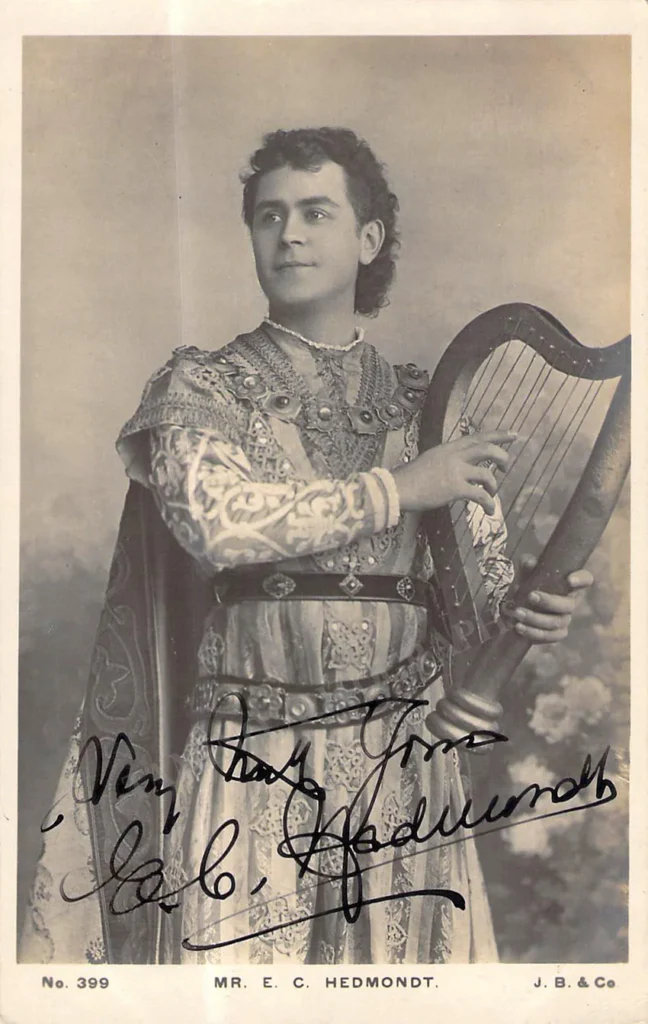
“483 PILGRIMAGES TO ROME – A TENOR WHO HAS BEEN CURSED MANY TIMES – “No,” said Mr. Hedmondt, “we’ll keep off that subject, if you please.” The subject was Wagnerian music. “Why, do you get enough Wagner as it is! I suppose you must,” said the writer. “For years and years I have been haunted by the vision of Wagner,” said Mr. Hedmondt. “He comes to me in my dreams. I think him. sing him, dream him. So you must see that it is hardly fair to ask me to enter into a discussion about his music, much as I admire it. “You must be a veritable haunted man?” suggested the writer. “I am,” said Mr. Hedmondt, a haunted man, and a man accursed. Four hundred and eighty three times have I been on a futile Pilgrimage to Rome; four hundred and eighty three times have I been cursed as never other man was cursed; four hundred and eighty three times have I been excommunicated; four hundred and eighty three times have I beheld the miracle of a barren stick sprouting into life and leaf. Oh, I am a much cursed man — and not a penny the worse for it.” “It is a fact,” the famous Wagnerian tenor proceeded, “that I played the part of “Tannhauser” on Monday night here in Hull for the 463rd time. I was the original “Tannhauser” as a matter of fact (though I don’t like to speak of myself in this way) in the English province. When I joined the Carl Rosa Company soma years ago I stipulated that if I came they were to produce “Tannhauser” on the provincial tour, and they did so.” “How long ago is that?” “It was in the Maria Rose and Durward Lely days. A curious thing happened in connection with my joining the company. The directors of the company had expressed a wish that I should give a trial performance with them in Birmingham as Jose in “Carmen.” I proceeded to the theatre, asked for the “star” tenor room, was shown to it, and began to disrobe for the part. As I was pulling off my boots, in walked a handsome young man, who asked me, “Is this the tenor dressing room?” I said it was, and he began to disrobe too. He asked me who I Was, and I asked who he was, and we found we were both dressing for the same part! It was Durward Lely. It turned out that the directors had forgotten to tell Mr Friend, the manager, of their arrangement with me, and that Lely’s name had got into the bills. So Lely had to play the part, and I had to put on my boots again. However, I was engaged without the trouble of a trial, and three months later I played “Tannhauser” for the first time in the provinces at Leeds.” Mr. Hedmondt is a Canadian; and, as a matter of interest, it m»y be said that his initials “E. C.” stand for Emmanuel Christian “I am proud to say,” he will tell you, “that I have Irish blood in my Veins.” Mr. Hedmondt has had a wide Continental experience. He is retained by the municipality of Leipsic as a permanent singer at the theatre. “You may assure my friends in England,” he says, “that if ever such a dreadful contingency should occur as the collapse of my voice, I shall be provided for, for the Leipsic arrangement brings to me a pension in case of such a disaster. Certain conditions have to be fulfilled, and one is that I have to return to Leipsic at stated intervals and sing as required by the management.” Mr. Hedmondt is married to a distinguished lady professor of singing at the Leipsic Conservatoire.” [Hull Daily Mail, Issue: 4954, Wednesday, Sept. 4, 1901]
9th – 14th Sept 1901 ???
| 16th – 21st Sep [1 week] Birmingham, Prince of Wales Theatre | |
| Mon 16th Sep 1901 | Tannhauser |
| Tue 17th Sep 1901 | Faust |
| Wed 18th Sep 1901 | Carmen |
| Thu 19th Sep 1901 (m) | Faust |
| Thu 19th Sep 1901 (e) | Cinq Mars |
| Fri 20th Sep 1901 | Lohengrin |
| Sat 21st Sep 1901 | Cinq Mars |
“I am glad to see the vigorous efforts now being made by the Directors of the Carl Rosa Company (says “Sketch”). Some of the works promised during the next campaign of the company are very ambitious. For example, “The Prophet” of Meyerbeer will be given in an English version. Many of the best native vocalists will take part in the performances. It is also gratifying to see Dr. Stanford’s “Much Ado About Nothing” announced, with, of course, English singers.” [Dundee Evening Telegraph, Friday, Issue: 7678, Sept. 20, 1901]
| 23rd – 28th Sep [1 week] Bradford, Royal Theatre (as mentioned in “Yorkshire Evening Post)” | |
30th Sept 1901 – 5th Oct 1901 ???
| 7th -12th Oct [1 week] Sheffield, Lyceum Theatre | |
| Mon 7th Oct 1901 | Tannhauser – Herr Julius Walther (Tannhauser), Mr. Arthur Deane (Wolfram), Mr. Alex Bevan (The Landgrave), Mr. Edward Davies (Walther), Mr H. Asprey Dick (Biterolf), A. Felton (Heinrich), Mr. Sydney Poyser (Reinmar), Miss Annie Walker (Shepherd Boy), Miss Winifred Ludlam (Venus), Miss Lucile Hill (Elizabeth); c. Mr. Eugene Goossens |
| “The Carl Rosa Company has gone through many vicissitudes. In a career extending over quarter of a century it is not surprising; but it survives to maintain the high traditions of grand opera The name, perhaps, has not quite the fascination that it once possessed in operatic circles; still it must be one to conjure with when artistes are able to give such a representation of “Tannhauser” as that which thrilled the audience at the Lyceum Theatre last night. Theatre-goers in Sheffield have had grand opera in a flood of late. There is no call for comparison when the operatic stage is illumined by so much brilliancy. Let it suffice to say that it is a long time since the Carl Rosa gave such a fine performance of Wagner’s work. It suggested the palmy days of old, and stimulated the audience to a pitch of enthusiasm that augurs web for a successful visit. The principal characters were taken as follows:— Tannhauser, Herr Julius Walther; Wolfram, Mr. Arthur Deane; The Landgrave, Mr. Alex Bevan; Walther, Mr. Edward Davies; Biterolf; Mr. H. Asprey Dick; Henrich, Mr. A. Felton; Reinmar, Mr. Sydney Poyser; the Shepherd Boy, Miss Annie Walker; Venus, Miss Winifred Ludlam; Elizabeth Miss Lucile Hill. The performance had a magnificent prelude in the overture, which was played with excellent precision and expression. It is rarely an audience is influenced so early, but Wagner speedily laid hold of the imagination through the augmented band, conducted by Mr. Eugene Goossens, and there was a decided inclination to encore. But the curtain ascended, revealing Venus and Tannhauser in the grotto, and on went the flowing melody, while dancers marked the rhythm. There is no necessity to dwell on the mythical story. In the parts of Venus and Tannhauser Miss Winifred Ludlam and Herr Julius Walther gave the work a brilliant opening. Pathos and passion found expression in the voice of the former, who sang with rare dramatic power. The solo and chorus singing throughout the scene was of a high standard; indeed, it was the same throughout, the principals especially being well chosen. Miss Lucile Hill’s Elizabeth was an artistic performance. She has not perhaps the dramatic strength sometimes associated with the part; but any deficiency in this direction was last night more than atoned for by vocal efforts. She has a soprano voice, rich and mellow, with a flexibility that increased the charm of her singing. She sang the “Hall of Song” with the joyous emotion that moved the audience to give unmistakable signs of approval. In the closing scene of the tournament of song, her passionate appeals for Tannhauser found vent in vocal music both pathetic and sweet, and her appeal to the Virgin in the final act, was a fitting finale to an artistic performance. Her Julius Walther maintained his reputation as Tannhauser. The impassioned music in the Halls of * Venus and the tournament of song was effectively rendered. But his best performance was as the heart-broken, unforgiven pilgrim from Rome in the last act, when he concludes his plaintive strain with an exultant appeal to Venus. It was a triumphant effort, and was recognised as such by an appreciative audience. Mr. Arthur Deane was in excellent voice, and did not allow the music allotted to Wolfram to suffer, while the other characters were allotted to capable artistes. There were times when the choral body appeared to lack a little power, but the chorus came out well in the Hall of Song, particularly the male voices in the finale. Altogether, it was a fine performance of “Tannhauser,” and opera is still safe in the hands of the Carl Rosa Company.” [Sheffield Daily Telegraph, Issue: 14428, Tuesday, Oct. 8, 1901] | |
| Tue 8th Oct 1901 | Carmen – Mr. E. C. Hedmondt (Don Jose), Miss Lizzie Burgess (Michaela), Mr. Arthur Deane (Escamillo), Mr. Gilbert Davies (Dancairo), Mr. Edward Davies (Remendado), Mr. Sydney Poyser (Zuniga), Mr A. Felton (Lillas Pastia), Mr. H. Asprey Dick (Morales), Miss Stone Humphries (Mercedes), Miss Florence Lelgarde (Frasquita), Miss Georgina Delmar (Carmen); c. Mr Walter van Noorden |
| “It cannot be said that undue public appreciation is being accorded to the Royal Carl Rosa Opera Company, which this week occupies the boards of the Lyceum Theatre. Last night again there were a large number of vacant seats, and the performance certainly merited a larger audience. The opera was Bizet’s famous “Carmen,” and the company gave a rendering of it worthy to be long remembered. In all respects it was completely successful — in principals, in chorus, in orchestra, and in stage setting. The four chief characters were in the hands of an accomplished quartette. Miss Georgina Delmar who appeared as Carmen, was notable for singing and acting alike; the singing displayed to its full power an admirable voice, while the acting was fully in keeping with the coquettish character of the gipsy. Miss Lizzie Burgess, as Michaela, realised the simplicity of the steadfast nature which is such an effective foil to the more fiery part of Carmen, and sang delightfully in that clear voice which has been admired in Sheffield before. Mr. E. C. Hedmondt, who is no stranger to local opera patrons, ably filled the exacting part of Don Jose, and, in the last act, added to fine vocalisation powerful acting. Mr. Arthur Deane was equally successful as Escamillo, and the other characters were also capitally taken. A special word of praise is due to the work of the orchestra, under the conductorship of Mr. Walter Van Noorden.” [Sheffield Daily Telegraph, Issue: 14429, Wednesday, Oct. 9, 1901] / “It is ail very well for a place to call itself musical and to take pride in the term, but when given the opportunity of witnessing and hearing some of the gems of true opera it deliberately turns its back upon the occasion, one is not unnaturally tempted to call into question the right of title. The performance of Bizet’s “Carmen” at the Lyceum Theatre last night, was as replete an interpretation of operatic work as the most captious critic could long for — the brilliance of the work all round in third act could not have been surpassed — yet as the reward of their labours the artistes have to look back upon vacant places, a half-filled house. One could have forgiven the talented performers if the scantiness of the patronage accorded had produced a not inexcusable reflection in the shape of spirited interpretation, yet such was not at all the case, and every member of the Carl Rosa Company is still the Car! Rosa company, for the old spirit is by no means dead or decaying — entered with remarkable thoroughness into the work that fell to their lot. The enthusiasm of the minority went some way towards compensating for the apathy of the majority, yet it in no way explained the same, and Sheffield will have to produce more tangible evidence than has in recent times all too often been forthcoming, to demonstrate that the title of “musical” is not entirely a misnomer. Much could be forgiven were the occasion an isolated one, which unhappily it is not. We have said the performance was of the most artistic description. Additional interest centred on it by reason of the first appearance in Sheffield in the title role of “Mdlle.” Georgina Delmar – though why she should hide her nationality under a prefix one knows not. “Mdlle” Delmar is of English birth and of English training, and after her successful performance last night she has no reason to be ashamed of the fact being freely known. The moreso as an English “Carmen” must necessarily be more than usually interesting, whilst the part is one which occupies such a noticeable position in the range of operatic character by reason of its individuality. “Mdlle.” Delmar has necessarily own interpretation to show, and she must be said to be a really successful “Carmen.” It is hardly necessary to say that Mr. Hedmondt was brilliant as Don Jose or that Mr. Arthur Deane again rose to every occasion in the part of Escamillo, and Miss Lizzie Burgess secured the warmest appreciation by her tuneful singing as Michaela. Under the skillful baton of Mr. Walter Van Noorden, the orchestra responded finely to every demand, and it is no exaggeration to say that a more successful performance of the opera could hardly have beer achieved – a comment which may be specially commended to the music lovers of the city.” [Sheffield Evening Telegraph, Issue: 4464, Wednesday, Oct. 9, 1901] | |
| Wed 9th Oct 1901 | The Bohemian Girl – Robert Cunningham, Lizzie Burgess |
| “The Carl Rosa Opera Company produced Balfe’s masterpiece at the Lyceum Theatre, Sheffield, last night, to an audience large in numbers and enthusiastic in its demonstrations of approval of the performance. The melodic fluency of the of the music and the vivacity of the general details ‘ have endowed “The Bohemian Girl” with a popularity which of a certainty will endure for long years ‘ to come. Last night’s performance was fully deserving of all the appreciation bestowed upon it Under the baton of Mr. Walter van Noorden, the orchestra played the overture in faultless style, and were equally successful in the rendering of the subsequent music- The chorus was unmistakably well balanced, and, with few exceptions, all the concerted numbers were given with an invigorating briskness. Every praise is due to the principals. The chief I honours rest with Miss Lizzie Burgess, who gave a charming representation of Arline. Her singing of “I dreamt that I dwelt” was received with a storm of applause, and an encore was graciously accorded. As the Gipsy Queen, Miss Winifred Ludlam was hardly lees successful;. In “Love smiles but to deceive,” she scored as well as Miss Ludlam, and her performance throughout was of a most capable character. Mr. Robert Cunningham took the part of Thaddeus. He was in excellent voice, and frequently received tokens of appreciation. Mr. Alex. Bevan, who took the part of Devilshoof, was suffering from a cold, but in his acting he imparted all the hilarity which the c, haracter demands. Mr. Haigh Jackson came off creditably as Count Arnheim, and as Florestein Mr. Edward Davies gave a praiseworthy performance.” [Sheffield Evening Telegraph, Issue: 4465, Thursday, Oct. 10, 1901] | |
| Thu 10th Oct 1901 | Faust – Julius Walther, Lizzie Burgess, Mr. Alex. Bevan, Mr. Arthur Deane, Mdlle. Georgina Delmar, Miss Douglas Wilson; c. Eugene Goossens |
| “A marked improvement was shown in the appreciation of the Carl Rosa Company at the Lyceum Theatre, Sheffield, last night. During the week the company has produced grand opera in an elaborate manner, but it is doubtful if any performance has reached the standard which was attained last night when Gounod’s “Faust” was staged. Principals, chorus, and orchestra were all at their best, and the audience were ever ready to demonstrate their enjoyment. Under the baton of Mr. Eugene Goossens the orchestra brought out to the full the impressive character of the music. The choral numbers, without exception, were rendered with a precision only to be attained by a faultless body oi vocalists. Miss Lizzie Burgess, in the character of Marguerite, took first honours. The florid character of the Jewel Song was maintained throughout, and at the conclusion, in addition to receiving enthusiastic plaudits, Miss Burgess was also presented with a handsome bouquet. The name part was brilliantly sustained by Herr Julius Walther, whose rich tenor voice delighted all his hearers. Mr. Alex. Bevan was as successful in the character of Mephistopheles, and was loudly applauded. The part of Valentine was taken by Mr. Arthur Deane, who has a magnificent voice. His acting also, particularly at the conclusion of the fourth act, was of a powerful nature, and he certainly scored one of the greatest successes. Mdlle. Georgina Delmar gave a worthy representation of Siebel, and the minor part of Martha was capably filled by Miss Douglas Wilson. Mention should be made of the success achieved in the Soldiers’ Chorus, which was enthusiastically encored.” [Sheffield Daily Telegraph, Issue: 14431, Friday, Oct. 11, 1901] | |
| Fri 11th Oct 1901 | Cinq Mars – Julius Walther, Lucile Hill, Mr. Arthur Deane, Winifred Ludlum, Alex Bvan, c.Mr.Walter Van Noorden |
| “The Carl Rosa Company are to be congratulated on having given “Cinq Mars” a permanent place in their programme. They produced it, for the first time in the city, on the occasion of their last visit to Sheffield. It was then favourably received. Their second performance was even more brilliant, and no audience could have shown a higher appreciation of opera than that at the Lyceum Theatre last night. The principals were repeatedly called before the curtain, and a tumult of applause followed the final duet, so tragic in theme, with which the opera closes. Gounod’s “Cinq Mars” has not attained the same place as “Faust;” the subject has not perhaps appealed to the genius of the composer so strongly in the former work; but there is no denying that it has a musical grandeur when performed by capable artistes. The rich melody flowing through some of the choral parts for the male voices found full vent through a well-trained chorus, and the solos and concerted pieces were given with great charm by the principals. Some of the scenes are illuminated by brilliant orchestration, and here praise should be given to the instrumentalists. Mr. Walter Van Noorden, the conductor, had a ready response to his demands upon the orchestra. The band gave a colour to the instrumental work which in no small degree contributed to the success of the performance. Reference has already been made to the excellence of Herr Julius Walther’s tenor voice. Last night he appeared as the Marquis of Cinq Mars in a way which could only tend to enhance his reputation. In the love duet at the close of the first act, both he and Miss Lucile Hill, who took the part of Princess Marie, gave charming expression to the passionate music, and throughout the tenor and soprano numbers were admirably rendered. Mr. Arthur Deane has not been more successful in any character this week than as the Comte de Thou, and although the audience would have had many of the solo and chorus parts repeated, had encores been permitted, there was no denying a repetition of the recitative and air at the opening of the fourth act, in which De Thou valiantly pledges his friendship to Cinq Mars. It was an artistic effort on the part of Mr. Deane, which was highly appreciated. Miss Annie Ludlam again demonstrated her vocal ability as Marion, and Mr. Alex. Bevan displayed a rich bass voice in the part of Father Joseph. The passionate trio between Cinq Mars, Marie, and Father Joseph, in which the two lovers defy the Cardinal, the pastoral music, and the chorus of the conspirators, which gives a brilliant finale to the second act, were among the gems of a brilliant performance.” [Sheffield Daily Telegraph, Issue: 14432, Saturday, Oct. 12, 1901] / “If the audience at the Lyceum Theatre last night , was not quite so large as it might have been, and it was not by any means of small proportions, more lavish appreciation could not have been bestowed on any performance than the rendering of Gounod’s romantic opera, “Cinq Mars,” produced. A finer interpretation of an operatic work it would be hardly possible to secure, and as long as Sheffield is honoured by a visit from the accomplished Carl Rosa company it is ‘ sincerely to be hoped that ” Cinq Mars” will not be omitted from the repertoire. In ” Cinq Mars” a wealth of beauteous sound has flown from Gounod’s harmonious pen, and the fact that it was in Sheffield that the second production of the opera in this country took place, just under a year ago, ought to render it additionally attractive to the musical enthusiasts of the city. As “Cinq Mars” becomes better known so must it increase in the public favour, whilst so long as the Carl Rosa Company can give such a brilliant exposition of opera as was forthcoming last night, so must they retain the hold they enjoyed in days long since gone on public patronage. The most enlightened connoisseur must have sat enthralled as the wonderful stream of melody continued its unbroken course, and it falls to the lot of few artistes or combination of artistes to secure such rapturous approval as that in which last night’s performance was consummated. The outstanding feature of the present Carl Rosa combination is its general level of excellence, and all round nothing but the highest praise can be given. Here Julius Walther as the Marquis de Cinq Mars gave a wonderful display of vocalism — his pure and perfectly trained voice being heard with magnificent results. Mr. Arthur Deane, who was associated with Herr Walther in the triumph of the night, is altogether a favourite. His rich baritone is always a source of delight, and he it was who had to do what on other occasions was necessarily denied — namely, respond to an encore. In the duet at the termination of which the opera reaches its tragic finale, the two singers achieved an effect that only those who were present can altogether appreciate. Miss Lucile Hill was thoroughly successful as the Princess Marie, Miss Winifred Ludlam sang tunefully as Marion, and in the thankless work that falls to the lot of Father Joseph, Mr. Alex. Bevan scored distinctly. The chorus was at its best, the “Conspiracy” chorus in the third act being given in magnificent fashion, and enthusiastically cheered. To the orchestra fell an immense amount of work, which could not be passed over. Their task was executed with splendid precision and taste. The instrumentalists have in “Cinq Mars” almost unusual scope, and they responded to the occasion in most artistic style. The captivating ballet music in the third act was delightfully played, and Mr. Van Noorden — to whom it should be added we are indebted for the English translation of the “story” — is deserving of the heartiest congratulations upon the pitch of perfection at which he has his instrumentalists.” [Sheffield Evening Telegraph, Issue: 4467, Saturday, Oct. 12, 1901] | |
| Sat 12th Oct 1901 (m) | Lohengrin – Mr E. C. Hedmondt (Lohenfrin), Mr. Alex Beva (Henry the Fowler), Mr. Haigh Jackson (Frederick of Telramund), Mr. H. Asprey Dick (Herald), Miss Winifred Ludlum (Ortrude), Miss Lucile Hill (Elsa); c. Mr. Eugene Goosens |
| Sat 12th Oct 1901 (e) | Maritana – Mr. Robert Cunningham (Don Caesar de Bazan), Mr. Haigh Jackson (Don Jose), Mr. Sydney Poyser (King of Spain), Miss Georgina Delmar (Lazarillo), Miss Lizzie Burgess (Maritana); c. Mr. Isidore de Solla |
| “The Royal Carl Rosa Opera Company brought their week’s engagement at the Lyceum Theatre, Sheffield, to a very successful conclusion on Saturday. The afternoon opera, “Lohengrin,” drew a very good house, and the representation given was fine in every respect. Mr. E. C. Hedmondt, in the character of the stainless knight, sang beautifully, and Miss Lucile Hill was a very fine Elsa. High praise must be given to Miss Winifred Ludlam as Ortrude, and to Mr. Arthur Deane, whose rendering of the music allotted to the herald was one of the features of the performance. The other characters were in the hands of Mr. Alex. Bevan (Henry) and Mr. Haigh Jackson (Frederick of Telramund), and both artistes fully maintained their reputations. The chorus, and the orchestra, under the conductorship of Mr. Eugene Goosens, also reached a high pitch of excellence. Lighter opera was given in the evening, when “Maritana” was performed. The house was the best of the week, the circle being the only part in which vacant seats were to be seen. The performance of Wallace’s joyous, tuneful music was admirable. Mr. Robert Cunningham, as Don Caesar de Bazan; Mr. Haigh Jackson, as Don Jose; Mdlle. Georgina Delmar, as Lazarillo; and Miss Lizzie Burgess, as Maritana. were among the members of the caste. Mr. Isidore de Solla was the conductor.” [Sheffield Daily Telegraph, Issue: 14433, Monday, Oct. 14, 1901] |
| 14th – 19th Oct [1 week] Manchester, Queens Theatre | |
| Mon 14th Oct | Tannhauser – Julius Walther (Tannhauser – first appearance in Manchester in this role), Lizzie Burgess, Annie Walker, Winifred Ludlam, Arthur Deane, Alex Bevan; c. Eugene Goosens |
| “ROYAL CARL ROSA OPERA COMPANY – “TANNHAUSER” AT THE QUEEN’S – Yesterday the Royal Carl Rosa Opera Company began their week at the Queen’s Theatre with a performance of “Tannhauser.” There was a fairly strong east, the best impersonations being those of Wolfram (Mr. Arthur Deane) and Tannhauser (Herr Julius Walther). Unfortunately, Miss Lucille Hill was prevented by a severe cold from assuming the part of Elisabeth, and Miss Lizzie Burgess acted as substitute. Making due allowance for this circumstance, she acquitted herself well, but was obviously acting at a disadvantage. Miss Winifred Ludlam was the Venus, and in the long duet with Tannhauser in Act I gave a very satisfactory rendering of the part. Of the less important characters, Miss Annie Walker sang very sweetly as the shepherd boy, and Mr. Bevan’s Landgrave was admirable. Owing to a little delay at starting, and intervals of unnecessary length, amongst other things, the action appeared to drag somewhat, and far better representations have been given by the company on previous occasions. Under the baton of Mr. Goossens, whose abilities in this direction have never been questioned, the band roused something like enthusiasm by their performance of the overture, and elsewhere gave proofs of having been well trained. There was a fair attendance, and the efforts of the performers were duly recognised.” [Manchester Courier and Lancashire General Advertiser, Tuesday, Volume: 77, Issue: 14020, Oct. 15, 1901] | |
| Tue 15th Oct | Carmen – Miss Georgina Delmar, Mr. Hedmondt, Mr. Deane, Miss Lizzie Burgess, Misses Stone Humphrey and Florence Lelgarde, Mr. Gilbert Davies, Mr. Edward Davies; c.Mr. Walter van Noorden |
| “CARMEN – Last evening Bizet’s ever-popular opera was staged at the Queen’s Theatre, and attracted a much larger audience than did “Tannhauser on Monday. It would be futile to waste time in reminiscences of Carmens, Joses, Michaelas and Escamillos. No doubt many of those present could point to a sure favourite who, years ago, fulfilled their ideals of those characters, and have waited in vain for their successors to appear, but our concern is only with the present. Briefly, it may be said that Miss Georgina Delmar as Carmen lacks fire. A pretended gipsy n would have no chance of carrying out her disguise unless assisted by a gipsy-like demeanour, and this quality Miss Delmar did not exhibit. In other respects, however, she achieved success, and in common with the rest of the company, improved as the action proceeded. Mr. Hedmondt as Don Jose showed that he still remains a favourite with Manchester audiences, and Mr. Deane’s Escamillo won him well deserved applause the Toreador song being encored, as usual. Miss Lizzie Burgess’s principal effort is, of course, the celebrated song in act III “I said nought should frighten me here,” and this proved one of the chief successes of the evening. Frasquita and Mercedes (Misses Stone Humphrey and Florence Lelgarde) assisted Carmen, Dancairo (Mr. Gilbert Davies), and Remendado (Mr. Edward Davies), in making the quintets pass off with eclat, and the band and chorus, under the conductorship of Mr. Walter van Noorden, worked with ability and energy. The principal scenes roused the audience to enthusiasm and if the remaining performances are equally well received the company will have no reason to regret its return to Manchester after a long absence. The introduction of ballet dancing is, however, hardly a move in the right direction.” [Manchester Courier and Lancashire General Advertiser, Volume: 77, Issue: 14021, Wednesday, Oct. 16, 1901] | |
| Wed 16th Oct | Cinq Mars |
| “About three-quarters of a century ago the Comte de Yigny, a celebrated writer of the period, wrote a historical romance dealing with a touching episode in the reign of Louis XIII., of France. Years afterwards the subject was worked up into an opera by MM. Poisson and Gallet and set to music by Gounod, but his reputation would not have suffered if he had left it alone. After lying in neglect in France for a long interval, it was resuscitated last year by the Carl Rosa Company, at Leeds, an English version having been provided by Mr. Walter van Noorden, then, as now, one of the company’s two conductors. Except that Poisson and Gallet did not write a poem, as implied on the title-page of the book of words, and that the word “tableau” at the end of a French play looks a little odd when translated “Picture,” there is little to object to in Mr. Van Noorden’s version, but not all the art of the Carl Rosa or any other company can infuse life into what is an extremely dull and ineffective adaptation of the original romance. So far as there is any plot at all it works out as follows: Cinq Mars is in love with Princess Marie de Gonzague, but the great Cardinal Richelieu objects to the match, and even forbids it. The hero thereupon conspires against the Cardinal, and is joined by De Thou, a friend who, from disinterested but misguided motives, throws in his lot with the conspirators. Father Joseph, Richelieu’s agent, gets wind of the plot, and takes measures accordingly. Cinq Mars and his friend are ultimately led off to execution, Mario meanwhile having been induced by Father Joseph to give up her lover on the understanding that his life would be spared as the reward of her renunciation. Of the characters in this structureless and incoherent opera Miss Lucile Hill (Princess Marie) sang very well, the cantilena “Night pure and resplendent ” being her chief success, and she was well supported by Miss Burgess as Marion Delorme, whose cadenza at the end of the passage “Sweet Shepherds, ye who wish to enter” was admirably done. The shepherd’s sonnet, in the Italian style, which followed shortly afterwards, has the merit of tunefulness, like most of the music, but it does not represent Gounod at his best. It was well sung by Miss Georgina Delmar, who, with several other artistes present last night, farmed part of the original cast at Leeds. Mr. Arthur Deane was loudly applauded for a recitative and cantabile in Act 4. which was encored, and finally Herr Julius Walther, as Cinq Mars, made several hits, notably in his interview with Marie and Father Joseph (Mr. Alex. Bevan) in Act II, and with the conspirators in Act III. Subsequently, however, he grew slightly hoarse, though not thereby marring the cavatina in Act V. A special word of praise is due to the chorus, and also to the band, who, under Mr. Van Noorden, rendered most valuable assistance to the soloists.” [Manchester Courier and Lancashire General Advertiser, Volume: 77, Issue: 14022, Thursday, Oct. 17, 1901] | |
| Thu 17th Oct | The Bohemian Girl – Miss Lizzie Burgess, Miss Florence Lelgarde, Miss Winifred Ludlam, Mr. R. Cunningham, Mr. Haigh Jackson, Mr. Edward Davies, Mr. Arthur Winckworth. |
| “Yesterday the Carl Rosa Company fell back upon an opera which survives rather by the influence of certain popular airs than for any dramatic or literary merits it possesses, but this is a question to be settled between the public and the opera managers. Yesterday, as on previous evenings, the action improved with the course of the play, and the old favourites were received with the same appreciation as of yore. The cast included Miss Lizzie Burgess as the grown-up Arline, Miss Florence Lelgarde as her attendant, Buda, and Miss Winifred Ludlam as the Gipsy Queen. Of the male characters, Thaddeus was impersonated by Mr. R. Cunningham, Count Arnheim by Mr. Haigh Jackson, Florestein by Mr. Edward Davies, and Devilshoof by Mr. Arthur Winckworth. All these were sources of strength to the company, and it is hardly necessary to add that “I Dreamt That I Dwelt.” ‘”The Heart Bow’d Down.” “When Other Lips.” and the Gipsy Queen’s song, “Love Smiles but to Deceive.” were welcomed with heartiness. The chorus were heard to advantage from the outset, and with the general performance there was little fault to find. To-night the company essay a far more difficult task nothing less, in fact, than “Siegfried,” the third drama in Wagner’s great tetralogy. The performance will begin at 7, instead of the usual hour.” [Manchester Courier and Lancashire General Advertiser, Volume: 77, Issue: 14023, Friday, Oct. 18, 1901] | |
| Fri 18th Oct | Siegfried (Special Production) – E. C. Hedmondt, Lucile Hill, Mr. Bevan, Mr. Seph Jones, Mr. Poyser; c. Eugene Goossens |
| “Last evening the Carl Rosa Company undertook the most ambitious venture in their repertory, Wagner’s “Siegfried.” The opera is not quite new to Manchester, since it was given at the Prince’s Theatre, some years ago, by the same company, but during the interval the public appreciation of Wagner’s later works has been steadily growing, and their revival is an event of great popular interest. “Tristan and Isolde” stands on a somewhat difficult footing from the Nibelung series, in that, it is self-contained, but “Siegfried” to be understood aright, must be viewed in its proper connection. It is the third in order of sequence of the Tetralogy, and has been called the “Scherzo” of the Nibelung symphony, though it is more intimately bound up with the “Rhine-gold,” the “Valkyries.” and the “Twilight of the Gods” than this term would necessarily imply, the gods of the Eddas are not immortal, but their destiny is ruled by inexorable Fate, and in “Siegfried” we have more than one hint of their approaching doom. Siegfried i= the grandson of Wotan, the Jupiter Jupiter of the Norse Pantheon, and is fittingly endowed with dauntless courage. He has been rescued by Mime, a dwarf of the Nibelung race of whom Alberich is King, and on reaching mans estate, defies the authority of his foster-parent, and forces the latter to confess that the relationship is of no closer kind than this. He also treats with contempt Mime’s skill as a smith, and smashes to pieces a sword which the dwarf has forged for him out of the sword which once belonged to his father, Siegmund, and has been shivered by contact with Wotan’s spear, he himself fashions a new weapon, and subsequently destroys the same spear with it, though held in Wotan’s hands meanwhile. This is, in a sense, the beginning of the end, though much remains to be accomplished before the “twilight of the gods” turns into endless night. Siegfried slays the giant, Fafner, now transformed into a dragon, the better to guard his treasures, viz., the Ring and the Cap of Invisibility. In the combat, the blood of the “worm” spurts upon his arm, and the instinctive action of putting his tongue to what seems to be a wound causes him to understand the language of birds. One of them acts as his guardian angel, telling him where the Ring and Cap are to be found, and warning him of the intentions of Mime, who thinks to poison him by a lethal draught of wine. ‘ Still guided by the bird, he hastens to the rampart, where Brunnhilde, chief of the Valkyries, lies in a deep sleep, guarded by a ring of flames, the punishment of disobedience to Wotan’s commands with regard to the succour of Siegmund in the previous drama. With the awakening of Brunnhilde – who had prevailed upon Wotan so far as to obtain a promise that she should never be discovered except by a hero — and the kindling of a mutual passion at the incident, the curtain is rung down. To those who have witnessed elaborate performances of “Siegfried,” either at the headquarters of the Wagner cult at Bayreuth. or at Covent Garden, last night’s representation appeared wanting in many of the essentials of success. But, judging it from the standpoint of a travelling company, charging popular, not fancy prices for admission, and eschewing the “star” system, and the verdict will be altogether different. Mr. Hedmondt appeared in the title role, and was the mainstay of the action. As the youthful Seigfried, overflowing with animal spirits and thirsting after mighty deeds, he presented a very attractive figure, and his voice, though put to a severe and very prolonged test, bore the strain extremely well and frequently recalled his many successes in past years. Mr. Bevan, as Wotan, looked dignified and imposing, and, next to Mr. Hedmondt, carried off the chief honours of the evening. His voice, however, was slightly marred by a “vibrato.” Mr. Seph Jones, as Mime, had also an arduous task, most of which was accomplished in excellent style, though it was not all on the same level. Thus he was more successful in his dialogue with Siegfried than with Wotan or Alberich, but none the less came in for hearty rounds of applause along with both these characters. Mr. Sydney had the rather thankless task of infusing speech and intelligence into a fearsome dragon whose dentition does not agree with thant of any known reptile and whose eyes were formed, not for the purpose of perceiving light, but of giving it. The King of the dwarfs looked as if he had stepped out from one of Mr. E. T. Reed’s “Prehistoric Peeps” in “Punch,” and, like Mr. Poyser, acted his part with great vigour. Miss Lucile Hill was an admirable Brunhilde, but unfortunately her appearance on scene is so late that o many of the audience were unable to do more than listen to the wondrous fire music without without waiting for her dialogue with Siegfried. Erda, the earth goddess, gave Miss Stone Humphries an opportunity of which she made good use. The band was far from perfect but was very capably led by -Mr. Goossens, and the flaws were not prominent. There was a large and enthusiastic audience.” [Manchester Courier and Lancashire General Advertiser, Volume: 77, Issue: 14024, Saturday, Oct. 19, 1901] / “A RUSH UPON “SIEGFRIED” – The Moody Manners Opera Company recently revived “Siegfried,” the third part of Wagner’s Tetralogy, playing it in Birmingham, Glasgow, and elsewhere; last week the Carl Rosa Company put on an elaborate production of the opera at Manchester, with Mr. Hedmondt as Siegfried and Miss Lucille Hill as Brunnhilde; and now Herr Julius Walther, who is forming a new opera company composed mainly of German and American vocalists to tour the English provinces next year, has determined to make “Siegfried” one of his chief attractions. It will not be the fault of these three companies if Wagner is neglected by the provincials, for the repertoire of each troop includes at least three Wagner performances per week. Herr Walther is even ambitious to do the whole Nibelungen Ring — an achievement in which, being German and very Wagnerian, he is not unlikely to succeed. The Moody-Manners Company have already attempted at Manchester the experiment of an entire Wagner week.” [Dundee Evening Telegraph, Thursday, Issue: 7707, Oct. 24, 1901] / “Siegfried,” which is promised for the Prince’s Theatre, Bristol, was performed by the Carl Rosa Troupe at Manchester, it is said with Wagner’s original orchestration, which is often much altered in the provinces.” [Western Daily Press, Volume: 87, Issue: 13533, Monday, Oct. 21, 1901] | |
| Sat 19th Oct (m) | Cinq Mars |
| Sat 19th Oct (e) | Faust |
| 21st – 26th Oct [1 week] Stoke Newington, Alexandra Theatre | |
| Mon 21st Oct 1901 | ?? |
| Tue 22nd Oct 1901 | ?? |
| Wed 23rd Oct 1901 | ?? |
| Thu 24th Oct 1901 | ?? |
| Fri 25th Oct 1901 | ?? |
| Sat 26th Oct 1901 | “SCENE AT A LONDON THEATRE – On Saturday evening there was a serious disturbance at the Alexandra Theatre, Stoke Newington. Owing to the increased demand for seats on account of the engagement of the Carl Rosa Opera Company, three additional rows of seats had been added to the stalls. This action of the proprietor aroused the ire of the patrons of the pit-stalls, who raided and successfully took possession of the seats they were in the habit of occupying. The services of an inspector and a squad of constables from the neighbouring police station were requisitioned, but the intruders refused to budge, and ultimately had to be left in peace.” [Derby Daily Telegraph, Volume: 45 , Issue: 6849, Monday, Oct. 28, 1901] / “The Carl Rosa Company had a strange experience on Saturday night at Stoke Newington, when the “pittites” seized the orchestra stalls before those who had “booked” the seats arrived. The boxes had to be utilised for those whose seats had been so unceremoniously occupied.” [Hull Daily Mail, Issue: 5001, Monday, Oct. 28, 1901] |
| 28th Oct – 2nd Nov [1 week] Notting Hill, Coronet Theatre | |
| Mon 28th Oct 1901 | ?? |
| Tue 29th Oct 1901 | ?? |
| Wed 30th Oct 1901 | ?? |
| Thu 31st Oct 1901 | ?? |
| Fri 1st Nov 1901 | Siegfreid – E. C. Hedmondt |
| “Siegfried” in the Suburbs — The experiment of giving Wagner’s “Siegfried” in English in the suburbs of London was tried by the Carl Rosa Opera Company at the Coronet Theatre. Notting Hill, last night, Mr E. C. Hedmondt appearing as Siegfried with success.” [Edinburgh Evening News, Issue: 8903, Saturday, Nov. 2, 1901] | |
| Sat 2nd Nov 1901 | ?? |
| 4th- 9th Nov [1 week] Bristol, Prince’s Theatre | |
| Mon Nov 4th 1901 | Tannhauser – Julius Walther, Lucile Hill, Winifred Ludlam, Arthur Deane, Alex Bevan, Annie Walker; c. Eugene Goossens |
| “The Prince’s Theatre — The Carl Rosa Opera Company to-night start a week’s engagement at the Prince’s Theatre with Wagner’s famous opera – “Tannhauser.” Particular request is made that the audience should be in their seats by 7.30, so that the world-renowned overture may not be marred by late arrivals. To-morrow night “Faust” will be presented, and the remainder of the week’s programme will be found in our advertising columns.” [Western Daily Press, Monday, Volume: 87, Issue: 13545, Nov. 4, 1901] / “TANHAUSER – lovers of grand opera look forward every year to the coming of the Carl Rosa Company, and in particular to the performance of “Tannhauser” It is some ten years ago that “Tannhauser” was first produced in this city, and it was then presented by the same company, the part of Tannhauser being given a memorable rendering by Mr. E. C. Hedmondt. He is here this week, but last night did not act, his place befog taken by Herr Julius Walther. Naturally there was a fine attendance; the beauty and dignity of the most famous of Wagner’s operas have won their way to the appreciation even of persons whose love of Wagner is an acquired taste, and aver since the memorable performance of which we have spoken, Bristol audiences have felt assured that a Carl Rosa rendering would not be lacking in the “high seriousness” due to the great work in which Wagner mirrored the conduct between the impulse that tends to gross passion and the ennobling influence of religions faith. Particular interest attached to the appearance of Herr Julius Walther as Tannhauser. His success in the London season of she company was complete, and he has been regarded by the highest critics as an operatic singer of very exceptional ability. In this special part of Tannhauser, with its exacting demands upon its exponent, his marvellous voice could not have been heard to more advantage. And he is not only a fine singer, he is a good actor, too. This is a very rare combination in operatic art nowadays. There were many in last night’s audience who were mentally comparing Herr Walther’s Tannhauser with that of Mr. Hedmondt, or with the last performance in this city by Mr Manners. Herr Julius Walther has a voice of wonderful calibre and infinite delicacy that his singing and his acting, delivered with the excellent judgment he displays, made his performance last night not only memorable, but create a standard of operatic art that will seldom he reached. His acting was of a distinctly dramatic character, and in the last act was an artistic achievement, the artist being apparently carried away by the emotional part. Turning to the part of Elizabeth, played last night by Miss Lucile Hill, unstinted praise must again be given. Elizabeth has been played by many talented singers at the Prince’s Theatre, but Miss Hill gave such a refined and tender grace to it that her performance ranks with the very best. Elisabeth’s Prayer was beautifully sung by her, as, indeed, were all the other numbers. Miss Winifred Ludlam, who was allotted the Venus music, sang everything that was required of her in good style. The Wolfram of Mr Arthur Deane was also a very fine performance, his song, “Star of Eve,” being particularly applauded. Mr Alex. Bevan, who played The Landgrave, was dignified, and a good word should be said for Miss Walker’s Shepherd Boy. The Carl Rosa chorus showed, as usual, signs of splendid training and management, and in the Hall scene were greatly applauded. Mr Eugene Goossens, who conducted the opera, added a certain finish to the performance, and the band played magnificently, both in the overture and all through the trying music, the harp being especially good.” [Western Daily Press, Tuesday, Volume: 87, Issue: 13546, Nov. 5, 1901] | |
| Tue Nov 5th 1901 | Faust – E. C. Hedmondt (Faust), Alex Bevan [as advertised] OR Arthur Winckworth (Mephistopheles) [one reviewer credits the role to Arthur Winckworth on this occasion], Haigh Jackson (Valentine), Georgina Delmar (Siebel), Miss Douglas Wilson (Matha), Miss Lizzie Burgess (Marguerite) |
| “”FAUST” AT THE PRINCE’S THEATRE – Gounod’s operatic version it the Faust legend has been heard many times in Bristol, for so sure is it of drawing a big attendance that rarely does the Carl Rosa or other grand opera company visit the city without including the French composer’s masterpiece in the list of operas presented. Last night proved no exception, for the audience was both large and fashionable, and the opera throughout was followed with the closest interest, and was received with great enthusiasm. Those present last evening were fortunate in finding so capable an artist as Mr. E. C. Hedmondt in the title role. Both in voice and in the dramatic power displayed his efforts were of a very high standard. What been been said of Mr. Hedmondt applies quite as much also to the Marguerite of Miss Lucile Hill, who was in capital voice, and played with great sympathy and intensity. The “Jewel Song” was given with charming effect, and later on in the same act, when Miss Hill was associated with Mr. Hedmondt in the love passages, the audience were treated to some fine vocalisation. Of a contrasting kind, but also greatly effective, were their efforts in the prison scene, and at the fail of the curtain Miss Hill, Mr. Hedmondt, and Mr. Arthur Winckworth were recalled again and again. No small measure of success was achieved by Mr. Winckworth, whose Mephistopheles will rank high among those that have been seen as the Princes Theatre. One number particularly, the mock serenade outside the house oi Marguerite in the fourth act, was capitally rendered. A good word may well be said for Mdlle. Georgina Delmar’s Siebel, Although not a big part the songs attaching to it were nicely given. Mr. Haigh Jackson did well as Valentine, and the minor characters of Martha and Wagner were respectively in the capable hands of Miss Wilson and Mr. H. Asprey Dick. The chorus work was again last night of a high order, and this being so, the famous ‘Soldiers’ Chorus’ was, of course, redemanded. Mr. Walter Van Noorden was the conductor for the occasion, and under his direction the enlarged orchestra acquitted itself well.” [Western Daily Press, Wednesday, Volume: 87, Issue: 13547, Nov. 6, 1901] | |
| Wed Nov 6th 1901 | Cinq Mars – Miss Lucile Hill (Princess Marie), Herr Julius Walther (Marquis de Cinq Mars), Miss Lizzie Burgess, Mdlle. Georgina Delmar |
| r Nov 7 | |
| Thu Nov 7th 1901 (m) | Lohengrin – Herr Julius Walther (Lohengrin), Miss Lucile Hill (Elsa), Mr. Alex Bevan, Mr. Haigh Jackson, Miss Winifred Ludlam |
| r Nov 8 | |
| Thu Nov 7th 1901 (e) | The Bohemian Girl – Miss Lizzie Burgess (Arline), Miss Winifred Ludlamn (Queen of the Gipsies), Mr. Alex Bevan (Devilshoof), Mr. Haigh Jackson (Count Arnheim) |
| Fri Nov 8th 1901 | Siegfried (First time in Bristol) – Miss Lucile Hill, Miss Lizzie Burgess, Miss Anita Sutherland, Mr. E. C. Hedmondt, Mr. Alex Bevan, Mr. Arthur Deane |
| r Nov 9 | |
| Sat Nov 9th 1901 | Maritana – Miss Lizzie Burgess, Mdlle. Delmar, Miss F. Lelgarde, Mr. Haigh Jackson, Mr. R. Cunningham, Mr. S. Poyser, Mr. Asprey Dick, Mr. A Fenton, Mr. Gilbert Davies |
11th – 16th Nov 1901 ???
| 18th – 23rd [1 week] Leeds, Grand Theatre | |
| Mon 18th Nov 1901 | Tannhauser – Julius Walther |
| r Nov 19 | |
| Tue 19th Nov 1901 | Faust – Mr. Lionel Robsarte (Faust) |
| Wed 20th Nov 1901 | Cinq Mars – Julius Walther |
| r Nov 21 | |
| Thu 21st Nov 1901 | The Bohemian Girl |
| Fri 22nd Nov 1901 | Siegfried – E. C. Hedmondt (Siegfried), Miss Winifred Ludlam (Brunnhilde) |
| Sat 23rd Nov 1901 (m) | Faust – Julius Walther |
| Sat 23rd Nov 1901 (e) | Carmen |
| 25th – 6th Dec [2 weeks] Dublin, Gaiety Theatre 27th Year of the Royal Carl Rosa Opera Company Conductors: Mr. Eugene Goossens, Mr. Walter van Noorden, Mr. Richard Eckhold (Mr. Isidore De Solla is also mentioned); Leader: Mr Isidore Schwilier | |
| “CARL ROSA OPERA COMPANY – On the occasion of the last visit of the Carl Rosa, additional interest was aroused locally by the first appearance in this city of Herr Julius Walther, who came with the reputation of being the finest exponent of Wagner’s music dramas on the British stage, and the wonderful hit he made as Tannhauser and Lohengrin full justified the anticipations held out by the company’s advertising manager whom we learn is now acting as Herr Walther’s personal representative on this tour. Mr. Yolland, who will be remembered as Mr. Rousebey’s manager during his enormously successful season on 1897, has booked the Comedy Theatre, Manchester, for three weeks, where “Siegfried” will be produced on Bayreuth lines. An orchestra of 25 and a chorus of 50 will travel with the new organisation, and, judging by the phenomenal success which has attended the performances given by Herr Walther, and the fact that the Carl Rosa have doubled his terms and he is now the highest paid tenor with the company, there is every promise of success crowning the efforts of the organisers of this great enterprise. Herr Richard Eckhold will be responsible for the orchestra.” [Irish Daily Independent, Friday, November 22, 1901; Page: 6] | |
| “The boards of the Gaiety Theatre will be occupied next week and the week following by the Carl Rosa Opera Company, who, during their engagement, commencing on Monday night, will produce a number of operatic works never performed in Dublin before, so that the citizens have thus provided for them a most enjoyable opera season, brief though it may be. All the operas will be produced under the direction of Mr. T. H. Friend, the conductors being Mr. Eugene Goosens, and Mr. Walter Van Noorden. The company, which is one of the highest rank; includes the most distinguished and accomplished artistes, while the chorus and band will be found, as usual, thoroughly efficient. Wagner’s “Tannhauser” will be the opera produced on Monday night, in which Herr Julius Walther, who has become honourably identified with the character, will sustain the title role, and Miss Lucile Hill will appear as Elizabeth. “Carmen” will be performed on Tuesday night, Miss Georgina Delmar appearing as Carmen, Miss Lizzie Burgess as Michiela, and Mr. E. C. Hedmondt as Don Jose. Gounod’s romantic opera, “Cinq Mars,” or the Conspiracy will be produced for the first time in Dublin on Wednesday night, Herr Walther taking the leading part of Henry D’Effiat (Marquis de Cinq Mars). The opera is founded on the novel by Paul de Vigny, and deals with one of the many conspiracies that were formed against the power of Richelieu, the period being the concluding years of the reign of Louis XIII of France, The opera for Thursday night will be “Maritana,” the title character being impersonated by Miss Lizzie Burgess, and Mr. Robert Cunningham appearing as Don Caesar De Bazin. Wagner’s “Siegfried,” the third music drama of Der Ring Des Nibelungen, will be produced according to Bayreuth traditions for the first time here on Friday night, when the cast will be as follows: Siegfried, Mr. Hedmondt; Brunhilde, Miss Lucile Hill; Mime, Mr. Seph Jones; Der Wanderer, Mr. A. Bevan; Alberich, Mr. A. Deane; Slimms des Waldvogels, Miss Lizzie Burgess; Fafner, Mr. Sydney Poyser; and Erda. Miss Lydia Walsh. “Tannhauser” will be repeated at the matinee on Saturday, with the same cast as on Monday, and “Faust” will be performed on Saturday night, with Miss Lizzie Burgess as Marguerita. Amongst the works to be presented during the following week will be Sir Arthur Sullivan’s romantic opera, “The Beauty Stone,” which has never before been performed out of London; “Tristan and Isolda,” also to be played for the first time in Dublin; “Bohemian Girl,” and “Lohengrin.” We will give the programme for the second week of the engagement in a later issue.” [Irish Daily Independent 1893-1904, Saturday, November 23, 1901; Page: 6] | |
| Mon 25th Nov 1901 | Tannhauser – Julius Walther (Tannhauser), Lucile Hill (Elizabeth) |
| “The Carl Rosa Opera Company opened last night a fortnight’s season at the Gaiety Theatre. The company contains strong talent in its ranks, the names of several artists with voices of superior character being announced to appear at the various performances. The list of operas to be played during the coming visit is an excellent one, including many of the popular and classical pieces which the public love to listen to, together with a few choice productions which are new to Dublin, such as Gounod’s romantic “Cinq Mars,” announced for to-morrow evening and Wagner’s great work, “Siegfried,” which is billed for Friday night. The theatre was crowded last night when Wagner’ unrivalled masterpiece “Tannhauser” was presented. It would hardly have ben possible for the company to usher in their visit with the presentation of a piece more ambitious, more exacting in its demands upon the artists than “Tannhauser,” or more sublime in its ideas, and more massive in its music. The work is one that is impressive, imaginative, and devotional to an indescribable degree, while both vocally and orchestrally music is full of rich artistic elaboration. The opera was interpreted last night in a way that was not unworthy of the brilliant traditions associated with the name of Carl Rosa in the past. Herr Julius Walther, as Tannhauser, scored a splendid success. His singing was most cultured and earnest throughout the opera. Dublin audiences have seen him previously as Tannhauser, and consequently they know the fulness of his entry into the rue spirit of the part. It is true that there is something in the expression of his countenance which is by no means convincing in his moods of greatest rapture. But apart from that, Herr Walther adorned the role of the knight who fell a victim to Venus with a degree of dramatic sensibility which was not unworthy to accompany his vocal triumphs. In the passions of his pleasure and of his penitence he was equally telling. In his farewell to Venus his singing was very fine – his avowal of his profane love in the “tournament of song” reached a height of intensely ardent feeling. In the end, when despair and repentance conflict his soul, his singing reflected most graphically the mental complexities of his fate. Miss Lucille Hill, as Elizabeth, used her rich voice with surpassing sweetness, and her bearing was graceful and sympathetic. Miss Winifred Ludlam, as Venus, realised by her charming singing all the alluring attributes of the gay goddess. Mr. Arthur Deane, as Wolfram, sang with fine feeling and acute appreciation of the sympathies that sway the character. His rendering of “When for the Palm in Song we were contending” was beautifully phrased, while “Oh Star of Eve” was sung with splendid effect. Miss Annie Walker was very winsome in her limited opportunities as the Shepherd Boy. Mr. Alex Bevan, as the Landgrave, was dignified in his acting, and his singing was vigorous, although scarcely all that could be desired in quality. Mr. E. Davis, as Walther; Mr. A. Felton, as Henrich; Mr. Sydney Poyser, as Reinmar, were efficient exponents of their parts. The mounting of the piece was handsome. The tournament of song scene was strikingly staged, and, artistically, the singing was heard to advantage. The orchestra, under the gifted conductorship of Mr. Eugene Goosens, brought admirable execution to bear on the gorgeous music. The overtire was rendered with a fine realisation of its matchless beauties. The choruses were evenly balanced. The chanting of the Pilgrim’s Chorus was full of fervour and nicety of tone, the gradual approach and dying away of the strains being finely handled. The celebrated “March” was interpreted in a manner that emphasised its impressiveness, both by singers and instrumentalists. To-night “Carmen” will be played.” [Evening Herald, Tuesday, November 26, 1901; Page: 4] | |
| Tue 26th Nov 1901 | Carmen – Miss Lizzie Burgess (Michaela), Mr E. C. Hedmont (Don Jose), Miss Georgina Delmar (Carmen), Mr. Arthur Deane (Escamillo) |
| “The Gaiety Theatre was again crowded last night, when the Carl Rosa Opera Company appeared in “Carmen.” In many parts of the house the later arrivals could not be accommodated. The performance was” a most creditable one, developing in many respects points of uncommon excellence. The really successful production of the piece following on the brilliant representation of so different a class of work as “Tannhauser” the night before, demonstrates the fact that the Carl Rosa Company, as at present constituted, has the materials for interpreting, without fear of failure, most exacting works of the present day popular repertoire of grand opera. There is no opera in existence which is sprightlier in its whole conception than Bizet’s great work, none more teeming with delicacies of orchestration, and also with gems of real comedy, both in song and in action. Last night’s performance realised in a most meritorious manner, all the diversified elements of charm in the piece. Miss Georgina Delmar was thoroughly acceptable “Carmen.” Her singing was artistic and expressive in the extreme. Her acting was coquettish, mischievous, insinuating, and teaseful enough to present all her frolics and whims in an utterly realistic light. It is true that her acting fell short of the diablerie and abandon with which other Carmens have succeeded in endowing the part, but a perfect picture of the gay gipsy girlis a rare and difficult study. It sufficed that her “Carmen,” in its comedy side, was very fascinating. while her vocalism was delightfully captivating. Her singing of the “Habanera,” for instance, was full of life and imaginative feeling, while her songs and dances in the second act, as she ensnares Jose, were irresistible. Mr. E. C. Hedmondt, an Don Jose, sang with, an intensity of spirit, earnestness and culture, although apparently handicapped by a slight cold. His rendering of “When Away, the word I say.” was a very fine piece of vocalism, and indeed, his singing all through was of even excellence. Miss lizzie Burgess, as Micaela, was most sympathetic, and her singing in the opening duet was consummately sweet, Mr. Hedmondt’s part in that splendid number being in perfect accord also. Mr. Arthur Deane, as Escamillo, sang very nicely. His singing of the “Toreador” song was exceedingly pleasing, his voice being of superior quality, and used with refinement; yet the number was not delivered with all the dash and dramatic colouring with which the Toreador must be invested to be heard to full advantage. The chorus of this song was sung with harmony and vigour, indeed, all the choruses in the piece were distinguished with a manifestation of strength and unison that reflected the spirit of every passage. Mr. Sydney Poyser, as Zuniga acquitted himself admirably, Mr. Asprey Dick, as Morales, sang effectively. Messrs. G. and E. Davies were robust and racy exponents of the parts of Dancairo and Remendado. The orchestra did its part with sound judgment, and with a thorough appreciation of the music in all its subtleties of technique and brilliance. Mr. Walter Van Noorden directed his band in masterly fashion, and extracted from their talents the most striking result. To-night for the first time in Dublin, “Cinq Mars,” by Gounod, will be performed.” [Irish Daily Independent, Wednesday, November 27, 1901; Page: 6] | |
| Wed 27th Nov 1901 | Cinq Mars or The Conspiracy (First perf in Dublin) – Herr Julius Walther (Cinq Mars), Miss Lucile Hill (Princess Marie) |
| “…Of the singers it would be almost impossible to speak too highly Herr Walther who took the part of Cinq Mars, sang and acted magnificently, and accounted for most of the success of the opera. The part, of course, is a very much slighter one than the part of Tannhauser or Lohengrin, but it showed Herr Walther to be possessed of a lyrical quality of voice, which one might hardly have expected from hearing him only in Wagner parts. Miss Lucille Hill, aa Princess Marie, had many opportunities of displaying her fine soprano, and her performance was singularly refined as well as powerful, and wholly free from any touch of exaggeration or over-emphasis. Mr. Deane, as the Count de Thion, was excellent, and gained an enthusiastic recall for his singing of the ballad at the opening of the 3rd Act. Mr. Alexander Bevan wis an impressive Friar Joseph, and some of the most dramatic passages in in the opera fell to his share. Miss Lizzie Burgess, as Marion, and Mdlle. Delmar, as the Shepherd Boy, were both admirable. The remainder oi the parts were satisfactorily filled. The chorus appeared thoroughly at home in their work, and the _orchestra, under Mr Van Noorden, did their work excellently. To-night, “Maritana.” [Freemans Journal, Thursday, November 28, 1901] / “CARL ROSA OPERA COMPANY – To the Editor of the “Evening Herald.” Dear Sir — I notice with regret that there is no announcement of the repetition of Gounod’s “Cinq Mars.” Can it be possible that such beautiful music and such a remarkably fine performance of an opera is to pass unheeded in Dublin? — Yours truly, C.P.” [Evening Herald, Saturday, November 30, 1901; Page: 3] | |
| Thu 28th Nov 1901 | Maritana – Mr. Robert Cunningham (Don Cesar de Bazan), Miss Lizzie Burgess (Maritana) |
| “That “Maritana” with its familiar melodic charm, its romantic story, its well worn jocularities, is still an opera to conjure with in Dublin the congested condition of the Gaiety last night abundantly testified. When all the merits of Wallace’s work are granted there is still some explanation needed. Can it be found in the affectionate remembrances of many no longer young? Possibly the hilarity of the audience is assisted by not a few who laugh at the memory of their earlier laughter, who laugh now because they laughed then. Be these things as they may, the fact remains that whilst the principal songs are, relatively, losing importance, the encore occurring only three or four times the body of the work receives the friendly attention of a house thronged in the dearer parts as densely as in the gallery. It was rewarded by a very excellent performance. The fact, to which attention was directed in the notice of “Carmen,” that there was a strong dramatic element in the composition of this company, now proved, of course, useful here. Mr. Robert Cunningham’s Don Caesar was, from that point of view, a masterpiece, and he sang with much acceptance, receiving a recall in “Let me like a soldier fall.” The Maritana of Miss Burgess appeared to satisfy everybody. There was a good Don Joze in Mr Jackson, and the clever Mdlle. Delmar was an ideal Lazarillo. Mr Van Noorden again wielded the baton – to the great advantage of all who assisted at what was an unquestionably meritorious treatment of a work with regard to which a Dublin audience is exceptionally critical.” [Freemans Journal, Friday, November 29, 1901] / “MARITANA – To the Editor of the “Evening Herald.” Sir, – I beg respectfully to ask through your columns would the Carl Rosa Opera Company, if possible, give another performance of “Maritana” next week, as I am sure the evergreen opera would be a boon to the hundreds of disappointed persons who could not obtain admission on last Thursday on account of the crowd that were there, Yours, OPERA” [Evening Herald, Saturday, November 30, 1901; Page: 3] | |
| Fri 29th Nov 1901 | Siegfried – Mr. E. C. Hedmondt (Siegfried), Mr. Seph Jones (Mime), Mr. Alex Bevan (Der Wanderer), Mr. Arthur Deane (Alberich), Mr. Sydney Poyser (Fafner), Miss Lizzie Burgess (Stimms des Waldvogels), Miss Anita Sutherland (Erda), Miss Winnifred Ludlam (Brunnhilde); c. Mr. Eugene Goossens |
| “SIEGFRIED – The performance of “Siegfried” last night by the Carl Rosa Opera Company was an event in the musical history of Dublin. For one thing, it demonstrated the truth of an assertion that has often been made by lovers of Wagner in the face of emphatic denials form the critics – namely, that Wagner’s dramas when well given appeal to the general public. Before half-past seven o’clock every part of the house was crowded with an attentive and appreciative audience, and the prolonged applause at the close of each act showed how sincere was the enthusiasm aroused by he work, to which most of those present were listening for the first time. The “opera” of “Siegfried,” if we must use a word that was above all others hateful in the ears of Wagner, is, as everybody knows, one of the famous Tetralogy, “Der Ring des Nibelungen.” It is the third of the series, the others being “Das Rheingold” – which is in the nature of a prelude to the whole drama; “Die Walkure,” and “Die Gotterdammerung.” In order to understand the action of “Siegfried” it is necessary to know something of the rest of the story, for though complete work in the sense that it can be separately presented, it was never intended to be heard in this splendid isolation. It is closely connected with the rest as are the movements in a symphony….[ ] …The whole performance was one of the most perfect we have ever heard in a Dublin Theatre. Mr. Hedmondt was an ideal Siegfried. He was in splendid voice, and his acting throughout conveyed a perfect impression of the youthful, fearless waif, the hero. He sang his earlier songs with a magnificent abandon, and, in the scene with Brunnhilde, rose to a great height of passion and tenderness. Miss Winifred Ludlam, Brunnhilde, was no less successful. Her voice was fully equal to the trying and difficult music, and she acted with fervour and dignity. The Mimi of Mr. Seph Jones lost something from his unnatural enunciation, which made it sometimes a little difficult to follow the words, but his acting was exceedingly clever, and his make-up capital. Mr. Alexander Bevan, as the Wanderer, used his fine voice to great advantage, though he had little opportunity for histrionic display; and the Alberich of Mr. Arthur Deane was an admirable impersonation. The other characters were equally well filled. Special praise is due to the orchestra, who, under the able conductorship of Mr. Goossens, played splendidly the very difficult music entrusted to them. The colouring was excellent and every member of the band seemed to be fully alive at every point, and doing his utmost to produce an artistic effect. Mr. Goossens received an enthusiastic and well-deserved recall at the close of the performance. It is to be hoped that the Carl Rosa Company will give another performance of Siegfried next week.” [Freemans Journal, Saturday, November 30, 1901] / “THE GAIETY PROGRAMMES – To the Editor of the “Evening Herald.” Dear Sir — The Carl Rosa Opera Company undoubtedly scored a great triumph last night in their production of one of Wagner’s masterpieces, viz., “Siegfried.” As an evidence of the popularity amongst Dublin theatregoers of the maestro’s great works, a full house was the result on this the first rendering of “Siegfried” in Dublin. The encomiums lavished on artistes and orchestra alike by the critic in the “Daily Independent and Nation” will surely be shared in by all who were there — the vocalism and orchestral execution being such as to please the most fastidious. Still, is it not a matter for wonder that, on the production of a work unknown to habitues of the Gaiety, no argument or description of the opera presented should find a place on the programme. Why pay for a programme which contains the dramatis personae only, without even mentioning the number of acts and where the scenes are laid? Not but there was room enough on that part of the “bill of fare” usually allotted to such information. I remember when the Moody-Manners Company produced the “Amber Witch,” etc.. a very succinct resume of the “plot” was given. Why not the Carl Rosa Company do the same? The exact knowledge given in the programme was to be had in the advertisement in your paper – it is therefore, absurd to issue a sheet of advertisements, with the gratuitous information that “this Theatre is Disinfected with ‘Jeye’s’ Sanitary Compounds.” and charge the audience for same. The meaning of programme is an outline of the entertainment; why not give it, and save disappointment to patrons? — Yours truly, VOX POPULI” [Evening Herald, Saturday, November 30, 1901; Page: 3] | |
| Sat 30th Nov 1901 (m) | Tannhauser – Julius Walther (Tannhauser), Lucile Hill (Elizabeth), Arthur Deane (Wolfram) |
| Sat 30th Nov 1901 (e) | Faust – Robert Cunningham (Faust), Alex Bevan (Mephistopheles), Haigh Jackson (Valentine), Georgina Derlmar (Siebel), Lizzie Burgess (Marguerite); c. Eugene Goosens |
| Mon 2nd Dec 1901 | (Originally advertised as The Beauty Stone (Sullivan) first time in Dublin – this didn’t take place and was replaced by:) The Bohemian Girl – c. Walter van Noorden |
| “THE BOHEMIAN GIRL – There was a very good house at the Gaiety last night, and an excellent representation of Balfe’s charming and still popular opera, nearly all the principal numbers being received with satisfaction, and some of them encored, including “I Dreamt I Dwelt” by Arline (Miss Burgess) and “Love smiles but to Deceive” by the Gipsy Queen (Miss Winifred Ludlam). Mr. Alex Bevan was a very popular Devilshoof and realised all he traditional fun of the part. Mr. Haigh Jackson’s Count Arnheim was a very praiseworthy performance, and Mr. Cunningham was heard to great advantage as Thaddeus, his version of “The Fair Land of Poland” being received with much enthusiasm. The band, under Mr. Van Noorden’s direction, did its work most capably. “Carmen” will be repeated tonight.” [Freemans Journal, Tuesday, December 03, 1901] | |
| Tue 3rd Dec 1901 | Carmen – Julius Walther, Geraldine Delmar, Lizzie Burgess, Arthur Deane |
| Wed 4th Dec 1901 | (Originally advertised as Tannhauser, but replaced with) Maritana – E. C. Hedmondt, Lizzie Burgess, Haigh Jackson, Sidney Poyser, Georgina Delmar |
| Thu 5th Dec 1901 | Lohengrin – Julius Walther (Lohengrin), Haigh Jackson (Telramund), Alexander Bevan (Henry), Winifred Ludlam (Ortrud), Lizzie Burgess (Elsa); c. Eugene Goosens |
| “CARL ROSA OPERAS – LOHENGRIN – A good house witnessed the performance of “Lohengrin” last night at the Gaiety Theatre, The opera is, perhaps, the most generally popular of all Wagner’s works. It is full of melody, effective in construction and it affords splendid opportunities for the artists. It may be as well to admit at once that, with one or two notable exceptions, these opportunities were not used to anything like their full extent by the Carl Rosa Company last night. Herr Walther, as Lohengrin, was magnificent; his performance alone was of so high a character as to go far to atone for all shortcomings. But with the material at the disposal of the company it is difficult to understand why there should have been so many defects in the representation. As seen last night, “Lohengrin” gave the impression of having been insufficiently rehearsed. Wagner, even in so familiar an opera as “Lohengrin,” cannot be put on the stage without a good due preparation. The deficiency was most apparent in the choral passages. In some of the most dramatic scenes, such, for instance, as the scene which precedes the first entrance of Elsa, the chorus, upon which so much of the spectacular effect depends, showed but a languid interest in the proceedings; in others there was a visible uneasiness as to what was going to happen, and, when not quite indifferent to the situation, the Brabant nobles and dames frequently turned to one another with a look that seemed to say “What are we supposed to do now?” This particular Carl Rosa company is an excellent one; it has given abundant proof during the past fortnight of its ability to perform the most difficult music with intelligence, skill, and dramatic power; and it is therefore quite capable of improving its performance of “Lohengrin” with a very small amount of trouble. We should advise it to take this trouble before playing “Lohengrin” again. The work really deserves it. We desire to exclude the orchestra from all adverse criticism. The band – a considerably smaller one than the “Siegfried” orchestra – was full of colour, and gave the music with admirable clearness and expression. The beautiful pianissimo chords of the opening prelude, of which the ethereal Grail motif is the basis, were played with extreme delicacy; the gloomy and sinister effects in the prelude to the second act were equally well brought out; and the brilliant orchestral introduction to the third act was given with great dash and spirit. Unlike the chorus, the orchestra was wide awake and seemed to be alive to the dramatic possibilities of the work. We have said that Herr Walther was a magnificent Lohengrin. He has played the part in Dublin before, but his representation seems to have gained in breadth and power as much as his voice has gained in sonorousness and in the quality of dramatic intensity. He was alternately majestic in his denunciations of Ortrud and Frederick; tender in his love passages with Elsa; and full of an impassioned, fervid ecstasy in the grand parting song, in which he describes Montsalvat and the Knights of the Holy Grail. The Elsa was played by Miss Burgess. Her performance was, all things considered, creditable enough, but she has hardly voice enough for so big a part. In the first act she was visibly suffering from nervousness, but improved as she went on; and in the bridal scene with Lohengrin she rendered the conflicting emotions of Elsa, terminating in her inexpressible curiosity to learn the name and race of Lohengrin, with considerable power and feeling. Mr. Alex. Bevan, rich in voice and noble in presence, gave the music of the King with fine effect; and the Ortrud of Miss Winifred Ludlam was a capital study. She sang the weird music of the second act, with its undercurrent of plot and mystery, with passionate emphasis, the band rendering the difficult progressions with precision. Her invocation of the gods, before Elsa’s entrance, was especially fine in its dramatic force. Mr Haigh Jackson was the Frederick, and gave an intelligent and capable – if not particularly inspired – reading of his part. Of the Herald, Mr. Asprey Dick, we can only say that a little rehearsing would do him no harm. The impressive closing scene, in which the full development of the Grail motif is heard, was admirably given by the orchestra. “Tristan and Isolda” to-night.” [Freemans Journal, Friday, December 06, 1901] / “There was a large audience last evening; in the Gaiety Theatre, when the Carl Rosa Company appeared in “Lohengrin.” The story of the famous Wagnerian open is intensely fascinating;, while the music breathes with vividness in every note of the dramatic or passionate inspirations with which the splendid work is so strongly endowed. The piece was played in most credible style. Herr Julius Walther filled the title role. He sang with his usual refinement and vigour, and his pourtrayal of the Knight of the Holy Grail was an artistic performance. Miss Lizzie Burgess, as Elsa, sang with most sweet and winsome expression. The duet in the Bridal Chamber was admirably sung. Mr. Haigh Jackson made the most of the part of Frederick of Telramund, his baritone voice, of great purity, being, beard to fine advantage. Miss Winifred Ludlam, as Ortrude, sang with consummate culture and richness of style. Mr. Alexander Bevan, as Henry the Fowler, was dignified, but the part has been better filled in a vocal sense on previous occasions. Mr. H. Asprey Dick was effective as the Herald. The choruses were splendidly sung, the rendering; of the “Bridal Chorus” being remarkably good. The band, under the conductorship of Mr. Eugene Goossens, handled the music with the utmost skill, and did justice to the numerous opportunities afforded in the score for brilliant orchestration. The staging was capital. At the end of each, the principals were called before the curtain and heartily applauded. To-night, Wagner’s “Tristan and Isola” will be produced for the first time in Dublin, and to-morrow (Saturday) night, another novelty, Sir Arthur Sullivan’s “The Beauty Stone,” will be presented.” [Irish Daily Independent, Friday, December 06, 1901; Page: 5] | |
| Fri 6th Dec 1901 | Tristan and Isolda (First time in Dublin) – E. C. Hedmondt (Tristan), Lucille Hill (Isolda), Arthur Wincksworth (King Marke), Arthur Deane (Kurvenal), Winifred Ludlum (Brangaene); c. Richard Eckhold |
| “In the early days of Wagner’s operas in England, “Punch” once wittily described “the music of the future” as “promissory notes”; and an enthusiastic Wagnerite, when the master’s fame was once established, claimed that they had become payable in gold. The experience of the past week shows that they are readily negotiable in Dublin. It is not merely that the Gaiety Theatre was crowded to hear “Siegfried,” and last night to hear “Tristan and Isolde,” for curiosity often attracts an audience to a novelty. Nor was it an audience of superior persons, or of persons pretending to superiority; for you cannot crowd the pit and gallery beyond the limits of “standing room only” with people of that class. The evidence of Wagner’s hold on the public was not merely in the size of the audience, but in the behaviour of the audience. A public accustomed to outbursts of applause after each aria, or concerted piece in the older and more familiar forms of opera held its breath the whole act through as it watched the development of a tragedy of love and death; and only when the curtain fell did the tense interest manifest itself in applause which was no mere expression of critical approval, but the tribute of feelings deeply stirred. The man who made a noise, or whispered to his neighbour, was looked upon as public enemy. And this, be it remembered, during the performance for the first time in Dublin of an opera which, in its structure and method, is a complete break from the opera of tradition with which the Dublin public is most familiar. It was, I believe, Mark Twain who said he was credibly informed that “Wagner’; music is as bad as it sounds.” Last night’s public were perfectly willing to take it as it sounded, and to pronounce it great. There are, however, two more or less distinct “musical publics” in Dublin. There are the people who like light, “tuneful” music, and who crowd the theatre when “Maritana” and the “Bohemian Girl” are given; and there are the people who rarely stir abroad except when a work of the first-rate quality is produced. Speaking generally, it must be admitted that the former class receive vastly more consideration at the hands of what Mr. Yeats would call “the theatre of commerce” than the latter; and we, therefore, desire to express our unqualified satisfaction when the said theatre resolves to disregard the time-honoured favourites of the popular fancy, and boldly aim at higher things. For between the two well-defined classes of people to which we have referred, there is a third and very numerous class, composed of persons whose artistic education is still so far from complete that they are very uncertain about their own likes and dislikes. Their taste is, in fact, in process of formation; and they are rather thankful otherwise for the opportunity of extending their knowledge, which a brief respite from “old favourites” affords. We are certain, for instance, that the performance of “Siegfried” and “Tristan” has been little short of a revelation to many people in Dublin, who would have averred three weeks ago that, with the exception of “Tannhauser” and “Lohengrin,” Wagner’s music dramas were far too heavy to be listened to with satisfaction by any but persons of highly cultivated musical taste; and we, therefore, regard their production as an educational achievement of no small importance. Having said so much, let us consider briefly the opera which roused the Gaiety Theatre to such a pitch of appreciative enthusiasm last night. “Tristan and Isolde” can in no sense of the word be described as in any sense resembling a “popular” opera. It has, in fact, fewer of the elements of popularity than “Siegfried,” comparison which were attempted to be set up in many minds last night. It has but few characters and little incident; and the spectacular element which forms so important a feature of “Siegfried” as of all the Niebelungan cycle, is in “Tristan” altogether absent. The first act takes place on the deck of a ship, and there is no alteration of the scene throughout, if we except the drawing and withdrawing of a curtain at intervals; the second act is in a dimly lit garden; and the third act is in a ruined courtyard. The drama, too, moves slowly; the inner psychological process through which the characters pass are unfolded in music which must have sometime seemed to those unacquainted with Wagner’s methods a little long-drawn out; and even when the drama unfolds, and the supreme moments arrive, there are long pauses when the action – outwardly, at all events – seems to stand still. If this were all, the ordinary operagoer who read of Tristan might conclude that it was a dull work. But it is very far from being dull. The one thing of supreme importance in “Tristan” – the one thing that “happens,” as Wagner himself said – is the music. Throughout the entire work the feeling of inspiration is sustained almost without a break. With an intensity of passion, with a marvellous sort of unpremeditation – an unpremeditation which is a triumph of genius, since, through all the seeming spontaneity, the form of this word-tone-poem, is in the most perfect accordance with Wagner’s art theories – the stream of harmony flows on; surely the sublimest expression of purely human emotion to be found in the whole range of musical composition. In Tristan and Isolda, the stage is held by two figures; the rest, even the devoted Brangane and the faithful Kurvenal, seem far away, and Melot is almost as much of a shadow as the Morold of whom Isolde sings. The tragic love of the two central figures is surrounded by an atmosphere of lofty, almost superhuman passion, expressed in orchestral music of the sublimest beauty; the tension is hardly loosened till the end, and then only that the emotion may be strung to a still higher pitch in the final death scene. From the opening notes of the prelude – a simple chromatic progression frequently repeated throughout the drama, and which ring out mournfully as the curtain falls – we are conscious of a spirit of relentless impending tragedy, which seems to brood, like a giant fate with folded wings, over the destinies of the lovers. The performance last night, considering that it was the first time the work was presented by the company, was worthy of very high praise. Miss Lucille Hill, as Isolda, was fully equal to the very trying music that fell to her lot. In the defiant passion of the first act, where she reproaches herself for not having killed Tristan, her acting and her singing were alike at a very high level of artistic excellence. This is unquestionably the most difficult scene of the whole work to render effectively, and if we except a tendency to sing too obviously to the audience, instead of to Brangane, Miss Hill’s performance was a magnificent one. The Brangane of Miss Ludlam was also an exceedingly fine interpretation of a very trying part. Her dramatic instinct never failed her; and in the scene in which she prepares the cup, she showed her power to pourtray conflicting emotions with splendid effect. Mr. Hedmondt’s Tristan, while a cultivated and expressive rendering, lacked at times a little in purely vocal power. Occasionally, especially in the second act, his voice seemed a little weak against the full orchestra and his words were not always so audible as they might have been. His acting, however, was always admirable; he seemed to enter thoroughly into the spirit of his part and to be a very incarnation of the tortured spirit of the hero. The Kurvenal of Mr Arthur Deane was a most meritorious performance. He gave splendidly the rollicking songs in the first act – which in their tragic setting come with a sort of electric effect – and one could hear every word he said, a fact to which in no small part of the pleasure one felt in listening to him was due. Only once, in the last act, did he require the assistance of the conductor, Herr Eckhold, who saved the situation so skilfully that many of the audience did not observe the hitch. The Kink Mark of Mr Arthur Winckworth would have been better if this artist had not been evidently suffering from a severe cold; but he will have to put a little more conviction into his part if he is to make it a success. The part is by no means an easy one on account of its passive character, and requires considerable skill at pourtraying subtle motions to make it a success. The band, under Herr Eckhold, did extremely well though a little extra rehearsing will improve their performance considerably. The magnificent music of the first act was admirably given, especially the dramatic climax as the Cornish shore was reached. In the second act the orchestra was somewhat less successful. To begin with, the horns off the stage which indicate the progress of a nocturnal hunt were not only out of tune, they were hardly even coherent. The ‘cellos, too, were more than once a little defective. During this act the orchestra is of the utmost importance to the interpretation of the psychological drama being enacted on the stage. There was throughout this act a want of light and shade, and the softer passages a want of delicacy that further study will no doubt repair. The harp is introduced with very beautiful effect, and was played with taste and skill by the lady harpist. In this second act one of the most successful numbers was the duet between the lovers, “O might we then together die,” in the midst of which the motif of “the draught of death” breaks in with exquisite effect. In the third act the band was much more successful, and rose to the magnificent climax with great fire and spirit; Miss Hill singing her “Swan” song with an intensity of dramatic fervour which we have seldom heard surpassed. At the close of the performance the artists were repeatedly called before the curtain, and finally Mr Hedmondt came forward alone, and in a brief speech thanked the audience on behalf of the Carl Rosa Company for the reception given to the work, and the band for “the inspiration we have received at their hands.” He said that he considered Wagner had paid Ireland a great compliment in selecting his heroine from the Irish legendary tales, a sentiment which must have been received with some amusement, seeing the position which this Celtic legend occupies in the literature of the world.” [Freemans Journal, Saturday, December 07, 1901] | |
| “Hardly ever in the Dublin annals of opera has a piece been produced which has thrilled the senses so profoundly as “Tristan and Isolda,” by the very exaltation of human passion in the lofty and legitimate channel of music vividly responsive to every emotion of amorous complexities. The Gaiety Theatre was crowded last night to its utmost capacity; so thronged, indeed, was the balcony in contrast to its emptiness when “Siegfried” was produced, that people were obliged to seat themselves on the steps of the passages which descend through that portion of the auditorium. A performance of the piece was given which was highly creditable throughout, and in some respects was brilliant. The music of the piece was nothing short of superb. The opera is not so essentially an orchestral one to the subordination of every other element in the piece as “Siegfried,” yet the orchestra as it is in every Wagnerian opera, is that supreme factor without which the rest of the work would be nothing, notwithstanding the excellence of the libretto, which also is Wagner’s own composition. The piece is not entirely – like “Siegfried” – without choruses, but the choruses which it contains are practically of a negligible quantity. The result is that the orchestra comes into greater play as a medium of interpreting the composer’s art, but the principals in the piece are by no means so subsidiary to the instruments as they are in “Siegfried.” They enlist immeasurably more the attention of the audience and while there may be a greater continuity of action in the piece of the Nibelungen Ring presented last week, there is vastly more living interest in last night’s work. The orchestra, under Herr Eckhold, a conductor whose skilfulness has won the highest appreciation in our midst in the past, played in magnificent style. The music is of a depth of sublimity which defies description, much less detailed analysis. It palpitates all through with passion. The overture is not a ponderous exercise of the Maestro’s music writing. It is rather soft and subdued, but is acutely suggestive of the spirit which pervades the opera. In the first act, while the couple are aoard ship coming from Ireland to Cornwall, the music is strong in its harmonies. Its quality of graphic descriptiveness asserts itself in full countenance with the turbulence in the temper of Isolda, chagrined as she is beyond all bearing by Tristan’s refusal to be enticed into her pavilion. Just before the love potion is drunk instead of the death draught, the music breaks into a vein of silvery sweetness, that is the result of the most ingenious instrumentation. After the draught has been drunk in the suspense of waiting for the death that does not arrive the music is indescribably attuned to the situation while in the excess of passion when Isolda takes the “beloved traitor” to her arms the orchestra rises thoroughly to the occasion. There is an overture of fine construction to each of the three acts. With the rise of the curtain in the second act a very deft handling of some of the brass instruments gives a magnificent conception of a send-off to the huntsmen from King Mark’s Castle. During the protracted and emotional duet between the lovers the orchestra plays with the height of artistic effect. Never, indeed, was so delightful accompaniment vouchsafed to a song, and the orchestra did their part with the most discriminating judgement, the strings especially being brought most dexterously into the general scheme. At the discovery of the lovers clandestine meeting the notes of alarm and confusion are realistically sounded in the swell of the brasses and well-balanced backing-up of the other instruments. The third act opens with an exquisite spell of melody in imitation of pipe playing. The instrumentation during the delirium of the unhappy Tristan is a true keynote to his disordered mind. Thence down to the end it is illustrative to a keen degree. For instance, when Kurvenal erroneously imagines that his master is dead, and feels his pulse to satisfy himself, the orchestra conveys the throbbing sensations with forcible effect. The composer has not brought into the opera any of the incidents prior to the sailing of the ship to Cornwall, so that none of the scene is laid in Ireland. He also omits the second Isolda – the lady in Brittany, whom the hero in the legend marries and tires of – from the story. In this omission he idealises the love story of the pair at the expense of a more dramatic denouement. But, indeed, his whole policy, on his own admission, was to eliminate so far as possible all internal surroundings, and to develop the story from within, and he succeeded. With the single exception of the singing of the sailors on board the ship, he has tabooed all choruses, and those which he introduces are by no means solid or exhilarating. Miss Lucile Hill was a great success as Isolda. Her acting does not show her in the most loveable light at the outset – indeed, she looked a rather stiff, constrained picture of imperiousness. But the fault of this was not all on her side, the composer’s conception was partly to blame. Her singing, even before the declaration of love broadens her character, was artistic and expressive to an intense degree. Afterwards not only was her singing full of emotional charm, but her bearing was thoroughly sympathetic. Mr. Hedmondt sang very creditably as Tristan. His singing was spirited, cultured, and alive to all the sensibilities of the part. There were a few occasions, however, when he failed to tackle a note with the best results. However, these slight blemishes did not seriously count against the favourable impression created by his singing. His acting was very convincing; he is a good type of a Wagnerian hero. The passionate duet between the lovers in the second act was sung to capital advantage. Each seemed to find inspiration from the realities of their relations to one another, and the number was rendered with great spontaneity of feeling. Mr Arthur Winckworth, as King Mark, sang very earnestly, and for the most part effectively, but his voice did not always yield the requisite measure of satisfaction. Mr. Arthur Deane as Kurvenal sang in first class style. He was a vigorous exponent of the faithful servant of Tristan. When towards the end he was comforting his dying master his expression strongly lighted up with cheerfulness and exultation, and the scherzo strains of the orchestra imparted to the item a very animated effect. Miss Winifred Ludlam shred with Miss Hill the honours of the evening for her rich and dramatic vocalism in the part of Brangaena. Her singing was amongst the chief successes of the production. Mr. S. Lockridge made the most of the part of Melot, the enemy and slayer of Tristan. The finale, exulting in the death of all the principals save the king and Brangaena was thoroughly maintained in its high tension of tragedy. At the close of the second act the principals were cordially applauded. Mr. Friend and Herr Eckhold, the conductor, appeared on the stage and shared in the ovation. Miss Lucille Hill was presented with a beautiful wreath of flowers, which Mr. Hedmondt, amidst general amusement, placed over her head and round her neck. To-day “Faust” will be repeated at the matinee. The season of the Carl Rosa Co. will conclude to-night with the production for the first time of Sir Arthur Sullivan’s “The Beauty Stone.” [Irish Daily Independent, Saturday, December 07, 1901; Page: 6] | |
| Sat 7th Dec 1901 (m) | Faust – Julius Walther (Faust), Arthur Winckworth (Mephistopheles), Lucille Hill (Marguerite), Haigh Jackson (Valentine), Georgina Delmar (Siebel); c. Eugene Goossens |
| Sat 7th Dec 1901 (e) | The Beauty Stone (First time in Dublin) – Robert Cunningham (Philip, Lord of Miriemont), Georgina Delmar (Jacqueline), Arthur Deane (Guntrun), Lizzie Burgess (Laine), Haigh Jackson (Simon Limal), Alex Bevan (The Devil), Winifred Ludlam (Saida); c. Walter van Noorden |
| “CARL ROSA CO IN THE “BEAUTY STONE” – On Saturday evening The Carl Rosa Opera Co. closed their very successful season extending over a fortnight at the Gaiety Theatre with the performance for the first time out of London of Sir Arthur Sullivan’s romantic comic open, “The Beauty Stone.” There was a large audience. The story of the piece developed in the libretto has already been dealt with in detail in our columns. The idea worked out in the plot is novel and fascinating. Messrs. Arthur W. Pinero and Dr. Comyns Carr have done their part of the collaboration in clever style. The book, although not of extraordinary merit, has elements that not only sustain the interest of the audience, but sometimes turn out decidedly pleasing. There are few fetching lyrics. The music, regarded in its entirety, is somewhat disappointing, when considered as the work of so’ eminent a composer as the late Sir Arthur Sullivan. It is not, indeed, that it is lacking in tunefulness or in brightness, but there is little or nothing in the opera of such melodic magnificence as is likely to keep it out of the limbo of ephemeral effort There is not much, if anything, that will endure in “The Beauty Stone.” It is evident that the great composer of lighter operas had already out lived the maturity of his prolific art when he composed this particular production. There were some passages in the piece which stood out from the rest as music of exceptional sparkle and gaiety. The overture, for instance, is of delicate, and skilful construction, and some soft instrumentation of a pleasing character accompanies the shuttle duet at the opening. The chorus of the crowd mocking the crippled girl is a rather vigorous piece of rapid singing. The chorus in connection with the beauty show is also a bold specimen of romantic music, and it was attractively sung. A weak point in the work is its superabundance of dialogue. Many a clever situation went off rather flatly owing to the fact that much of the matter was spoken instead of sung. Of course, this made the progress of the story more lucid; but still, the piece was an opera, and for the sake of art it should not have been difficult to replace tome of the speech with equally understandable song. Miss Lizzie Burgess as Laine, the limping, ugly daughter of the weaver, who gains beauty through the talismanic stone, is glad again to lose her good looks, which, however, do not lose her love, filled the part with consummate charm. Her singing of the song to the Blessed Virgin asking for love – a very nice number — was characterised with a marked degree of prayerful pathos. Mr. Robert Cunningham as Philip Lord of Mirlemont hardly sing with uniform excellence. He was perceptibly weak at parts, but to his credit it must be said that he sang with spirit and sensibility in the love duet with Laine, which is very pretty, both in words and air. Miss Burgess also sang in this duet very winsomely. His final song, when, stricken with blindness, he chooses the ugly girl far the sake of her spiritual beauty, was also sung with telling effect. Mr. Alexander Bevan was fairly well equal to the demands upon him as the Devil. The authors of the opera have found it necessary to apologise for the grotesqueness of his character, and certainly it could not be said that all his mannerisms were either conventional or convincing. His song detailing how the beauty stone always came back to him “at the toll of the bell” was thoroughly Sullivanesque in the music, and indeed it might be classed as Gilbertian in its words. Mr. Bevan sang it with a dramatic degree of dash, and the song was beyond doubt a successful one. Miss Georgina Delmar as Jacqueline, the good-natured but mischievous girl, who enters the service of the Devil as a page, used her fine rich voice to first-class advantage. The duet between Jacqueline and the Devil was a passage of decided animation and sprightliness, The dancing of both was exceedingly dexterous, and was sensational in its climax. Mr. Arthur Deane sang with splendid spirit as that very candid courtier, Guntran. His song, “I’ll tell them what thou was’t when first I knew thee,” a reproach to Lord Philip for his inclination to shirk the battle, was sung with culture and vehemence. Mr. Haig Jackson as Simon Limal the weaver, sang in admirable style. He is made to cut a sorry figure towards the close when he in turn has been rejuvenated by the stone. Miss Winifred Ludlam won the most complimentary opinions on her portrayal of the role of Saida, the jealous beauty from the East. Her song, “Safe in her Island Home,” was irresistibly delightful, and the dances which accompanied it were most graceful. Miss Stone Humphries as Joan the weaver’s wife, made the most of the part, but her voice had too much freshness for the character of an aged woman. The choruses were satisfactorily sung. The orchestra, under Mr. Van Noorden, played in a way that did full justice to the music. The staging was very picturesque. The lighting, however, at the commencement of the third act was outrageously unnatural. At the close of the piece and of the company’s season the principals were greeted with hearty and prolonged applause.” [Irish Daily Independent, Monday, December 09, 1901; Page: 5] |
| 9th – 14th Dec [1 week] Belfast, Grand Opera House | |
| Mon 9th Dec 1901 | Tannhauser– Julius Walther (Tannhauser), Alfred Deane (Wolfram), Alex Bevan (The Landgrave), Mr Edward Davies (Walther), Mr. S Lockeridge (Biterolf), Mr. A Felton (Heinrich), Mr. Sydney Poyser (Reinmar), Miss Annie Walker (Shepherd Boy, Miss Winifred Ludlam (Venus), Miss Lucille Hill (Elizabeth); c. Eugene Goosens |
| “TANNHAUSER – This company were welcomed back on the occasion of their annual visit to this city by a very large and appreciative audience at the Grand Opera House last night. Those present were amply rewarded. The performance of the evening as it progressed gave most gratifying proof that this long-established and popular company has attained again to a very high level. In fact, one was reminded of the palmy days of the Carl Rosa Company. The programme of the week is a very attractive one. It opened with “Tannhauser,” and will include “Carmen,” “Cinq Mars,” “Maritana,” “Faust,” “The Beauty Stone,” and “Siegfried.” The company did well in beginning with “Tannhauser.” This magnificent work is one of the most popular of the music dramas of Wagner. It seems strange, however, that the first performance of this great tone poem was not appreciated. That occurred at Dresden in 1845. Ten years later when the “Tannhauser” overture was performed in London the late Queen Victoria and Prince Albert were among the audience. The late Queen was so delighted with the overture that she sent for the composer and expressed her warm appreciation of it. As has been already stated, “Tannhauser” is now one of the most popular of the music dramas of Wagner. We are indebted, to the Royal Carl Rosa Company for the fact that it is so well known in this city. The work is one that we can never tire of hearing. Its themes of such wonderfully melodious beauty seem ever to haunt the ear. “Tannhauser” is one of those compositions that strike one not only on account of their massive power of construction, but also by reason of their exceedingly elaborate character. It exemplifies opera as it was reformed by Wagner. It is great as a dramatic as well as a musical work. All the parts fit into one another, and all are designed in combination to set forth the meaning of the whole. The overture, so rich in beauty, shows forth Wagner’s marvellous powers of orchestration; and as the work proceeds it seizes hold upon one the more strongly by its wealth of music and dramatic energy and power. “Tannhauser” can never be too well performed, nor can too much attention be given to details. The performance of last night was one, taken all round, that reached a considerable height of success. The orchestra might have been more powerful, but notwithstanding the instrumental interpretation was very choice. The tone was delightful in its richness and purity, and the expression was highly artistic. This could hardly fail to be the case with Mr. Eugene Goossens as conductor. Herr Julius Walther, who was the Tannhauser, fully justified all that had been said of him. In fact, he made a most powerful impression. His tenor is very rich and pure, and it was heard to very fine effect in the music of his role. But this was heightened by his dramatic exposition, which showed a splendid conception, and was marked by intensity of power, especially in the last act. Miss Lucille Hill, who was the Elisabeth, was here with the Carl Rosa Company in 1898; and it may be recalled that she took a leading part in a performance of “Tannhauser” which was given by the Belfast Philharmonic Society in March of last year. Miss Lucille Hill was in splendid vocal form last night. Her voice seems even to have improved since we heard it last. It stands the exacting strain of Wagner’s music most admirably. Her soprano is of very pure quality; it is also of considerable power, and in the high notes is exceedingly good, taking them with the greatest ease. Her dramatic interpretation was likewise an artistic triumph. The overture received its almost inevitable tribute of applause. The music between Venus and Tannhauser was given with dramatic energy. In the fourth scene of the first act the music was well rendered, the song of Wolfram being given with fine effect. The act closed amidst a great outburst of applause. The processional music in the second act, which is one of the choicest and most impressive portions of the whole work, was rendered in a way that made a very telling impression. The singing of the minstrels was highly effective, and the act was brought to a close in the most brilliant style. At the close of the second act Herr Julius Walther, Miss Lucille Hill, Mr. Alex. Bevan, and the minstrels were called before the curtain and rapturously applauded. In she third act Elizabeth’s prayer was rendered with touching pathos and artistic expression by Miss Lucille Hill. As already indicated, Herr Julius Walther achieved a veritable vocal and dramatic triumph in this act. Praise deserves to be given to Mr. Arthur Deane, Mr. Alex. Bevan, and Miss Winifred Ludlam for the excellent rendering of their music. To-night “Carmen” will form the programme.” [Belfast Newsletter, Tuesday, December 10, 1901; Page: 5] | |
| Tue 10th Dec 1901 | Carmen– Julius Walther (Don Jose), Georgina Delmar (Carmen), Lizzie Burgess (Michaela), Arthur Deane (Escamillo), Gilbert Davies (Dancairo); c. Walter van Noorden |
| “ROYAL CARL ROSA OPERA COMPANY – The present visit of this company to Belfast is promising to be a great success in every way. The Grand Opera House was crowded in every part last night. The programme of the evening consisted of “Carmen,” a work very different in character, it need scarcely be said, to that of “Tannhauser” which was performed on Monday night. Yet the popularity of Bizet’s opera shows no sign of declining. Its bright, sparkling melody possesses a strong fascination for large numbers of the patrons of opera. The performance of last night was one of high merit oh the whole, although it cannot be pronounced of uniform excellence. At times, however, the success realised was very pronounced; and made a striking impression on the house.; As Don Jose, Herr Julius Walther had a much lighter part than on the preceding evening and the role must have afforded him recreation after his appearance in Wagner’s work. The fine quality of his tenor voice was again heard to advantage last night. He looked the part well, and gave an excellent dramatic interpretation. As Carmen, Mdlle. Georgina Delmar showed that she had formed an admirable idea of the role. Miss Lizzie Burgess, who was the Michaela, sang her music well. Mr. Arthur Deane was the Escamillo, and the Toreador’s song received the inevitable redemand. The performance, was received with great enthusiasm, and at the close of each act the principals were called before the curtain. To-night “Cinq Mars” will be performed for the first time in this city, and another crowded house may be anticipated.” [Belfast Newsletter, Wednesday, December 11, 1901; Page: 7] | |
| Wed 11th Dec 1901 | Cinq Mars – Herr Julius Walther (Henri D’Effiat, Marquis de Cinq Mars, Mr Arthur Deane (The Comte de Thou), Mr. Alex. Bevan (Father Joseph), Mr. Haigh Jackson (The Vicomte de Fontroulles), Mr. Sydney Poyser (The King), Mr. Edward Davies (Montmort), Mr. F. Iunias (De Montressor), Mr. H. Asprey Dick (De Brienen), Mr. Gilbert Davies (Eustache), Miss Lizzie Burgess (Marion), Miss Lingard (Ninon), Miss Annie Walker (A Shepherd Boy), Miss Lucile Hill (Princess Marie); c. Walter van Noorden |
| “ROYAL CARL ROSA OPERA COMPANY – “CINQ MARS” – The performance of last night was one of the most interesting in connection with the present visit of this company to Belfast, and is likely to be long remembered. There was again an exceedingly large attendance at the Grand Opera House, proving that the interest which was evinced in this engagement from the first is being maintained. It is gratifying to find that this company are being so well patronised. We never, in fact, remember an occasion when their annual visit evoked a more widespread interest. The patronage is exceedingly well deserved, judging by the performances so far, which have reached a high degree of merit. The programme of the present week is an exceedingly attractive one, and the company have done well to study variety. Three of the works included are novelties to the Belfast public, and one of these was presented last night. This was Gounod’s opera, “Cinq Mars, or the Conspiracy,” founded on the poem by Paul Poisson and Louis Gallet. This work was produced for the first time in English by the above-mentioned company at Leeds in October, 1900. The audience of last night must have experienced something of the nature of a delightful revelation. The character of the work seemed to dawn upon them by degrees. The applause which greeted the opening stages developed into warmer and warmer enthusiasm as the opera progressed; and, long before the close was reached it was evident that a very deep impression was being made. The opera is one that affords considerable scope for dramatic display; but, while this is the case, the music is a far stronger point still, dominating everything. The music may not be Gounod at his best; it may give evidence here and there of rapid or hurried workmanship, but still it is Gounod. The opera is not based upon the style of the old Italian school, airs for particular voices not being a prominent feature. The melodious character of the work is exceedingly beautiful and refined, and the music is at the same time well suited to the dramatic nature of the subject. Where choral workmanship occurs it is very striking, coming in with most telling effect. Gounod is to be ranked amongst the great masters of instrumentation, and the orchestration of this opera is one of its principal features. One is made sensible that no attempts are made to produce bizarre effects. With the wealth of splendid resources which the composer had at his command he had no need to try anything of the kind. The effects and harmonies which he produces in the instrumental setting to this opera are beautiful in the extreme, and without them the work would lose one of its chief charms. The opera will not be performed again during this visit; but now that the Carl Rosa Opera Company have made the Belfast public acquainted with so delightful a composition, it as to be hoped it will find a place in their future programmes. The last years of the reign of Louis XIII., when Richelieu was the real governing master of France, form the period of the opera. Romance and conspiracy are mixed up together, and the subject is treated in a highly poetic style, from literary and musical points of view. The work ends in the deep gloom of tragedy, and along with the passion there is not wanting sombreness. But this element is not too strongly obtruded, and there is a most delightful and picturesque relief afforded in the masque in the third act. In this there is a dance of shepherds, . with pretty pantomime effects. The whole of this incident is treated in the most refined manner, and has a brightening effect. The music to the masque is exceedingly happy, and illustrates how beautifully even subjects of this light nature can be dealt with. The company were fortunate in having in the caste of last night Miss Lucille Hill as the Princess Marie and Herr Julius Walther as the Marquis de Cinq Mars. Miss Lucille Hill was in splendid vocal form. We never heard her soprano to better advantage. It is fresher than ever, of great clearness and purity, and in the !high notes especially, exceedingly good. She gave a very poetic rendering of the part. As the Marquis, Herr Julius Walther was singularly successful, both vocally and dramatically, investing the role with much interest. He was Romeo-like in his tenderness and passion, and in the sad scene at the close rose to a very tragic height. As the Comte de Thou, Mr. Arthur Deane gave admirable support, and Mr. Alex. Bevan was well suited to the role of the ecclesiastic, who plays such a sinister part in the plot. Mr. Arthur Deane shared the dramatic honours with Herr Julius Walther in the closing act, and Mr. Bevan sang his music well In the first act, the beautiful cantilena, “Night pure and resplendent,” was given with charming effect by Miss Lucille Hill. The masque in the third act is followed by the conspiracy scene, which was rendered in very spirted style, the male choral singing being very fine. In the fourth act Mr. Arthur Deane was enthusiastically encored in the cantabile, “On the stream bearing you onward.” The music preceding the entrance into the chapel was beautifully rendered. The duet between. Miss Lucille Hill and Mr. Alex Bevan at the close of the fourth act was artistically expressed, and the fifth act; was presented with dramatic intensity, Herr Julius Walther and Mr. Arthur Deane, as has been stated, sharing the honours in this respect. The closing act produced a very striking impression. On every available opportunity the principals were called before the curtain. Mr. Walter Van Noorden gave most efficient help as conductor. The whole performance was a marked success. To-night “Maritana” will be given.” [Belfast Newsletter, Thursday, December 12, 1901; Page: 7] | |
| Thu 12th Dec 1901 | Maritana – E. C. Hedmondt (Don Caesar), Georgina Delmar (Lazarillo), Lizzie Burgess (Maritana), Haigh Jackson (Don Jose), Sydney Poyser (King of Spain); c. Walter van Noorden |
| “ROYAL CARL ROSA OPERA C0MPANY – The present visit of this company is exciting a large amount of interest. We seldom remember better houses on the occasion of their annual visits. The Grand Opera House was crowded in every part last night, with the exception of the dress circle. The opera presented was ” Maritana,” which, it is quite apparent from what has been stated, has still a large number of admirers. The performance was a very successful one all round. The part of Don Caesar was taken, with much distinction, vocally and dramatically, by Mr. E. O. Hedmondt. The title role was taken by Miss Lizzie Burgess, who sang her music well. Mr. Haigh Jackson was an admirable Don Jose. The other parts were filled as follow:— King of Spain, Mr. Sydney Poyser; Captain of the Guard, Mr. H. Asprey Dick; Marquis, Mr. Albert Fenton; Alcaida, Mr. Gilbert Davies; Lazarillo, Mdlle. Georgina Delmar; Marchioness, Miss Douglas Wilson. A large number of the well known airs were rapturously applauded. To-day there will be a matinee performance of “Faust,”. and in the evening “The Beauty Stone” will be presented for the first time in this city.” [Belfast Newsletter, Friday, December 13, 1901; Page: 5] | |
| Fri 13th Dec 1901 (m) | Faust – Robert Cunningham (Faust), Alex Bevan (Mephistopheles), Hiagh Jackson (Valentine), Georgina Delmar (Siebel), Lucille Hill (Marguerite); c. Eugene Goossens |
| Fri 13th Dec 1901 (e) | The Beauty Stone (First time in Belfast) – Mr. Robert Cunningham (Philip, Lord of Mirlemont), Mr. Arthur Deine (Guntran of Beaugrant), Mr. Haigh Jackson (Simon Limal, a Weaver), Mr. Sydney Poyser (Nicholas Dircks, Burgomaster of Mirlemont), Mr. Seph Jones (Peppin, a Dwarf), Mr. Gilbert _Davies (A Seneschal), Miss Fox (A lad of the town), Mr. S. Lockridge (Baldwyn of Ath), Messrs. Albert Felton, Asprey Dick, and F. Inniss (The Lords of Sirault, Velaines, and St. Sauveur), Mr Alexander Bevan (The Devil), Miss Winifred Ludlam (Saida), Miss Stone Humphries (Joan, the Weaver’s Wife), Mdlle. Georgina Delmar (Jacqueline), Miss Annie Walker (Loyse, from St. Denis), Miss Lelgarde (Isabeau, from Florennes), Miss Smyth (Barbe, from Bovigny), Miss Bertha Cook (A Shrewish Girl), Miss Douglas Wilson (A Matron), Miss Lizzie Burgess (Laine, the Weaver’s Daughter); c. Walter van Noorden |
| “THE BEAUTY STONE – The .performance of last night was .one of particular interest in connection with the visit of this company, as the above-mentioned work was produced for the first time in this city. There was again a very large attendance, the house being almost fully occupied. It is very gratifying to be able to state that the houses have been crowded during the present engagement. This was the second occasion this week on which an operatic work was presented for the first time here. “The Beauty Stone” is described in the book of words as an “original romantic musical drama.” The description is very happy, but the two elements – the music and the drama — are somewhat unequally yoked together. The music is by the late Sir Arthur Sullivan, and towards the construction of the plot Mr. Arthur W. Pinero and Dr. Comyns Carr have collaborated. This musical drama was first performed on the 2Sth May, 1898, at the Savoy Theatre, London. One of the first impressions that must strike one on hearing this work for the first time is the difference between it and most of the other operas for which Sir Arthur Sullivan wrote the music. This difference is attributable to the fact that the libretto is not the work of Mr. Gilbert. Mr. Pinero and Dr. Comyns Carr are, no doubt, names to conjure with, but still Mr. Gilbert is Mr. Gilbert, and unquestionably his humour is not to be found in the opera presented last night. Sir Arthur Sullivan worked under a disadvantage here so far as the plot is concerned. The music over-shadows the libretto – very much, in our opinion. From the musical point of view, the “Beauty Stone” is nearly as good as any operatic work of Sir Arthur Sullivan. It is very characteristic of the composer. A very few of the opening bars of the opening overture suggest Sir Arthur Sullivan. The whole of the music, has his brightness and lightness of touch. The melody is always sunny — exceedingly pleasing to the ear; and the harmonies are exquisite. The orchestration is very rich, and likewise exceedingly captivating. Of course, no one would contrast this opera with lighter classical works. Sir Arthur Sullivan composed for light opera, and in his own domain he may have rivals, but perhaps not superiors. Whether this opera will have a long life it would be hard to say after having heard it for the first time, but if it has not it will not be the fault of Sir Arthur Sullivan. The weak point of it is the plot, which is decidedly original, but is unreal without being particularly attractive, and is deficient in humour, although at the same time it cannot he pronounced heavy or dull. The plot also suffers from being too long; it could have been kept within smaller limits. It is after the tales of the Arabian Nights, although probably falling behind them. The opera derives its name from a precious stone which imported beauty to the wearer. “This little relic of precious stone, A relic rescued from the wreck of Time, Hath so much virtue, that on man or maid, Whoe’er it be who owns it, there doth fall The gift of perfect beauty!” It is in the possession of the Evil One, who occupies a prominent place in this work. The following explanation is given in the “prefatory note”:— “If an apology be necessary for the aspect given to the Evil One in the story of the “Beauty Stone,” the reader is reminded that throughout the Middle Ages the Devil was a constant figure in popular imagination, familiarity engendering a sentiment in which contempt fought strongly with awe for pre-eminence. Thus, in the old Mysteries and Miracle-plays the Devil was usually presented as a grotesque personage; and it is in this spirit, if with some modification, that, the character is treated in the present instance.” So much for the introduction of this character, using the word in a dramatic sense, and the mode of treatment. The scene of the work is laid in the Flemish town of Mirlemont, in the beginning of the fifteenth century. In this town dwell a weaver and his wife named Simon Limal and Joan, who have a deformed daughter named Laine. They are termed the ugly family, and are mocked and jeered at by the population. In a beautiful song shortly after the opening Laine is found lamenting not so much that she is crooked, wan, and misshapen, as that she is unloved. The Devil appears soon afterwards, the precious stone is offered, and the weaver’s daughter is transformed into a most beautiful maiden. The beauty stone leads to various complications; it passes from one hand to another; but eventually, as the Devil foretold, in one of the early songs, it comes back to him “at the toll of the bell.” Philip, Lord, of Mirlemont, is one of the principal dramatis personae. In the earlier stages he is apt to remind one in his character of the historic Antony while in Egypt. The lady Saida is also another prominent personage. As the result of a beauty competition the Lord Mirlemont awards the prize to Laine, while in her state of transformation, and this aroused the jealousy of Saida. Lord Philip after a time braces himself up and goes to the wars, in the course of which he loses his sight, and returns home to wed Laine, who, having thrown away the beauty stone, has become as she originally was. Philip says that he is blind only with his eyes, and that with his understanding he sees at last all men and women, and the world we dwell in, right clearly. Therefore, he adds, “as an earnest of my good resolves toward you that live within my township, have I determined to mate with one that is humblest among, you. Yet I take small credit for this act, the maid I worship being the fairest of all I have e’er known — so pure is she in heart and disposition, wherein I now perceive lieth true beauty.” The work was on the whole well presented, musically and dramatically. All the leading characters were personated to advantage. Miss Lizzie Burgess distinguished herself in the role of Laine, singing her music excellently; and the same deserves to be said of Miss Winifred Ludlam as Saida. Mr. Alexander Bevan sustained the Mephistophelean role with dramatic effect. In the duet (with dance), “My name is crazy Jacqueline,” Mr. Bevan and Mdlle. Georgina Delmar were enthusiastically encored. Mr. Arthur Deane, as Guntran, was also heartily applauded in his song, “I’ll tell them what thou wast.” Mr. Walter Van Noorden conducted with characteristic ability. The Carl Rosa Company had a busy day yesterday. “Faust” was given at a matinee performance before a crowded house. To-night’s programme will be of a very important character. “Siegfried” will he presented. A crowded house may be anticipated.” [Belfast Newsletter, Saturday, December 14, 1901; Page: 6] | |
| Sat 14th Dec 1901 | Siegfried – Mr. E. C. Hedmondt (Siegfried), Mr. Seph Jones (Mimi), Mr Alexander Bevan (Der Wanderer), Mr. Arthur Deane (Alberich), Mr. Sydney Poyser (Fafnir), Miss Lizzie Burgess (Voice of the Bird), Miss Anita Sutherland (Erda), Miss Winifred Ludlam (Brunnhilde); c. Eugene Goossens |
| “SIEGFRIED – The visit of this company was brought to a close on Saturday night last. There was again a very large attendance, the Grand Opera House being filled almost to its utmost capacity. It is gratifying to be able to state that this year’s visit of the Carl Rosa Opera Company excited unusual interest, the house being crowded at every performance. On each occasion a separate work was presented. On Saturday the performance was of unusual interest and importance. “Siegfried” was given for the first time in this city. The public of Belfast ought to be grateful to the Carl Rosa Company for having afforded them an opportunity of hearing this magnificent work. “Siegfried” is the third of a quartette of musical dramas known as ” Der Ring des Nibelungen,” the two first being “The Rheingold” and “The Walkure,” and the fourth “The Gotterdamerung” (“The Dusk of the Gods”). It is stated that, while writing the dramas which form the basis of “The Ring,” Wagner conceived the germs of that wonderful music which was afterwards to illustrate them. “Siegfried” is in three Acts, the first of which is laid in a rocky cavern in the forest, with a naturally formed smith’s forge. In the previous drama Sieglinda, the mother of Siegfried, dies in the forest in giving birth to her son, but before her death she entrusts her child to Mimi, a Nibelung dwarf, at the same time giving him the fragments of the sword. Nothtung (needful), with the information that through this only could the Ring be recovered from the Dragon Fafnir, who had possesion of it. Mimi brings up Siegfried, not for any affection for him (on the contrary, he hates him), but in the hope that he will obtain for him the Ring by slaying the Dragon. To this end Mimi is continually occupied in forging swords, which Siegfried just as continually condemns and breaks into fragments. The curtain rises on Mimi’s futile efforts and his despair and rage. He tries in vain to forge a sword from the fragments Sieglinda gave him, but this can only be done by one who has never known what fear is, but presently, to his wonder and awe, Siegfried himself forges a sword out of the fragments of Nothung, which he tests by cutting through the rock on which he has previously shattered Mimi’s fabrications. In the second act, Mimi induces Siegfried (under pretext of teaching him how to fear, which he is curious to learn) to accompany him to a distant part of the forest, where dwells the Dragon in possession of Nibelung’s treasures, including the Ring. Here Siegfried fights and slays the Dragon, but during the combat gets upon his thumb some of the Dragon’s blood, which burns him so that he involuntarily pats his hand to his mouth and thus tastes the blood. This confers upon him the magic power of understanding the voices of the birds of the forest, who tell him of Mimi’s intention to poison him for the possession of the treasure, and he then kills the traitor. The birds also tell him where to find the magic ring and helmet, and also of a fair sleeping maiden (Brunnhilde) surrounded by fire, and lead the way to her. In the third act, Wotan, wandering uneasily through the world, conscious of impending doom, meets Siegfried and opposes his path to Brunnhilde, but the sword “Needful” cuts through his spear and destroys his power, whereupon he retreats to Valhalla to await the Dusk of the Gods. Siegfried thereupon plunges through the fire, wakes the sleeping Brunnhilde, woos and wins her, and the curtain falls on their loving embraces. It would be idle to attempt within these limits to give a description of the music of this wonderful work. Words would also be too weak to describe the grandeur and overpowering beauty of that music. In a work of this stupendous _character it would also require many hearings to enable one to grasp the significance of the many “leit motiven.” The work is peculiar in this respect that no chorus is employed, and that, with the exception of a few bars from the Voice of the Wood Bird Erda, no woman’s voice is heard in the first two acts and throughout a considerable portion of the third. The burden of the solo singing devolves upon Siegfried; and the orchestration, which is a great tone poem, forms one of the chief, features.. Indeed, it is difficult to withdraw one’s attention from the instrumentation to what is taking place on the stage, so intensely absorbing is the former. The audience of Saturday night appeared to be lost in astonishment by a work so unlike what they had been accustomed to. The wonderful Forge Song of Siegfried made a very striking impression. This entrancing piece of vocal melody was sung to the orchestral description of the blowing of the bellows, the filing of the sword, the hissing of the water, and the hammering on the anvil. It was a magnificent piece of musical and dramatic realism. This roused the enthusiasm of the audience to a very high pitch, and from this to the end they followed with increasing wonderment and interest. Too high praise cannot be given to Mr. Hedmondt for his splendid impersonation, vocally and dramatically. of the part of Siegfried. The duties entrusted to him were most weighty and exacting, but he discharged them with the greatest credit to himself and to the intense delight of the house.” He is an exceedingly impressive and capable Wagnerian artist with magnificent voice and captivating presence. His appearance in this role is not likely to be soon forgotten. It need scarcely be stated that the conductor, Mr. Eugene Goossens, had a most heavy and responsible work entrusted to him. This task he discharged with complete success. It. is, a long time since we have heard orchestral work better performed in Belfast. Mr. Fred W. Warden and the management of the Grand Opera House deserve to be congratulated on the great success of the visit of the Royal Carl Rosa Opera Company, which will be looked back upon as a leading event in the present local musical season.” [Belfast Newsletter, Monday, December 16, 1901; Page: 10] |
16th – 24th Dec???
| 26th Dec – 28th Dec [“Christmas Weeks Only”] Bradford, St. George’s Hall | |
| Thu 26th Dec 1901 (m) | Faust – Julius Walther, Lucille Hill |
| Thu 26th Dec 1901 (e) | Maritana |
| Fri 27th Dec 1901 | The Beauty Stone (“First time in Bradford”) – |
| Sat 28th Dec 1901 (m) | The Bohemian Girl – Robert Cunningham, Lizzie Burgess |
| Sat 28th Dec 1901 (e) | Tannhauser – E. C. Hedmondt, Lucille Hill |
| “Mr Julius Walther had formed a syndicate for the purpose of running opera in the provinces. But he has now resolved instead to rejoin the Carl Rosa Company as leading tenor, and he will also have a seat on the Board. The Carl Rosa troupe have arranged for a rather long suburban tour after the New Year, and will then revive the stage version of Berlioz’s “Faust.” [Dundee Evening Telegraph, Issue: 7762, Friday, Dec. 27, 1901] / “Mr. Julius Walther, who at one time contemplated the formation of an opera troupe, has signed a three years’ engagement with the Carl Rosa Company and accepted a seat on the board.” [Sheffield Evening Telegraph, Issue: 4534, Monday, Dec. 31, 1901] |
29th Dec 1901 – 18th Jan 1902 ???
| 13th – …. [1 week] Huddersfield, Theatre Royal | |
| “Huddersfield’s Taste in Opera — Preparatory to the visit of the Carl Rosa Opera Company to the Huddersfield Theatre Royal next week, 500 stamped post-cards bearing the titles of operas which the company are prepared to perform were sent to the principal residents and patrons of the theatre, who were asked to place a cross against the operas they preferred. The list sent out comprised Wagner s “Tannhauser,” “Lohengrin,” “Tristan and Isolde,” and “Siegfried”; Bizet’s “Carmen,” Gounod’s “Faust” and ” Cinq Mars,” Sullivan’s “Beauty Stone,” Balfe’s “Bohemian Girl,” and Wallace’s “Maritana.” Upon the votes given it has been decided to perform the following operas: — Monday evening and Saturday afternoon, “Tannhauser”; Tuesday, “Faust” ; Wednesday, “The Bohemian Girl”; Thursday, “Carmen”; Friday, “Lohengrin”; and Saturday evening, “Maritana”. [Yorkshire Evening Post, Issue: 3546, Friday, Jan. 10, 1902] | |
| Mon 13th Jan 1902 | Tannhauser |
| Tue 14th Jan 1902 | Faust |
| Wed 15th Jan 1902 | The Bohemian Girl |
| Thu 16th Jan 1902 | Carmen |
| Fri 17th Jan 1902 | Lohengrin |
| Sat 18th Jan 1902 (m) | Tannhauser |
| Sat 18th Jan 1902 (e) | Maritana |
| 20th – 25th Jan [1 week] Derby, Grand Theatre and Opera House | |
| “On Monday next the Royal Carl Rosa Opera Company will pay its annual visit, and there is every reason to anticipate performances of special interest. On this occasion Mr. Purcell’s supporters are to have a voice in the Selection of the operas to be presented. Voting papers have been sent. out, with a request that the recipients of them put a cross against such works as they would like to see interpreted at the six evening performances and one matinee which are to be given. The following is a list of the works from which the patrons of the Theatre are invited to make their choice:—Richard Wagner’s “Lohengrin,” “Siegfried,” and “Tristan and Isolde” Gounod’s “Faust and “Cinq Mars” Sir Arthur Sullivan’s “Beauty Stone,” Bizet’s “Carmen,” Wallace’s “Maritana,” and ” Balfe’s “Bohemian Girl.” The area of selection bears testimony to the artistic enterprise of . the Carl Rosa Company, and we hope the appeal to the ‘suffrages” of local lovers of the lyric drama will be heartily responded to. We shall publish, later in the week, the results of the voting.” [Derby Daily Telegraph, Volume: 46 , Issue: 6913, Monday, Jan. 13, 1902] | |
| Mon 20th Jan 1902 | Tannhauser – Herr Julius Walther (Tannhauser), Mr. Arthur Deane (Wolfram), Mr. Alexander Bevan (The Landgrave), Mr. Edward Davies (Walther), Mr. S. Lockridge (Biterolf), Mr. A. Felton (Heinrich), Mr. Sydney Poyser (Reinmar), Miss Annie Walker (Shepherd Boy), Miss Wlnifred Ludlam (Venus), Miss Lucile Hill (Elizabeth); c. Eugene Goossens |
| “The story of “Tannhauser” is intensely human. The ingenuous play-goer who complains that this or that Wagnerian book is mystical and confusing, cannot mistake the lessons conveyed by the experiences of the handsome, sorely-buffeted Minstrel Knight. Struggles for moral freedom such as he unavailingly puts forth, are to be witnessed every-day, and in every nook and corner of this prosaic world of ours. Tannhauser, when we meet him, has, like Byron, known the fulness of satiety. He wearies of the debasing pleasures which once enthralled him, and, after a valiant effort, breaks the fetters which have so firmly held him in shameful bondage. But, alas it is not given to every repentant youth to scatter at will all the contaminating influences of a life of debauchery. Some of the old influences will not be shaken off, and unexpectedly obtrude themselves at embarrassing moments. The beautiful sorceress is unable to subdue the traces of true manliness which have asserted themselves in her victim, but she throws out the warning note that her evil spirit will follow him in his fight for moral purification, and, too late, Tannhauser realises the force of her sinister prediction. He returns from the haunt of Venus to discover kind friends, and to be honoured by a pure woman’s love, but, in a moment of passion, these blessings are recklessly thrown away — as the wise and wicked woman knew they would be — and the Knight stands self-convicted of wrong-doing. It is now for him to learn how hard is the way of transgressors — or, at all events, many of them. A weary pilgrimage fails to secure him pardon, and, meanwhile, a heartbroken damsel pines away. Beside her corpse the wretched prodigal sinks in anguish, though his friends have hopes of his forgiveness by a more compassionate Judge than any on earth. Stripped of the old-world trappings to which so much prominence is given, is not this, as we have already insisted, an every-day story of sin and suffering? The interpretation of Wagner’s splendid work was, all things considered, the best we remember to have heard in Derby. This is saying a great deal when we recall other three fine performances, but we believe it is justified by circumstances. The vocal principals could hardly have been improved upon. Herr Julius Walther was an ideal Tannhauser. Sincere and unqualified as were our words of praise for his assumption of last year we are inclined to think that of Monday evening was yet more impressive. The significance of the great struggle with Venus for his liberty was fully realised, whilst there was no mistaking the deepness of his gratitude on finding himself restored to the society of honourable men and women. Into the passion of the minstrel scene he threw himself with unrestrained ardour, and aroused his audience to enthusiasm. The pathos of the closing scene was brought out in masterly style; he has done nothing finer than last night’s description of the horrors of the fruitless journey in quest of pardon. Herr Walther’s voice was at its best, and the entire assumption proclaimed him to be an ornament of the Wagnerian school. Well worthy of this glowing picture was Miss Lucille Hill’s pourtrayal of the part of Elizabeth. Traces of a cold were now and then discernible, but the singer’s incomparable art, not to speak of her splendid courage, enabled her to overcome all such difficulties, and delineate the varied emotions of this most unhappy of heroines with unerring skill. The love-duet with her restored Knight, was in delightful contrast with the storm and stress of the scene in which she saves her fallen idol from the fury of his virtuous companions. In the last act, Miss Hill deeply stirred the audience by the sweet dignity of her acting, and the beauty with which she delivered the wonderful Prayer for the wanderer. Vocally and dramatically, she is an artist of the highest rank. On the concert platform she had previously won favourable opinions in Derby; but on our local stage, last evening, she may be credited with having secured the highest honours. Miss Winifred Ludlam as Venus repeated a performance of much artistic importance. The dramatic music assigned her was rendered with a passionate emphasis worthy of all praise. Mr. Arthur Deane, as the chivalrous and devoted Wolfram, proved himself once more to be a genuine artist. His beautiful baritone voice, and rare dramatic intelligence were shown to the fullest advantage. The tall figure and sonorous voice of Mr. Alexander Bevan enabled him to give a stately impersonation of The Landgrave — the imaginative spectator might almost have supposed the stern, dignified, richly-clad figure had stepped from the canvas of an old German master — and the minstrel knights found vigorous and courtly representatives in Messrs. E. Davies, S. Lockridge, A. Felton, and Sydney Poyser. The efforts of these gentlemen in the finale to the first act, and in the animated-concerted music in the Hall of Song, were of the highest value. A word of praise should assuredly begiven to Miss Annie Walker, who excellently sang the pretty melody allotted to the Shepherd Boy. The chorus was in admirable form. The male voices did justice to the numbers assigned to the pilgrims, whilst the full strength of the choir was put forth with impressive effect in the familiar “Hail, bright abode.” The band played throughout with a refinement and smoothness which only accomplished executants could display; moreover, they gave a performance of the wonderful Overture which elicited loud and prolonged applause. That sound musician, Mr. Eugene Goossens, conducted the performance with his wonted discreetness.” [Derby Daily Telegraph, Volume: 46, Issue: 6920, Tuesday, Jan. 21, 1902] | |
| Tue 21st Jan 1902 | Faust – E. C. Hedmondt, Alex Bevan, Arthur Deane, Lizzie Burgess, Georgina Delmar, Miss Douglas Wilson, Mr H. Asprey Dick; c. Eugene Goossens |
| “The Carl Rosa Opera Company gave a very excellent production of Gounod’s “Faust” on Tuesday evening, when the building was again crowded with appreciative listeners. The familiar music of the illustrious French master was interpreted with a finish and completeness singularly grateful to the artistic ear. Mr. E. C. Hedmont appeared in the title role, and was heard to immense advantage throughout, his splendid voice and wide dramatic experience being displayed to the fullest advantage. One could scarcely imagine a more impressive Mephistopheles than that of Mr. Alex Bevan. He was enthusiastically applauded for his singing of “The Calf of Gold” as well as for his expressive rendering of the mocking serenade. The Valentine of Mr. Arthur Deane was a vigorous and manly assumption, the great air assigned him being given in splendid style. Miss Lizzie Burgess, a soprano well known in Derby, was a, charming Marguerite. She was heard to advantage in the garden scene, her singing of the Jewel Song being exceedingly fine, whilst in the prison scene she showed marked dramatic as well as vocal power. Mdlle. Georgina Delmar was a charming Siebel, and was enthusiastically recalled after singing “When all was young.” Miss Douglas Wilson was successful as Martha, and the character of Wagner was entrusted to Mr. H. Asprey Dick. The chorus acquitted itself with the greatest possible credit throughout, and the world-famed “Soldiers’ chorus,” was loudly encored. Mr. Goossens conducted. To-night Gounod’s romantic opera “Cinq Mars” will be produced for the first time m Derby.” [Derby Daily Telegraph, Volume: 46, Issue: 6921, Wednesday, Jan. 22, 1902] | |
| Wed 22nd Jan 1902 | Cinq Mars – Herr Julius Walther (Henry d’Effiat, Marquis de Cinque Mars), Mr. Arthur Deane (The Comte de Thou), Mr. Alex Bevan (Father Joseph), Mr. Haigh Jackson (The Viscount de Fontialles), Mr. Sydney Poyser (The King), Mr. Edward Davies (Monmort), Mr. F. Innes (De Montressor), Mr. H. Asprey Dick (De Briene), Mr. Davis (Eusteche), Miss Lizzie Burgess (Marion), Miss Annie Walker (Ninon), Mdlle. Georgina Delmar (A Shepherd Boy), Miss Lucile Hill (Princess Marie); c. Walter van Noorden |
| “The Carl Rosa Company cannot be charged with lack of enterprise; during its existence it has produced an astonishing variety of operatic works — more than eighty in all — a considerable proportion of which have been specially composed by British musicians at the invitation of its directors. Nevertheless, the performance, for the first time in Derby, of the late Charles Gounod’s “Cinq Mars,” reminds us that the list of works of acknowledged power which, familiar to most Continental cities, are unknown to the English people, is of astonishing dimensions. “Cinq Mars” was first submitted to the judgment of the Parisians in 1877, and it was not until the autumn of 1900 that it was performed in an English theatre. But there can be no two opinions as to its claim to a permanent place in the company’s extensive repertory. If unable to challenge comparison with some of its composer’s earlier and better-known works — especially with “Faust” — its strength and beauty are beyond all question. Gounod’s unfailing command of melody, his sound dramatic perception, and his great gifts of orchestration are lavishly displayed, whilst the spirit of intrigue and passion which pervaded the Court presided over by Louis XIII, but controlled by Cardinal Richelieu, has been caught with singular fidelity and power. The “book” of “Cinq Mars” is adapted from the well-known novel by Paul de Vigny, and is a serviceable piece of work. From the first the hero, Henry d’Effiat, Marquis de Cinq Mars, is recognised as a son of misfortune. He is an obstacle in the path of the great Cardinal. His devoted personal friend, the Viscomte de Thou, has two reasons for regarding his future with apprehension. In the first place, he is a true servant of the King, and desirous of liberating that Royal puppet from the iron grip of his all powerful minister: whilst in the second, he loves and is loved by the Prinecss Marie de Gonzague, whom Richelieu has decided to marry to the King of Poland. De Thou reminds the Marquis of the perils which surround him. but his prudent counsels are rejected, and the result is that the pair swear to share each other’s fate. From this point Cinq Mars bids defiance to one of the greatest and most unscrupulous masters of state-craft of his own or any other age. The outcome is, of course, misery and death for many persons. Cinq Mars puts himself at the head of a movement for breaking the power of the autocrat, but the movements of the conspirators, and the hero’s own meetings with the Princess are all made known, and brought to nothing. The spies and instruments of the lynx-eyed Cardinal are everywhere. The evil genius of Cinq Mars and his friends is a certain Father Joseph, a fanatical priest who spares no one. He is as merciless as he is ubiquitous. Never was a tyrant served with greater faithfulness and vindictiveness. Whenever the plotters or the lovers hold a secret meeting, the tall emaciated figure of Father Joseph is seen hovering near. No better illustration could be given of the awful power wielded by the King’s master. The last hours of Cinq Mars are embittered by the thought that the Princess is unfaithful to him, but that highborn damsel gains admittance to the prison in which her lover and the trusty De Thou are confined, and assures him of her unalterable love. Nay, more, she proclaims her ability to set the captive free. All the officials of the prison are with her, she says. Alas! she little knows the power of her relentless enemy. Her friends indulge in one brief moment’s exultation, when the tramp of armed men is heard, and the prisoners are called upon to forfeit their lives for presuming to oppose the great Lord Cardinal. The score of the opera is of sustained brilliancy and tunefulness. It would be impossible, within the limits of a brief notice, to particularise the numerous vocal gems with which it is studded, but mention may fittingly be made of the lovely air assigned to the Princess, “Night pure and resplendent,” and the succeeding cavatina for Cinq Mars; the impassioned duets for the lovers, the exquisite tenor air, “Image ever dear and living,” De Thou’s great song, “On the stream,” the exultant air in which Father Joseph proclaims that he has got the plotters in his grasp, and finally the impressive duet in the form of a prayer, “Oh, Saviour, help! Our trembling souls sustain” — singing which the two friends go forth to meet their doom. All these and many more numbers are in Gounod’s most attractive manner. The choruses, too, are animated and strong — especially those scored for male voices, whilst the music for the masque given at the house of the favourite, Marion Delorme, is conspicuously fresh and dainty. The song in the masque, assigned to the shepherd boy, “Whilst your beauty,” is also very sweet and melodious. We have referred to the unvarying beauty of the instrumentation, and need only say that it is worthy the composer’s reputation. The performance of the work, last evening, was singularly free from hitch of any kind. The vocal principals were all heard at their best. Miss Lucille Hill, as the heroine, confirmed the highly favourable impression created by her on Monday. Her singing was faultless throughout, and her acting marked by dignity and refinement. Herr Julius Walther sustained the role of Cinq Mars with characteristic enthusiasm. His glorious voice was in excellent condition, and, whether interpretating the passionate love-music or declaiming the patriotic numbers allotted him, acquitted himself with distinction. Mr. Arthur Deane must also be congratulated upon artistic work of the best possible kind. He was the generous, high-minded comrade to the manner born, and sang magnificently. The audience insisted upon his repeating the great air, “On the stream.” Mr. Haigh Jackson was a gallant and vocally capable De. Fontialles, and Mr. Alexander Bevan delineated Father Joseph with a grim earnestness that contributed vastly to the effectiveness of the performance as a whole. Miss Lizzie Burgess was a charming Marion, and well deserved the applause bestowed upon her for her rendering of the graceful song, “Sweet shepherds,” whilst Miss Georgina Delmar succeeded, without effort, in raising the small part of the Shepherd Boy to a level of artistic importance. Mr. Sydney Poyser, Mr. Edward Davies ; Mr. F. Innes, Mr. H. Asprey Dick, and Miss Annie Walker also rendered valuable assistance. The members of the chorus distinguished themselves greatly — their fine rendering of the conspirators’ chorus was a treat which will not be readily forgotten. Mr. Walter Van Noorden occupied the conductor’s desk, and discharged his task with rare conscientiousness.” [Derby Daily Telegraph, Volume: 46, Issue: 6923, Friday, Jan. 24, 1902] | |
| Thu 23rd Jan 1902 | The Bohemian Girl – Lizzie Burgess (Arline), Winifred Ludlam (Gipsy Queen), R. Cunningham (Thaddeus), Haigh Jaackson (Count Arnheim), Alex Bevan (Devilshoof), Miss F. Lelgarde (Buda); c. Walter van Noorden |
| “Another large and appreciative audience assembled at the Derby Grand Theatre and Opera House on Thursday evening, when the Carl Rosa Opera! Company gave a splendid interpretation of Balfe’s charming opera, “The Bohemian Girl.” The pit and gallery were particularly well filled, and the frequent and hearty demonstrations of approval that greeted the efforts of the performers testified not only to the excellence of their work, but to the popularity of the opera itself. It is, indeed, an old favourite with Derby audiences, and it has probably never been played better or been received with so much acceptation as it was last night. As is the case with every work they undertake the management of the Carl Rosa Company had allotted the various parts with care and discrimination, and those artistes who undertook the principal characters acquitted themselves admirably. Miss Lizzie Burgess again appeared in the role of Arline, the heroine, and scored a distinct triumph, her acting being excellent and her singing exquisite, and, needless to say, she was accorded a vociferous encore for her perfect rendering of “I dreamt I dwelt in marble halls.” Miss Winifred Ludlam was also an unqualified success as the Gipsy Queen, a character which is eminently suited to her voice and style, and her pourtrayal of it on this occasion could scarcely be improved upon, whilst her singing of “Love smiles but to deceive” evoked an enthusiastic recall. Mr. R. Cunningham made a capital and manly Thaddeus, and his singing was very fine, and appreciated to such an extent that he had to respond to encores for “Then you’ll remember me” and “When the fair land of Poland.” As Count Arnheim, Mr. Haigh Jackson gained much favour, and his principal vocal success was in “The heart bow’d down,” for which he was loudly encored. Mr. Alex. Bevan again appeared as Devilshoof, and nothing could excel his inimitable interpretation of this interesting character, his acting being beyond reproach. Miss F. Lelgarde completed the caste as Buda, and the choruses were all admirably rendered. Mr. Walter Van Noorden conducted the augmented orchestra, and in every respect the performance was distinctly creditable to the company.” [Derby Daily Telegraph, Volume: 46, Issue: 6923, Friday, Jan. 24, 1902] | |
| Fri 24th Jan 1902 | Carmen |
| Fri 24th Jan 1902 (e) | Lohengrin |
| Sat 25th Jan 1902 | Maritana |
27th Jan – 15th Feb ??
| 17th – ?? [1 week?] Camden Town | |
| “The Carl Rosa Company will start a provincial season at cheap prices at Camden Town on the 17th. They will try no novelties, their repertory consisting of “Lohengrin,” “Tristan,” “Tannhauser,” “Siegfried,” “Faust,” “Carmen,” “Cinq Mars,” “Trovatore,” “Cavalleria,” “Pagliacci,” “Maritana,” and the “Bohemian Girl.” The company includes Mesdames Lilian Coomber, Hill, Burgess, Ludlam, and Delmar; Messrs. Hedmondt, Walthew, Cunningham, Deane, Jackson, and Bevan, with Messrs. Van Noorden, Eckhold, and E. Goossens as conductors. Miss Coomber has returned from a successful opera tour in Australia.” [Western Times, Issue: 16190, Friday, Feb. 14, 1902] | |
| Mon 17th Feb 1902 | ??? |
Mid-Feb – Mar 3rd ???
| Fri 29th Mar – Derby, Drill Hall | |
| Fri 29th Mar 1902 | “…Those of our readers who are likely to remain in Derby on Good Friday will do well to make a note of the arrangements entered into for the appearance of a contingent of the Carl Rosa Opera Company at the Drill Hall on the afternoon of that day. A thoroughly interesting sacred concert will be given. For the first part Of the entertainment there is to be a rendering of Rossini’s “Stabat Mater,” whilst the second part will consist of a series of gems of sacred song. The vocal principals chosen for the occasion are the Misses Lizzie Burgess, Winifred Ludlam, and Georgina Delmar, Mr. Reginald Brophy, Mr. Arthur Deane, Mr. Haigh Jackson, Mr. Alexander Bevan, and Mr. E. Davies. A splendid orchestra and picked chorus will also take part in the concert, which is to be conducted by Mr. Walter Van Noorden.” [Derby Daily Telegraph, Volume: 46, Issue: 6956, Tuesday, Mar. 4, 1902] |
| “SACRED CONCERT AT. THE DRILL HALL – Recent experience has made it clear that consideration apart, an audience is obtainable in Derby for a good entertainment of the type given at the Drill Hall, Derby on Good Friday, many thousands made the most of yesterday’s pleasant air, but a large audience was attracted by the programme prepared by the directors of the Carl Rosa Opera Company, and received with such manifest approval the excellent musical fare served-up under the direction of Mr. Walter Van Noorden, that a sacred concert on Good Friday afternoon may be regarded in the light of a permanent local fixture. Rossini’s “Stabat Mater” has still a great company of admirers, despite a complaint of the hypercritical that it is “theatrical” in character and rendered as it was on this occasion, no impartial listener will hesitate to acknowledge that it is a work of undeniable interest and beauty. The solos were in the safe keeping of Miss Lizzie Burgess, Miss Georgina Delmar, Mr. Reginald Brophy, And Mr. Alexander Bevan (popular artists of the Carl Rosa organisation), who acquitted themselves with the highest distinction: It would be a difficult matter to specify which was the finest portion of the celebrated oratorio, but perhaps the best appreciated was the duet, “Quis est Homo,” by Miss Lizzie Burgess and Miss Georgina Delmar. The Derby Choral Union and other local musical societies rendered valuable assistance, and there was also a full orchestra. The second part of the programme was devoted to miscellaneous items, all rendered by the various members of he Carl Rosa Opera Company, and proved delightful. In addition to the artists mentioned, were Miss Winifred Ludlam, and Messrs. Edward Davies, Arthur Deane, and Haigh Jackson. Miss Winifred Ludlam was heard to advantage in the charming song of Teresa del Riego’s “Oh, dry those tears;” and another specially charming effort was that of Mr. Arthur Deane; the popular baritone, “Thou art passing hence.” Mr. Edward Davies was announced to sing “The perfect life;” but instead he gave a splendid rendering of the song. “Lend me your aid,” from Gounod’s “Queen of Sheba.” The audience demonstrated the deepest enthusiasm in the various songs, etc.; and this programme, which was a splendid one in every respect, was as follows:— Introduction, by the orchestra ; quartette, “Stabat Mater Dolorosa,” Miss. Lizzie Burgess, Miss Georgina Delmar, Mr. Alex. Bevan, Mr. Reginald Brophy, and chorus; air, “Cujus Animam,” Mr. Reginald Brophy; duet, “Quis est Homo,” Miss Lizzie Burgess and Miss Georgina Delmar; solo, “Pro Peccatis,” Mr. Alex. Bevana; solo, “Ela Mater” (unaccompanied). Mr. Alex Bevan and chorus; quartette, “Sancta Mater” Miss Lizzie Burgess, MiSs Geogina Delmar, Mr. Alex. Bevan, and Mr. Reginald Brophy; cavatina, “Fac ut Portein,” Miss. Georgina Delmar; air, “Inflammatus,” Miss Lizzie Burgess and chorus; quartette, “Quando Corpus” (unaccompanied) Miss Lizzie Burgess, Miss Georgina Delmar, Mr. Alex. Bevan, and Mr. Reginald Brophy; finale. “Amen,” Miss Lizzie Burgess. Miss Georgina Delmar, Mr.. Alex. Bevan, Mr. Reginald Brophy, and chorus; song, “Lead, kindly light” (Pugh Evans), Mr. Edward Davies; song, “Oh dry thy tears” (Teresa del Riego), Miss Winifred Ludlam; song, “There is a green hill” (Gounod), Mr. Haigh Jackson: song, “Oh, God have mercy” (“St. Paul,” Mendelssohn) Mr. Alex. Bevan; song, “Jerusalem” (“St. Paul,” Mendelssohn), Miss Georgina Delmar; song, “Thou art passing hence” (Sullivan). Mr. Arthur Deane; song, “Lend me your aid” (Gounod). Mr. Edward Davies; song, “Light in darkness” (Cowen), Miss Georgina Delmar; song, “Is not His word like fire” (“Elijah,” Mendelssohn); Mr. Haigh Jackson; song. “Angels ever bright and fair”(Handel), Miss Winifred Ludlam; song, “Nazareth”(Gounod), Mr. Arthur Deane: quartette. “God is a Spirit” (Bennett), Miss Ludlam, Miss Delmar, Mr. Brophy, and Mr. Bevan.” [Derby Daily Telegraph, Volume: 46, Issue: 6978, Monday, Mar. 31, 1902] |
30th Mar – 12th Apr ???
| 14th – 19th Apr [1 week] Portsmouth, New Theatre Royal | |
| “Next Monday and during the week the celebrated Carl Rosa Opera Company will make its welcome re-appearance at the Royal, when the following operas will be produced:— Monday evening and Saturday morning, “Faust”; Tuesday, “Lohengrin”; Wednesday, “Carmen”; Thursday, “Bohemian Girl”; Friday, “Tannhauser”: and Saturday evening, “Maritana.” Mr. T. H. Friend is bringing with him a notable Company, including the celebrated Wagnerian tenor. Mr. E. C. Hedmondt, Herr Julius Walther, and Mr. Robert Cunningham, together with an orchestra and chorus numbering 70 professional operatic artistes, conducted by those well known musicians, Mr. Eugene Goossens and Mr. Walter van Noorden. Herr Julius Walther, the fine robust tenor, who made his first appearance in Portsmouth last year as Tannhauser with that vocal and dramatic tour de force, which can only be attained by such a distinguished artist and fervent Wagnerite, will on this occasion be cast for the lighter roles. The possessor of a sweet and sympathetic voice, and a highly cultured style, he will doubtless maintain his great reputation. Herr Walther’s first appearance next week will be as Don Jose in “Carmen,” followed by “Tannhauser” on Friday and “Faust” on Saturday morning. Herr Walther, who was born in Hamburg in 1864, was at first supposed to be a baritone. The famous diva, Madame Patti, hearing him sing, said, “When you get older, you not only might, but ought, to become a tenor.” He has acted upon her advice, with what success lovers of grand opera know. Mr. E. C. Hedmondt, who will appear on Monday as Faust, is a Canadian by birth, and was the first tenor to sing “Tannhauser” in the English provinces. He has sung the music upwards of 500 times, and also appeared in the role at Covent Garden Opera House in 1895, where he made a very great impression amongst the highest musical critics.” [Portsmouth Evening News, Volume: 27, Issue: 7730, Saturday, Apr. 12, 1902] | |
| Mon 14th Apr 1902 | Faust – E,. C. Hedmondt, Alex Bevan, Lizzie Burgess, Georgina Delmar, Miss Douglas Wilson; c. Eugene Goossens |
| “The Carl Rosa Opera Company commenced a week’s engagement at the Portsmouth Theatre Royal, on Monday. Their visits are always welcome to those who appreciate the beauties of the old operas, and the better parts of the house last evening were crowded. The company, which is now touring under the direction of Mr. T. H. Friend, is a strong one, for not only does it include such celebrated tenors as Herr Walther, Mr. E. C. Hedmondt, and Mr. R. Cunningham, but there is a well trained chorus and orchestra numbering altogether 70 performers. “Faust” was the opera with which the week was opened, and Gounod’s beautiful music was heard to full advantage, Mr. Eugene Goossens being the conductor of the orchestra, which is to be specially complimented on the manner in which the finer passages were rendered. “Faust” is one of the most popular operas. Much of its music is very fine, and what perhaps is also of considerable importance, the plot can be readily understood and appreciated. The grim old professor (“Faust”), who made so fearful a contract with Satan, was represented by Mr. E. C. Hedmondt. He has a strong tenor voice, and sang his songs, especially those in the garden scene, with all that depth of passion which is so requisite. “All Hail, Thou Dwelling Pure and Lowly” was his best effort, and the song was much appreciated. He was also particularly good in the duet “Let Me Gaze,” with Marguerite and in the other love scenes in the garden. Mr. Alex. Bevan was particularly good as Mephistopheles. His bass voice is far above the average, and he uses it well. His acting also was about the best in the caste, and the rendering of the song “Catarina, While You Play at Sleeping,” in which he attempts to serenade the unhappy victim, was particularly fine, and well deserved the compliment which the audience passed on it. A word of praise is also due to the Valentine of Mr. Arthur Deane, the baritone of he company. His death scene in the fourth act was a splendid performance, and the song, “Even bravest hearts may swell.” met with the hearty applause it was fully entitled to. Miss Lizzie Burgess made an engaging Marguerite. Her soprano voice is clear and of a fine quality. She sang the “Jewel song” well, but was decidedly at her best in the repentant scene before the church doors and in those of the last act, where her rendering of the beautiful passages that there fell to her share was admirable. As Siebel, Mdlle. Georgina Delmar did the part justice, and the same may be said of Miss Douglas Wilson’s Martha, the former singing the romance, “When all was young and pleasant,” in the chapel scene, very pathetically. The soldiers’ chorus had to be repeated. It was a most , effective display of old-fashioned men-at-arms, with their quaint weapons.” [Portsmouth Evening News, Volume: 27, Issue: 7732, Tuesday, Apr. 15, 1902] | |
| Tue 15th Apr 1902 | Lohengrin – E. C. Hedmondt, Lucille Hill, Alex Bevan, Winifred Ludlam, A. Chapman, Haigh Jackson |
| “The performance of Richard Wagner’s “Lohengrin” by the Carl Rosa Opera Company at the Theatre Royal, on Tuesday evening, was a treat of which lovers of music in Portsmouth did not hesitate to show their appreciation. The piece is undoubtedly of the most difficult in the Carl Rosa repertoire, but its performance was admirable, the weird and austere, but beautiful music evoking many a hearty outburst of applause. Miss Winifred, as Ortrude was perfect, her beautiful mellow contralto voice being in excellent form. Her finest effort, however, was undoubtedly in Act 11. Mr. E. C. Hedmondt’s rendering of the title role was a fine piece of acting, his pure tenor being especially successful – more particularly in the softer passages, which were much admired. Miss Lucile Hill’s (Elsa) magnificent performance was much enjoyed, her balcony, selection in Act II being very much appreciated. Mr. Alex Bevan gave a capital rendering of his part, and Mr. H. Jackson and Mr. A. Chapman lent considerable aid to the success of the piece. The choruses were well balanced, and the orchestra (which bas been considerably augmented) played with perfect precision and ability.” [Portsmouth Evening News, Volume: 27, Issue: 7733, Wednesday, Apr. 16, 1902] | |
| Wed 16th Apr 1902 | Carmen – Julius Walther, Georgina Delmar, Lizzie Burgess, Arthur Deane |
| “The performance of Bizet’s “Carmen” by the Carl Rosa Opera Company attracted a crowded house to the Portsmouth Theatre Royal on Wednesday evening. The opera is an exceedingly popular one, and the attraction was added to by the appearance of Herr Julius Walther, the celebrated tenor. He has a superb voice, remarkable for its great breadth and purity of tone, and last night he enthralled the house with his magnificent rendering of all the numbers allotted to him, the repeated encores with which he was rewarded being no more than his due. The burden of the title role was admirably borne by Miss. Georgina Delmar, who added to her vocal success by a perfect realisation of the dramatic requirements of the character. Miss Lizzie Burgess, who has a soprano voice of unusual sweetness, upon which the strain of the character, Michaela, seemed to have no effect whatever, came in for a large share of the applause, her voice blending exquisitely with Herr Walther (Don Jose) in the duets in the first act. As Escamillo, Mr. Arthur Deane figured well, his rendering of the song of the toreador being vociferously encored. The minor characters were also in very good hands, whilst the choruses were powerful and well balanced.” [Portsmouth Evening News, Volume: 27, Issue: 7734, Thursday, Apr. 17, 1902] | |
| Thu 17th Apr 1902 | The Bohemian Girl |
| Fri 18th Apr 1902 | Tannhauser – Julius Walther, Arthur Deane, Alex Bevan, Winifred Ludlum, Lucille Hill |
| “It was gratifying indeed, in view of Portsmouth’s reputation as a music-loving town, to see the Theatre Royal audience last evening at the production of “Tannhauser” by the Carl Rosa Opera Company. The auditorium was packed from boxes to gallery and the play was followed with a keen interest and hearty appreciation that spoke well for the musical knowledge and likings of the vast assembly. Wagner’s weird, beautiful opera was grandly rendered. The wonderful overture was a triumph of execution. Herr Julius Walther personated the unhappy, world-seduced minstrel and his acting, as well as his singing, was perfection. Mr. Arthur Deane was admirable as Wolfram, and Mr. Alex Bevan (bass) as the Landgrave. Miss Winifred Ludlum took the part of Venus, and her powerful voice made her a great success. Miss Lucille Hill as the disappointed heart-broken Elizabeth, was most pathetic and her beautiful singing touched all hearers. To-night, in “Maritana.” Mr. R. Cunningham is Don Cesar, and Miss Lizzie Burgess is in the title role, while Mr. W. Van Noorden wields the baton.” [Portsmouth Evening News, Saturday, Volume: 27, Issue: 7736, Apr. 19, 1902] | |
| Sat 19th Apr 1902 (m) | Faust – Julius Walther |
| Sat 19th Apr 1902 (e) | Maritana – R. Cunningham, Lizzie Burgess; c. Walter van Noorden |

| During June 1902, the company also appears to have participated in a partnership with EDISON’S ANIMATED PICTURES: billed variously as “The English Light Opera Company”, the “Light Opera Recital Company” and the “Royal Carl Rosa Opera Recital Company – conducted by Walter van Noorden,” and featuring “Soloists from the Carl Rosa Opera Company” – it appeared as an accompaniment to an exhibition of “EDISON’S ANIMATED PICTURES – of two hundred special subjects” | |
| Fri 27th / Sat 28th June 1902 | Cheltenham, Montpellier Gardens |
| “…Though the untoward circumstances of the week have made it impossible for the promised Animated Pictures of the Coronation Procession, to be shown at Montpellier Gardens, there have of late been no lack of suitable subjects for cinematographic treatment. Commencing last night the Corporation Concert Committee and Messrs. Baring Bros, are exhibiting a number of the latest popular subjects, including the Queen at Ascot, and others even more up-to-date, and a collection of some two hundred films will be drawn upon to-night and during next week. The pictures will be varied this evening with Costume Recitals by some of the principal vocalists of the Royal Carl Rosa Opera Company, who will also give a special performance this afternoon; and next week by a vocalist and an entertainer.” [Cheltenham Looker-On, Issue: 3562, Saturday, June 28, 1902] | |
| “THE ENGLISH LIGHT OPERA COMPANY – Under the auspices of the Entertainment Sub-Committee of the Cheltenham Town Council some of the leading members of the Royal Carl Rosa Opera Company are paying a two-days’ visit to Cheltenham this week. There was a large audience at the Montpellier Gardens on Friday evening, when the Company gave the third and fifth acts of Gounod’s “Faust” and scenes from Wallace’s “Maritana.” The performances were of a high-class character, and were greatly appreciated. Mr. Edward Davis took the character of “Faust,” Mr. Alex Bevan ” Mephistopheles,” Miss Marie Burnett Siebel,’ Miss Newman “Martha,” and Miss Lizzie Burgess “Marguerita.” In the scenes from “Maritana the role of Don Caesar de Bazan was undertaken by Mr. Reginald Brophy, the other characters being Don Jose (Mr. Arthur Deane), King of Spain (Mr. Alex Bevan), Lazarillo (Miss Marie Burnett), and Maritana (Miss Bertha Cooke). The operatic selections were followed by a number of Edison’s animated pictures, given under the direction of Mr. H. Spencer Clarke, and these were thoroughly enjoyed by those who were able to see them, but Mr. Clarke explained that a larger sheet Would be brought into requisition on Saturday evening and the following week. On Monday and during the week the animated pictures will be continued, and a high-class concert party will also be in attendance.” [Gloucester Citizen, Volume: 27, Issue: 153, Saturday, June 28, 1902] |
| Jul 7th – 12th [1 week] Hastings Pier | |
| “This week a very attractive programme is being submitted at this Pier. On Monday evening there was a large audience to hear the selections from the well-known operas, “Faust” and “Maritana,” by the members -of the Carl Rosa Opera company. The artistes, all of whom possess excellent voices, found great favour. The entertainment opened with the Garden Scene from “Faust,” and in this Miss Lizzie Burgess found ample scope for her powerful soprano voice as Marguerite, Several of her solos were loudly applauded. Mr. Alex Bevan, the bass, excelled as Mephistopheles. Mr. Edward Davies was very successful in the title part. His tenor voice blended with charming effect in some of the duets and quartettes. Miss Marie Burnett as Siebel and Miss Newman as Martha, two other able vocalists, completed the cast. Following the interval, Acts 2 and 3 of “Maritana” were given by the Company. In this opera Miss Bertha Cooke was entrusted with the title role. Her soprano voice was all that could be desired in the songs assigned to her. Mr. Reginald Brophy was admirably fitted for the part of Don Caesar de Bazan, and was encored for a solo he rendered in capital style. Mr. Arthur Deane also received an encore for his singing of the baritone solo. “In happy moments.” Mr. Alex Bevan made an admirable King of Spain, and Miss Mario Burnett was equally good as Lazarillo… [ ] …Next week will bring to a close the present visit of the Carl Rosa Opera company.” [Hastings and St. Leonards Observer, Issue: 2326, Saturday, July 12, 1902] |